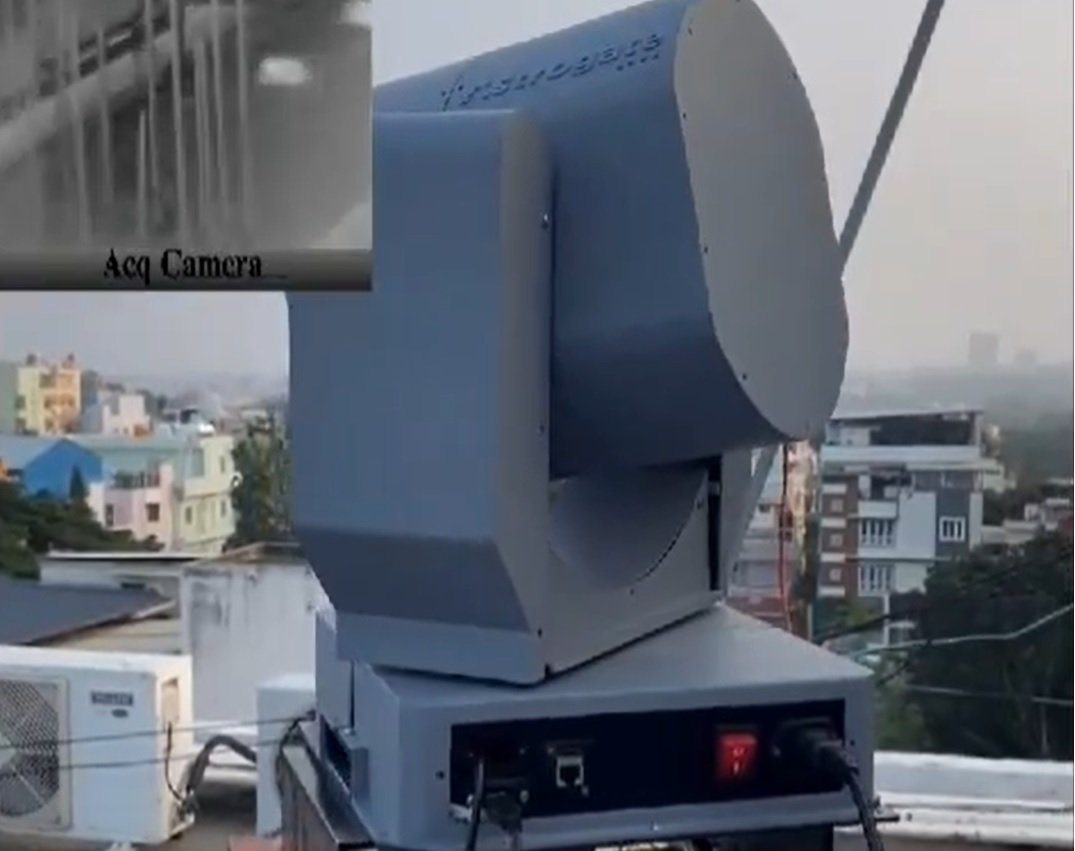
Bengaluru, — Indian deep-tech startup Astrogate Labs has tested the pointing and tracking system of Gen1, its mobile laser communication terminal designed for secure, high-speed connections between moving platforms, including naval ships.
Gen1 is designed to transmit up to 10 Gbps bidirectional data over distances of 20 km using Free Space Optical Communication (FSOC) instead of conventional radio frequency (RF) signals. The technology could support ship-to-ship and ship-to-shore communications.
Gen1 Tracking System and Specifications
Maintaining a laser connection between moving ships is challenging because vibrations and changes in position can disturb the narrow optical beam. Gen1 addresses this through an integrated Pointing, Acquisition and Tracking (PAT) system, combining coarse and fine tracking with active beam stabilisation. It is designed to maintain arc-second pointing accuracy.
Initial alignment uses automatic link acquisition supported by India's IRNSS navigation system and GPS.
Key specifications include:
-
Data rate: Up to 10 Gbps bidirectional.
-
Range: Up to 20 km under clear-sky conditions.
-
Wavelength: 1550 nm for transmission and reception.
-
Weight: Less than 9 kg.
-
Power consumption: Average 60W, excluding the management console.
-
Connectivity: 10G BASE-T/BASE-X Ethernet interfaces with passthrough.
-
Software: Adaptive link maintenance for traffic routing and network configuration.
Laser communication offers higher bandwidth and narrower beams than conventional RF systems. This can reduce spectrum congestion and make communications harder to intercept or jam. However, maintaining accurate alignment and line of sight remains essential.
Astrogate Labs' Space and Defence Programmes
Founded in 2017 by Nitish K. Singh and Aditya Kedlaya, Astrogate Labs develops optical communication terminals, modems and tracking systems for space, airborne and terrestrial applications.
The company has supplied an indigenously developed satellite-to-ground laser communication terminal to ISRO. Its terminals have reached Technology Readiness Level 8 (TRL-8) and are flight-qualified. Astrogate has also received the DRDO Dare to Dream 4.0 award.
At the 9th Bengaluru Space Expo in September 2026, the company demonstrated its 10 Gbps AstroLink Micro space terminal and announced plans to achieve flight readiness for India's first indigenous Optical Inter-Satellite Link (OISL) terminal by 2027.
Astrogate has also completed cross-compatibility testing with the University of Western Australia's TeraNet mobile optical ground station and partnered with South Korea's Spacebeam to develop end-to-end optical links and ground infrastructure.
With Gen1, Astrogate Labs is extending its optical communication technology beyond satellite applications to terrestrial and maritime platforms, including potential defence communication networks.
——— End of Article ———