WASHINGTON — April 19, 2026 : The U.S. Army has detailed plans to integrate long-range uncrewed aerial systems, known as “launched effects,” with its forthcoming ME-11B High Accuracy Detection and Exploitation System (HADES) intelligence aircraft, significantly expanding the platform’s operational reach while maintaining survivability in contested environments.
Program Overview and Timeline
The ME-11B HADES aircraft is based on the Bombardier Global 6500 business jet and is being modified by Sierra Nevada Corporation, which was selected for the program in 2024. The first prototype is scheduled to begin flight testing in summer 2026, with formal delivery expected before the end of 2026. Two additional prototypes are currently undergoing conversion.
The Army plans to procure a total of six production aircraft in addition to the three prototypes. Officials have indicated that fleet size is constrained by budget considerations and the need to balance competing modernization priorities.
For the past eight years, the Army has relied on contractor-owned and operated intelligence, surveillance, and reconnaissance (ISR) business jets, including Global 6500 variants, as an interim capability while transitioning to the HADES platform.
Integration of Launched Effects
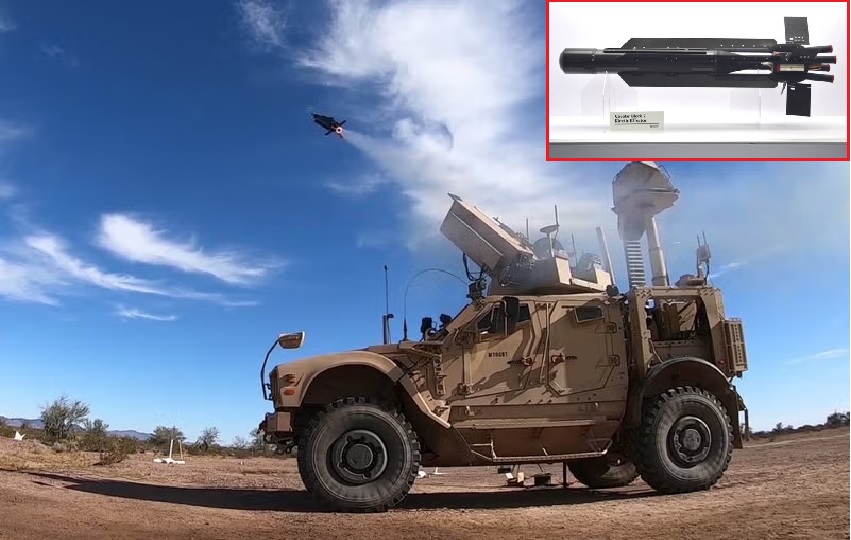
Army officials have outlined the integration of long-range drones capable of operating at distances of approximately 620 miles (1,000 kilometers) or more. These systems are designed to extend the sensing and operational reach of the ME-11B while allowing the aircraft to remain outside high-threat air defense zones.
Andrew Evans, Director of Strategy and Transformation in the Office of the Deputy Chief of Staff of the Army, G-2, stated during a roundtable at the Army Aviation Association of America’s 2026 Warfighting Summit that the combined range of the aircraft and its launched systems would provide broad operational coverage.
He noted that from a sensing perspective, the integration is intended to meet future operational requirements, adding that the Army has already engineered hardpoints on the aircraft to support the deployment of launched effects.
The drones are expected to be lower-cost, expendable systems optimized for networked and swarm operations. While individual platforms may carry limited sensor payloads, their collective use is intended to enable wide-area coverage. The Army is pursuing near-term experimentation contracts in the coming months, followed by a demonstration later in 2026 and additional contracts anticipated in 2027.
Aircraft Design and Capabilities
The ME-11B incorporates a modular open-systems architecture that allows for incremental capability upgrades across the fleet. Each aircraft will feature an onboard sensor suite and communications systems capable of near-real-time data transmission.
The baseline configuration includes a variant of the Advanced Synthetic Aperture Radar System-2B (ASARS-2B), originally developed for U.S. Air Force U-2 aircraft. The radar provides both synthetic aperture radar imaging and ground moving target indicator capabilities.
Modifications to the Global 6500 platform include the addition of four underwing pylons. These pylons support both the deployment of launched drones and the carriage of podded sensor systems, enabling rapid reconfiguration based on mission requirements.
Army Col. Joe Minor, Capability Program Executive for Aviation, stated that the use of external hardpoints allows faster integration of new systems compared with internal modifications. He also highlighted the aircraft’s performance characteristics, including a range of approximately 6,000 miles and a cruising speed of Mach 0.87, along with improved altitude, endurance, and payload capacity compared with earlier ISR platforms.
Survivability and Operational Concept
Army officials have emphasized survivability as a central factor in the design of the HADES platform. According to Evans, analysis indicates that the aircraft will conduct ISR missions in permissive environments for approximately 99.9 percent of its operational life without entering high-threat areas.
For the remaining fraction of operations involving elevated risk, launched effects will enable the aircraft to continue mission execution without direct exposure to enemy air defenses.
The ME-11B is also intended to function as a coordinating node within a broader operational network. Officials described the platform as capable of managing and integrating multiple assets, including uncrewed systems, to support high-priority missions.
Transition from Legacy Platforms
The HADES program represents a shift away from legacy turboprop ISR aircraft such as the RO-6A Airborne Reconnaissance Low-Enhanced (ARL-E). These earlier systems were primarily used in counterinsurgency operations and relied heavily on full-motion video sensors.
Army Col. Matt McGraw, commander of the 116th Military Intelligence Brigade, noted that current systems equipped with synthetic aperture radar and moving target indicator technologies allow operators to track hundreds of targets simultaneously, compared with one or two targets on older platforms.
Broader Context and Support Infrastructure
The selection of the Global 6500 airframe provides access to an established production line and global support network. The platform is also used in other roles, including the U.S. Air Force’s E-11A Battlefield Airborne Communications Node aircraft.
Integration work by Sierra Nevada Corporation is ongoing, with continued efforts focused on sensors, communications systems, and compatibility with launched effects.
The ME-11B is intended to deliver persistent, deep-sensing ISR capabilities in support of multi-domain operations, combining high-speed jet performance with modular systems and extended operational reach through drone integration.
——— End of Article ———