STERLING HEIGHTS, Mich. — May 16, 2026 : The U.S. Army has awarded General Dynamics Land Systems a $229.65 million fixed-price-incentive contract for the production of 50 Stryker Double V-Hull (DVH) A1 armored vehicles, continuing the service’s long-term modernization effort for its Stryker Brigade Combat Teams (SBCTs).
The contract was issued on May 15, 2026, by Army Contracting Command at Detroit Arsenal, Michigan. The procurement supports the Product Manager Stryker Brigade Combat Team program. According to contract details, work locations and funding allocations will be determined with each individual order, while overall contract completion is scheduled for June 30, 2028. The solicitation was conducted through an internet-based process, with one bid received.
General Dynamics Land Systems, headquartered in Sterling Heights, Michigan, is a subsidiary of General Dynamics and serves as the Army’s primary contractor for Stryker vehicle production and modernization.
Stryker Fleet Modernization
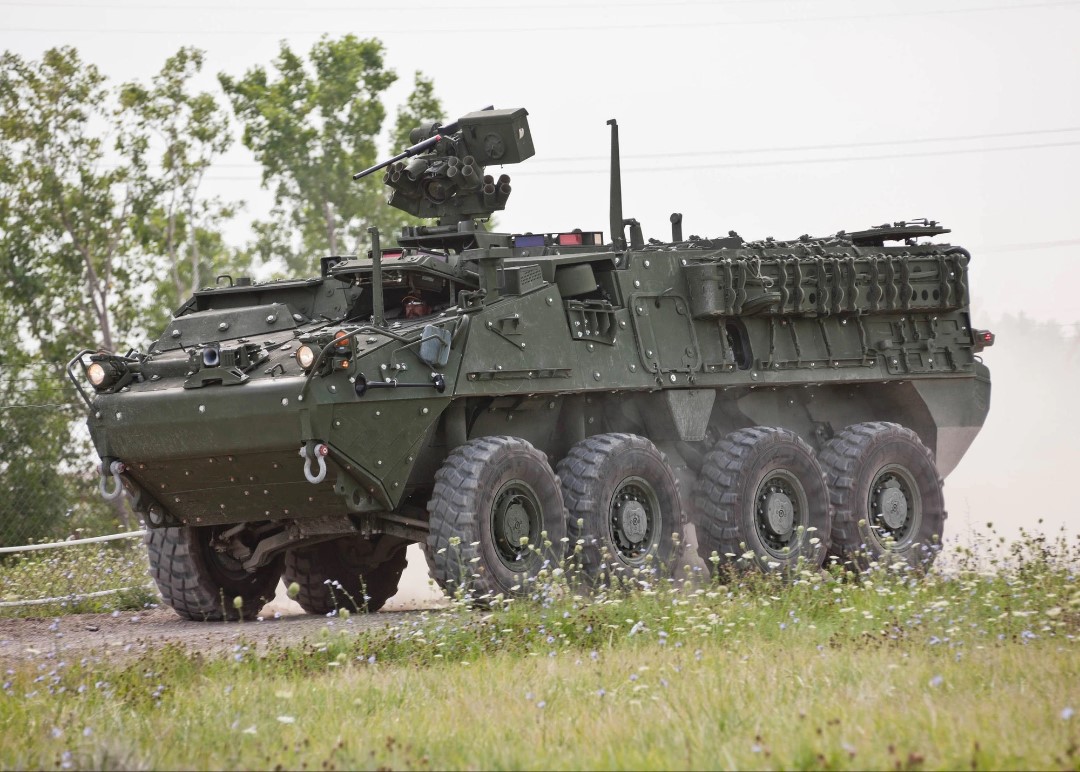
The Stryker is an eight-wheeled armored combat vehicle that entered U.S. Army service in 2002 and has since been deployed in Iraq, Afghanistan, Europe, and other operational regions. The platform forms the backbone of the Army’s Stryker Brigade Combat Teams, which are designed to provide a balance between the mobility of light infantry units and the firepower and protection of heavier armored formations.
The standard infantry carrier variant is operated by a two-person crew and can transport up to nine fully equipped infantry soldiers. Over the past two decades, the Army has fielded numerous mission-specific variants based on the Stryker chassis, including command vehicles, medical evacuation vehicles, reconnaissance platforms, mortar carriers, engineer squad vehicles, and anti-tank missile carriers.
The latest contract covers production of the Double V-Hull A1 configuration, one of the Army’s most advanced Stryker variants currently in service.
Double V-Hull Protection Upgrade
The Double V-Hull design was introduced after combat experience in Iraq exposed vulnerabilities in the original flat-bottom Stryker hull against improvised explosive devices (IEDs) and buried explosives. The redesigned hull structure incorporates angled lower surfaces that redirect blast energy away from the crew compartment, significantly improving protection for personnel during underbody explosions.
The Army began fielding Double V-Hull Strykers around 2011 as part of a survivability improvement program aimed at reducing casualties from roadside bombs and mines encountered during counterinsurgency operations.
A1 Automotive and Systems Enhancements
The A1 modernization package introduces major improvements to the vehicle’s automotive, electrical, and digital systems to extend operational service life and support future battlefield technologies.
A central component of the upgrade is the replacement of the earlier 350-horsepower Caterpillar C7 engine with a more powerful 450-horsepower Caterpillar C9 engine. The upgraded powertrain is intended to compensate for increased vehicle weight while improving mobility and operational reliability.
The A1 configuration also includes an upgraded suspension system rated for approximately 60,000 pounds, enhanced driveline components, improved thermal management systems, and upgraded environmental conditioning equipment. These modifications increase the vehicle’s gross weight capacity from roughly 55,000 pounds to approximately 63,000 pounds.
The vehicle’s electrical architecture has also been modernized through installation of a 910-amp alternator replacing the previous 570-amp system. The increased electrical generation capacity supports expanded communications equipment, onboard sensors, network systems, and future mission modules.
In addition, the Stryker A1 incorporates a modern in-vehicle data network with gigabit Ethernet capability and compatibility with the Army’s VICTORY network integration standards, enabling improved digital communications and system interoperability across formations.
Strategic Mobility and Operational Role
One of the defining features of the Stryker platform is its strategic mobility. Unlike heavier tracked armored vehicles, the Stryker can be transported by both C-130 and C-17 military cargo aircraft, allowing rapid deployment to overseas theaters with reduced logistical requirements.
The platform also uses a Central Tire Inflation System (CTIS), enabling crews to adjust tire pressure directly from inside the vehicle to improve traction across highways, mud, sand, and off-road terrain without stopping operations.
Stryker Brigade Combat Teams are intended to provide theater commanders with rapidly deployable combined-arms forces capable of conducting infantry, reconnaissance, security, and urban combat missions while maintaining higher operational mobility than traditional armored brigades.
Expanded Stryker Variants
In recent years, the Army has continued expanding the Stryker family to address evolving battlefield threats and operational requirements. Among the newer variants are the Stryker Dragoon equipped with a 30mm cannon turret and the Interim Maneuver Short-Range Air Defense (IM-SHORAD) system designed to counter unmanned aerial systems, helicopters, and low-flying aircraft.
Several upgraded Stryker variants have already been fielded with U.S. Army units deployed in Europe as part of broader modernization and deterrence initiatives focused on near-peer adversary environments.
Long-Term Sustainment Strategy
The latest procurement reflects the Army’s broader approach of incrementally modernizing existing combat vehicle fleets rather than pursuing immediate large-scale replacement programs. Army planners continue to focus on survivability, mobility, network integration, and power generation improvements across the Stryker fleet as the service evaluates future wheeled combat vehicle requirements.
The May 2026 contract maintains active production of the combat-proven Stryker platform while supporting continued modernization of the Army’s Stryker Brigade Combat Teams through the end of the decade.
——— End of Article ———