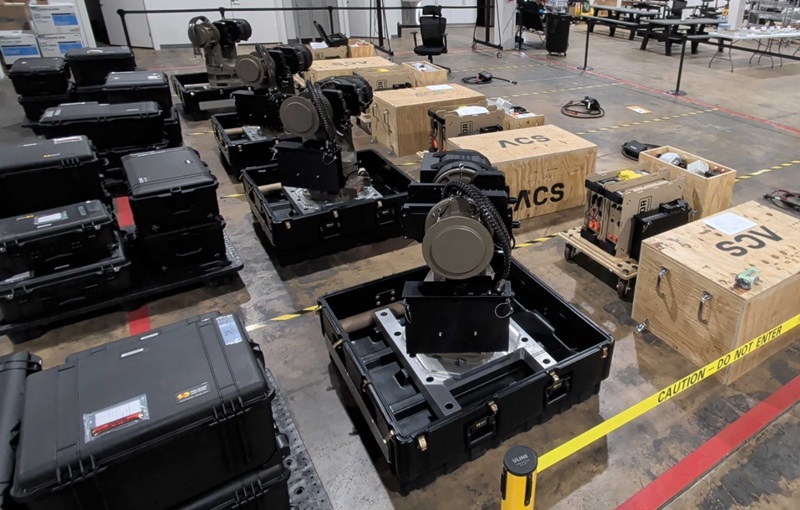
WASHINGTON, — March 23, 2026 : The U.S. Army has revised its approach to high-energy directed weapons, deciding not to transition its most powerful laser system—the 300-kilowatt Indirect Fire Protection Capability-High Energy Laser (IFPC-HEL), known as “Valkyrie”—into a formal program of record, according to a Congressional Research Service (CRS) report published on March 9, 2026.
The decision reflects a broader shift in Pentagon strategy toward joint-service laser development programs, with the Army now planning to use its remaining IFPC-HEL prototype as a research and development asset rather than an operational system.
Program Background and Contract Changes
The IFPC-HEL was designed as a truck-mounted directed energy system intended to defend against a range of aerial threats, including cruise missiles, unmanned aerial systems, rockets, artillery, and mortars. It represented the most advanced iteration in a series of Army laser demonstrators, following earlier platforms such as the 10 kW High Energy Laser Mobile Test Truck (HELMTT) and the 100 kW High Energy Laser Tactical Vehicle Demonstrator (HEL-TVD).
In July 2023, the Army awarded Lockheed Martin an Other Transaction Authority (OTA) agreement valued at up to $220.8 million to produce four IFPC-HEL prototypes. This contract built on earlier work under the Department of Defense’s High Energy Laser Scaling Initiative (HELSI), which delivered a 300 kW-class demonstrator in September 2022.
As recently as January 2026, Army plans called for transitioning the system into a program of record during fiscal year 2025, contingent on successful testing. However, the CRS report indicates that the contract scope has since been reduced from four systems to a single prototype.
The remaining unit is undergoing final laboratory testing at a Lockheed Martin facility in Morristown, New Jersey. Subject to successful results, the system is scheduled for developmental field testing at Dugway Proving Ground, Utah, in summer 2026. Delivery to the Army is expected between September and October 2026.
Following delivery, the prototype will not be fielded to operational units. Instead, it will be formally divested as a deployment candidate and repurposed to support future laser weapon development.
Transition to Joint Laser Warfighting System
The Army intends to integrate knowledge gained from the IFPC-HEL into the Joint Laser Warfighting System (JLWS), a collaborative program with the U.S. Navy outlined in the Army’s fiscal year 2026 budget request.
The JLWS is being developed in support of the Department of Defense’s “Golden Dome for America” concept—a proposed layered defense architecture combining kinetic interceptors and directed energy systems to counter ballistic, hypersonic, and cruise missile threats across domestic and expeditionary environments.
Budget documents describe the JLWS as the next stage in counter-cruise missile laser capability, reflecting a move toward interoperable, cross-service solutions rather than standalone Army systems.
The CRS report also notes that both the IFPC-HEL and the related IFPC High Power Microwave (HPM) variant, developed with Epirus, will not proceed to fielding and will instead contribute to joint program development.
Operational Drivers and Threat Environment
The requirement for improved counter-cruise missile defenses has been shaped by recent conflicts and intelligence assessments. Russian strikes on infrastructure in Ukraine and the use of Iranian-supplied munitions in the Middle East have underscored the growing accessibility and operational use of advanced missile systems.
A 2025 assessment by the U.S. Defense Intelligence Agency identified cruise missiles launched from Russian aircraft and Chinese naval platforms as a key vulnerability in the United States’ existing missile defense architecture, particularly in homeland defense scenarios.
Technical Challenges of High-Energy Laser Intercepts
High-energy laser systems face inherent physical and engineering challenges when engaging cruise missiles. Unlike slower, less durable drones, cruise missiles travel at high speeds and are constructed with hardened materials designed to withstand aerodynamic heating and stress.
Current IFPC-HEL technology relies on continuous wave lasers, which require sustained energy delivery focused on a precise point for several seconds to achieve a destructive effect. Maintaining beam quality and stability over long distances is complicated by atmospheric distortion, weather conditions, and tracking limitations.
These constraints reduce engagement reliability, particularly in operational environments outside controlled test conditions.
To address these limitations, research efforts are exploring pulsed laser technologies. These systems emit energy in ultra-short, high-intensity bursts, producing higher peak power and potentially reducing the dwell time required to damage or disable hardened targets. However, such technologies remain under development and are not yet operationally mature.
Related Program Adjustments and Parallel Efforts
The Army’s decision on IFPC-HEL aligns with a similar shift in its lower-power directed energy programs. The service recently discontinued plans to field the 50 kW Directed Energy Maneuver-Short Range Air Defense (DE M-SHORAD) system mounted on Stryker vehicles as a program of record.
A separate CRS report dated March 10, 2026, indicated that operational assessments conducted in the Middle East in 2024 revealed performance gaps between controlled testing and real-world conditions. Challenges included maintaining optical alignment, managing heat dissipation, and protecting sensitive components from dust and vibration during mobile operations.
In response, the Army has initiated work on a new Enduring High Energy Laser (E-HEL) program to address these limitations at the tactical level.
Meanwhile, other branches and defense programs continue to pursue higher-power directed energy capabilities. The U.S. Navy is advancing the 300 kW High Energy Laser Counter-Anti-Ship Cruise Missile (HELCAP) program, along with a 400 kW-class effort under the Office of Naval Research’s SONGBOW project.
Under the HELSI framework, contractor nLight is developing a megawatt-class laser system intended to counter ballistic and hypersonic threats. Defense industry updates indicate that a demonstration of this system is expected later in 2026.
Strategic Implications
The Army’s restructuring of the IFPC-HEL program indicates a transition from service-specific laser deployments toward integrated, multi-domain directed energy systems. While the 300 kW Valkyrie prototype will not enter operational service, it is expected to contribute technical data critical to future joint capabilities.
The CRS assessment suggests that directed energy weapons at both the 50 kW and 300 kW levels require further technological maturation before they can meet operational reliability requirements across diverse combat environments.
——— End of Article ———