JOINT BASE LEWIS-MCCHORD, Washington — March 23, 2026 : The U.S. Army has completed preparation of its first operational battery equipped with the Long-Range Hypersonic Weapon (LRHW), known as “Dark Eagle,” marking a key step in the service’s effort to field land-based hypersonic strike capabilities aligned with Indo-Pacific operational priorities.
The announcement, made on March 18, confirms that Bravo Battery, 1st Battalion, 17th Field Artillery Regiment, assigned to the 3rd Multi-Domain Task Force (MDTF), has completed initial setup, system integration, and unit-level training at Joint Base Lewis-McChord in Washington State. The unit is expected to receive its full complement of live missiles in the coming weeks, after which it will transition to full operational readiness.
The battery was officially activated in December 2025 and has been involved in training and familiarization with LRHW equipment since 2021 as part of the Army’s phased fielding process. Recent activities included safety validation, integration testing, and readiness certification required prior to live missile allocation.
System Design and Capabilities
The Dark Eagle system is a mobile, ground-launched hypersonic missile designed to engage high-value and time-sensitive targets at extended ranges. It incorporates a two-stage architecture developed jointly by the U.S. Army and the U.S. Navy.
The first stage consists of a large solid-fuel booster that accelerates the weapon into the upper atmosphere. Following booster separation, the Common Hypersonic Glide Body (C-HGB)—developed with industry partner Dynetics—continues unpowered flight toward the target. The glide vehicle travels at sustained hypersonic speeds exceeding Mach 5, with some flight profiles estimated to reach up to Mach 17.
Unlike traditional ballistic missiles that follow predictable trajectories, the C-HGB operates along a flatter, maneuverable path in the upper atmosphere. Its ability to alter course during the terminal phase is intended to reduce detectability and complicate interception by existing missile defense systems.
The system carries a conventional kinetic-energy payload rather than a high-explosive or nuclear warhead. Target destruction is achieved through the force generated by the projectile’s mass and velocity upon impact. The LRHW is reported to have an operational range exceeding 3,500 kilometers (approximately 2,175 miles).
Battery Configuration and Components
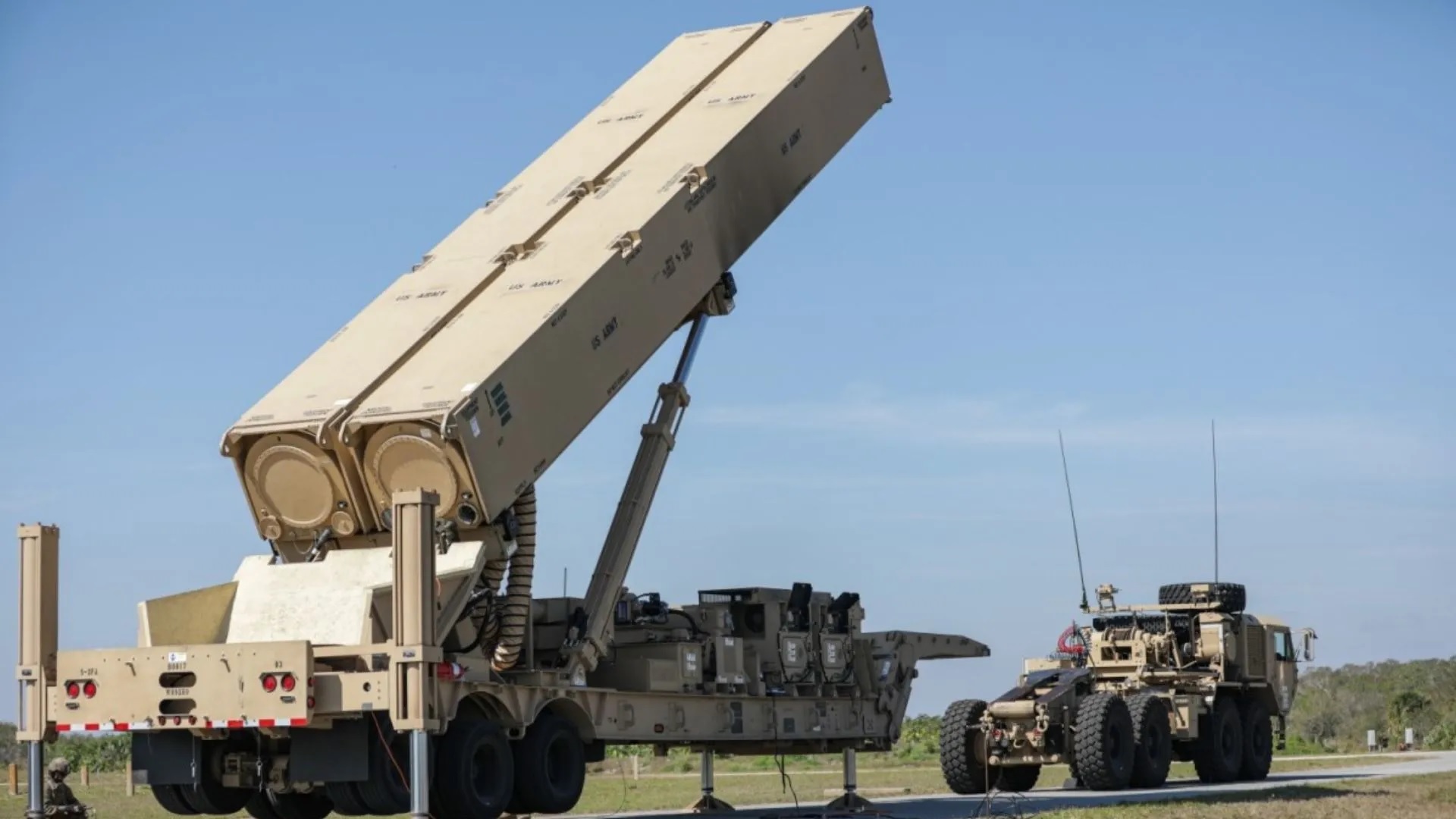
A standard Dark Eagle battery consists of four transporter-erector-launchers (TELs), each mounted on modified trailers and capable of carrying two missile canisters, providing a total of eight ready-to-launch rounds per battery. The configuration also includes a Battery Operations Center (BOC) responsible for fire control, targeting, and coordination, along with supporting vehicles and communications systems.
The program is led by Lockheed Martin as the prime contractor and system integrator. Dynetics has played a central role in the development of the Common Hypersonic Glide Body. Since 2018, the LRHW program has received more than $12 billion in funding and has undergone multiple iterations due to testing delays and technical integration challenges.
Integration into Multi-Domain Operations
The deployment of the first operational battery supports U.S. Indo-Pacific Command requirements and reflects the Army’s broader transition toward multi-domain operations. The 3rd MDTF, which operates the system, is structured to integrate long-range precision fires with cyber, space, electronic warfare, and intelligence capabilities.
In July 2025, elements of the 3rd MDTF deployed the Dark Eagle system outside the United States for the first time during Exercise Talisman Sabre in Australia’s Northern Territory. The deployment demonstrated the system’s transportability, setup timelines, and command integration in a forward environment. No live missile launches were conducted during the exercise.
The Army has indicated that additional LRHW batteries will be fielded across other MDTFs. A second battery is scheduled for delivery in the fourth quarter of fiscal year 2026 under a rapid fielding initiative that incorporates incremental system modifications.
Program Status and Outlook
According to Lt. Gen. Frank Lozano, the Army’s Program Executive Officer for Missiles and Space, the service is within weeks of completing the full equipping of the first battery. Remaining steps include final missile delivery and validation of operational capability under live conditions.
The Dark Eagle system is part of a broader U.S. effort to develop and deploy hypersonic weapons capable of operating in contested environments characterized by advanced anti-access and area-denial systems. The Army continues to address technical and production issues identified during earlier testing phases while advancing toward wider operational deployment.
——— End of Article ———