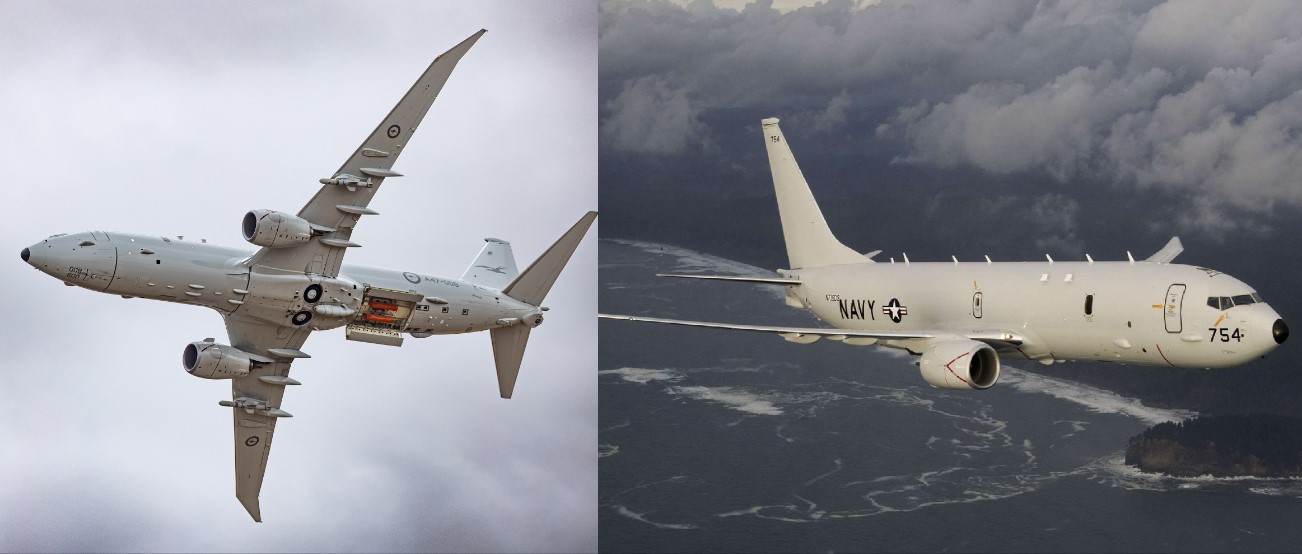
Washington : The United States has approved a major defence sale to Denmark, clearing the potential transfer of three P-8A Poseidon Maritime Patrol Aircraft (MPA) under the Foreign Military Sales (FMS) framework. The decision, announced by the U.S. Defense Security Cooperation Agency (DSCA) following authorization by the U.S. Department of State, places the total estimated value of the program at $1.8 billion.
The proposed sale is intended to significantly strengthen Denmark’s maritime surveillance, anti-submarine warfare, and intelligence-gathering capabilities, while deepening interoperability with the United States and other NATO allies. The DSCA formally notified the U.S. Congress of the approval on December 29, 2025, initiating the mandatory congressional review process.
Aircraft and Systems Package
According to the DSCA notification, Denmark has requested up to three P-8A Poseidon aircraft, supported by a comprehensive suite of mission systems, sensors, and secure communications equipment. The package includes four Multifunctional Distribution System Joint Tactical Radio Systems, four Guardian Laser Transmitter Assemblies for the AN/AAQ-24(V)N, and four system processor replacements for the same defensive system incorporating Selective Availability Anti-Spoofing Modules (SAASM).
Navigation and positioning capabilities will be enhanced through eight LN-251 Embedded GPS/Inertial Navigation Systems, also fitted with SAASM technology. In addition, the sale covers a wide range of non-major defence equipment, including Tactical Open Mission Software, MX-20HD electro-optical and infrared sensor turrets, NexGEN missile warning sensors, AN/APY-10 maritime surveillance radar, AN/AAQ-2(V) acoustic systems, and ALQ-213 electronic warfare management systems.
The support package further extends to Identification Friend or Foe (IFF) systems, secure UHF/VHF radios, countermeasures dispenser system programmers, cryptographic equipment, and a full spectrum of U.S. government and contractor engineering, technical, training, and logistics support services. These elements are designed to ensure rapid induction and sustained operational readiness of the aircraft within the Royal Danish Air Force.
Strategic and NATO Significance
U.S. officials emphasized that the proposed sale directly supports American foreign policy and national security objectives by reinforcing the capabilities of a key NATO ally. Denmark is regarded as a stabilizing force in Northern Europe, with growing responsibility for security in the North Atlantic, Baltic Sea, and Arctic regions, including areas surrounding Greenland and the Faroe Islands.
“The proposed sale will enhance Denmark’s capability to meet current and future threats by providing a credible force capable of deterring adversaries and participating in NATO operations,” the DSCA said in its statement. The agency added that Denmark is assessed to have no difficulty absorbing the aircraft and associated systems into its existing force structure.
P-8A Poseidon Capability
The P-8A Poseidon, manufactured by Boeing, is a long-range, multi-mission maritime patrol aircraft derived from the Boeing 737-800 platform. It is optimized for anti-submarine warfare, anti-surface warfare, intelligence, surveillance, and reconnaissance missions, and is capable of deploying torpedoes, sonobuoys, and anti-ship weapons while sharing data across NATO command networks.
The aircraft is already in service with several allied nations, including the United States, the United Kingdom, Norway, Germany, Australia, and India, making it a common and interoperable platform across NATO and partner air forces.
Industrial and Contractual Details
The principal contractor for the Danish sale will be Boeing, based in Arlington, Virginia. The U.S. government has stated that it is not currently aware of any offset agreements linked to the proposed transaction, noting that any such arrangements would be determined during subsequent negotiations between Denmark and the contractor.
While the approval does not constitute a final contract, it represents a critical step toward modernizing Denmark’s maritime patrol fleet and expanding NATO’s collective ability to monitor and secure vital sea lanes in Northern Europe and the Arctic.
If finalized following congressional review, the $1.8 billion program would mark one of Denmark’s most significant defence aviation investments in recent years, underscoring the growing strategic importance of maritime domain awareness in an increasingly contested security environment.
——— End of Article ———