WASHINGTON — March 14, 2026 : On March 13, 2026, U.S. Air Force strategic bombers carried out targeted airstrikes on Iran’s Kharg Island in the northern Persian Gulf, destroying extensive Iranian military infrastructure stationed on the island while avoiding its critical oil export facilities, according to U.S. officials.
A senior U.S. military official told The New York Times that the operation eliminated all identified military installations on the island. The strikes focused on facilities used to store anti-ship missiles, cruise missiles, and Iranian naval mines, as well as other military infrastructure supporting Iran’s defensive and maritime strike capabilities in the Persian Gulf.
According to the official, the list of targets included air defense systems, ammunition bunkers, missile storage facilities, communications infrastructure, and the island’s airfield. U.S. Central Command later confirmed that more than 90 military targets were struck during the operation.
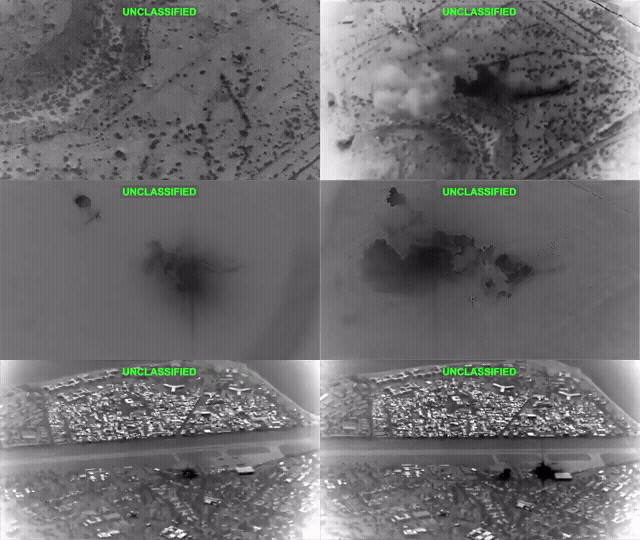
President Donald Trump released unclassified black-and-white night-vision footage of the bombing raid on social media. The video shows multiple explosions occurring across different locations on the island during the strike.
Open-source intelligence analysts later geolocated the footage and confirmed that the impacts corresponded to several key military facilities on Kharg Island. Analysts verified damage at air defense sites, ammunition storage areas, missile depots, communications infrastructure, and sections of the island’s airfield.
Kharg Island is located in the northern Persian Gulf approximately 15 nautical miles (about 28 kilometers) from the Iranian mainland and roughly 55 kilometers northwest of Bushehr. The island functions as Iran’s primary offshore oil export hub and handles about 90 percent of the country’s crude oil exports.
The island hosts large crude storage facilities and subsea pipeline connections to major offshore oil fields. Its historical export loading capacity has been estimated at up to seven million barrels per day.
Despite the scale of the strikes, U.S. forces deliberately avoided the oil export terminals located on the island. President Trump said the energy infrastructure was spared “for reasons of decency,” but warned that the decision could change if Iran interferes with commercial shipping through the Strait of Hormuz.
Following the strikes, Iranian state media and local officials reported that at least 15 explosions were heard on the island. Authorities stated that none of the oil export infrastructure was damaged and that crude export operations are continuing normally.
Iran’s joint military command issued a warning following the attack, stating that it could target oil, economic, and energy infrastructure across the Middle East belonging to companies that have American ownership or cooperate with the United States.
At the same time, the United States has begun reinforcing its military presence in the region. Approximately 2,200 Marines from the 31st Marine Expeditionary Unit, along with the amphibious assault ship USS Tripoli, have been ordered to deploy to the Middle East to join naval forces already operating in the Arabian Sea.
U.S. officials said the strikes on Kharg Island were conducted as part of the ongoing military exchanges between the United States and Iran and were directed specifically at military assets stationed on the island.
——— End of Article ———