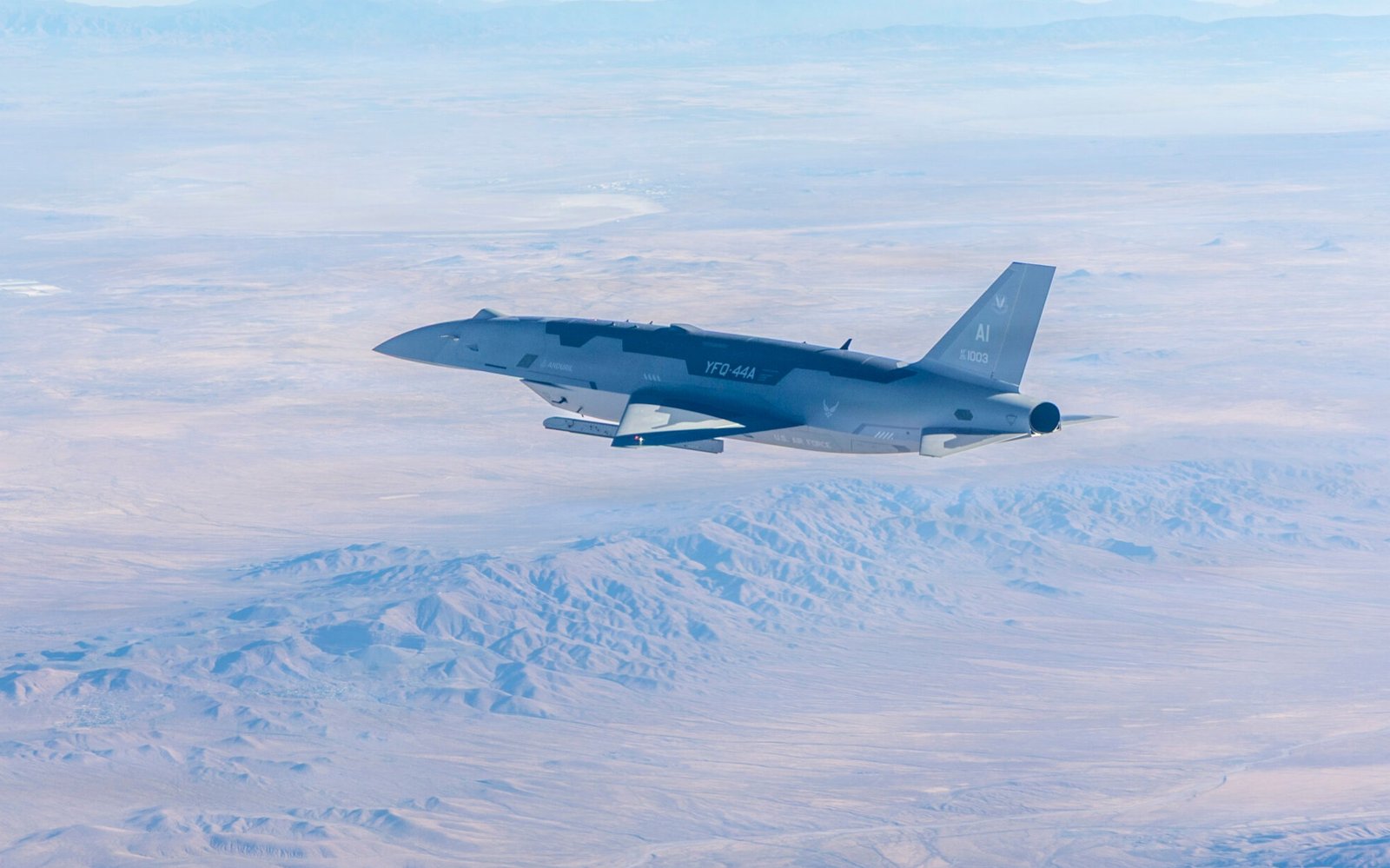
EDWARDS AIR FORCE BASE, Calif., — The U.S. Air Force has successfully demonstrated in-flight tactical control of an Anduril YFQ-44A Fury Collaborative Combat Aircraft (CCA) by an F-22 Raptor pilot. Conducted during the week of October 5, the test marks progress in integrating autonomous aircraft with crewed fighters.
F-22 Pilot Directs Fury Drone in Flight
Both aircraft took off from Edwards Air Force Base, California, and joined up in flight. The F-22 pilot then transmitted an updated mission plan to the YFQ-44A through a tactical data link.
Rather than remotely controlling the drone, the pilot acted as an airborne “quarterback,” issuing high-level tactical commands. The YFQ-44A’s onboard autonomous software interpreted the instructions and independently performed dynamic flight maneuvers and simulated combat tasks.
This approach allows pilots to focus on mission objectives while autonomous aircraft manage the flight actions needed to carry out assigned tasks.
Air Force Leadership Highlights Teaming
Secretary of the Air Force Troy Meink said the achievement demonstrates the value of military-industry cooperation in delivering new capabilities.
Air Force Chief of Staff Gen. Ken Wilsbach highlighted the operational advantages of crewed-uncrewed teaming, stating, “We must test often, learn fast and give commanders what they need, when they need it.”
The demonstration involved personnel from the 412th Test Wing, 422nd Test and Evaluation Squadron, 309th Software Engineering Group, Experimental Operations Unit, F-22 System Program Office, and CCA Software Autonomy and Teaming Branch.
YFQ-44A Part of the Collaborative Combat Aircraft Program
The YFQ-44A Fury is one of two designs selected for the first increment of the Air Force’s Collaborative Combat Aircraft program. The other is the General Atomics YFQ-42A.
The program aims to develop affordable, adaptable autonomous and semi-autonomous aircraft that operate alongside crewed fighters. These aircraft are intended to extend operational reach, improve situational awareness and support the survivability of U.S. airpower in contested environments. The F-22 is serving as an initial platform for testing autonomous wingmen.
Further Testing Planned Before Operational Deployment
The Air Force will use data from the demonstration to guide software development, further testing and future operating concepts. However, the test does not mean the YFQ-44A is ready for operational deployment.
Further evaluation will be required, including software refinement and testing a pilot’s ability to manage multiple drones. The Air Force must also establish production capacity to meet its fleet targets.
The service aims to field 500 combat-ready, semi-autonomous Increment 1 CCAs by 2032, as part of a planned fleet of approximately 1,000 or more aircraft.
The next planned milestone is Exercise Emerald Flag in December 2026, where the YFQ-44A Fury and General Atomics YFQ-42A are scheduled to participate in a large-force exercise integrating autonomous aircraft.
——— End of Article ———