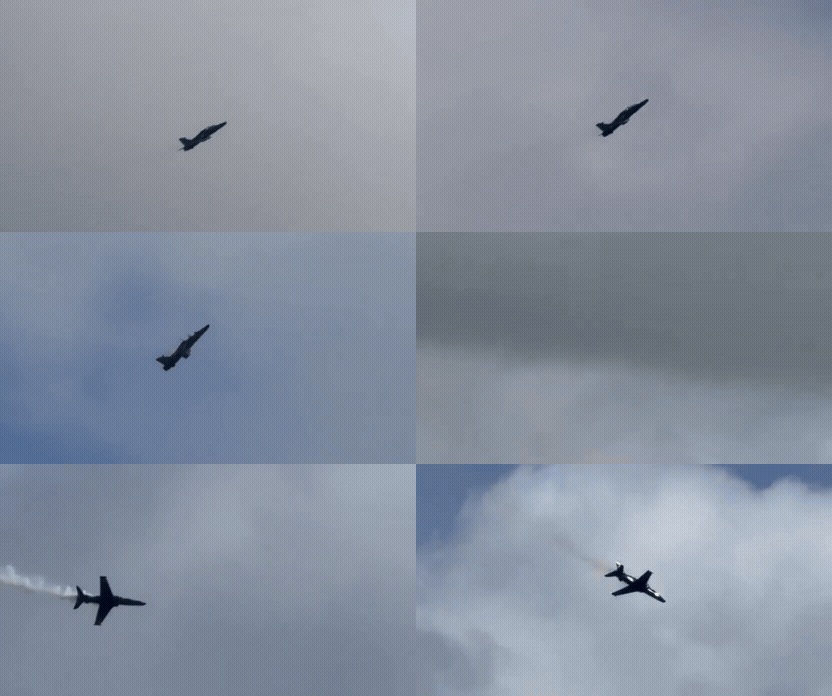
WASHINGTON, — May 30, 2026 : The U.S. Air Force has lifted the fleet-wide operational pause for the T-38 Talon trainer aircraft following the completion of inspection procedures developed after a training mishap involving the platform earlier this month. The pause officially ended on May 28, allowing inspected aircraft to gradually return to flying operations in the coming days.
The operational stand-down was imposed on May 20 and affected approximately 546 T-38 aircraft assigned across four major Air Force commands: Air Education and Training Command (AETC), Air Combat Command (ACC), Air Force Materiel Command (AFMC), and Air Force Global Strike Command (AFGSC). The measure was introduced after a May 12 crash involving a T-38 assigned to Columbus Air Force Base in Mississippi, with the Air Force temporarily suspending operations to support safety assessments and engineering reviews.
According to the Air Force, collaborative engineering and maintenance teams across the joint force finalized detailed inspection procedures to ensure aircraft safety before returning individual airframes to service. Aircraft that complete mandatory inspections and any required maintenance are expected to resume flying incrementally, while affected commands continue efforts to minimize disruptions to training pipelines, operations, and readiness.
The May 12 mishap occurred at approximately 12:00 p.m. during a routine training mission involving a T-38 assigned to the 14th Flying Training Wing at Columbus Air Force Base, which operates under AETC’s 19th Air Force. The aircraft crashed in rural Lamar County, Alabama, near the Mississippi border. Both crew members ejected safely, and no fatalities or serious injuries were reported. A Safety Investigation Board continues to examine the cause of the incident, with the operational pause initially intended to allow investigators to locate and assess evidence from the crash site.
During the temporary grounding, aircrews and student pilots across affected commands increased simulator-based training to maintain operational proficiency and meet flight currency requirements. The pause also affected international training activities, temporarily halting flying operations for Canadian pilots participating in fighter lead-in training through the Euro-NATO Joint Jet Pilot Training (ENJJPT) program at Sheppard Air Force Base in Texas.
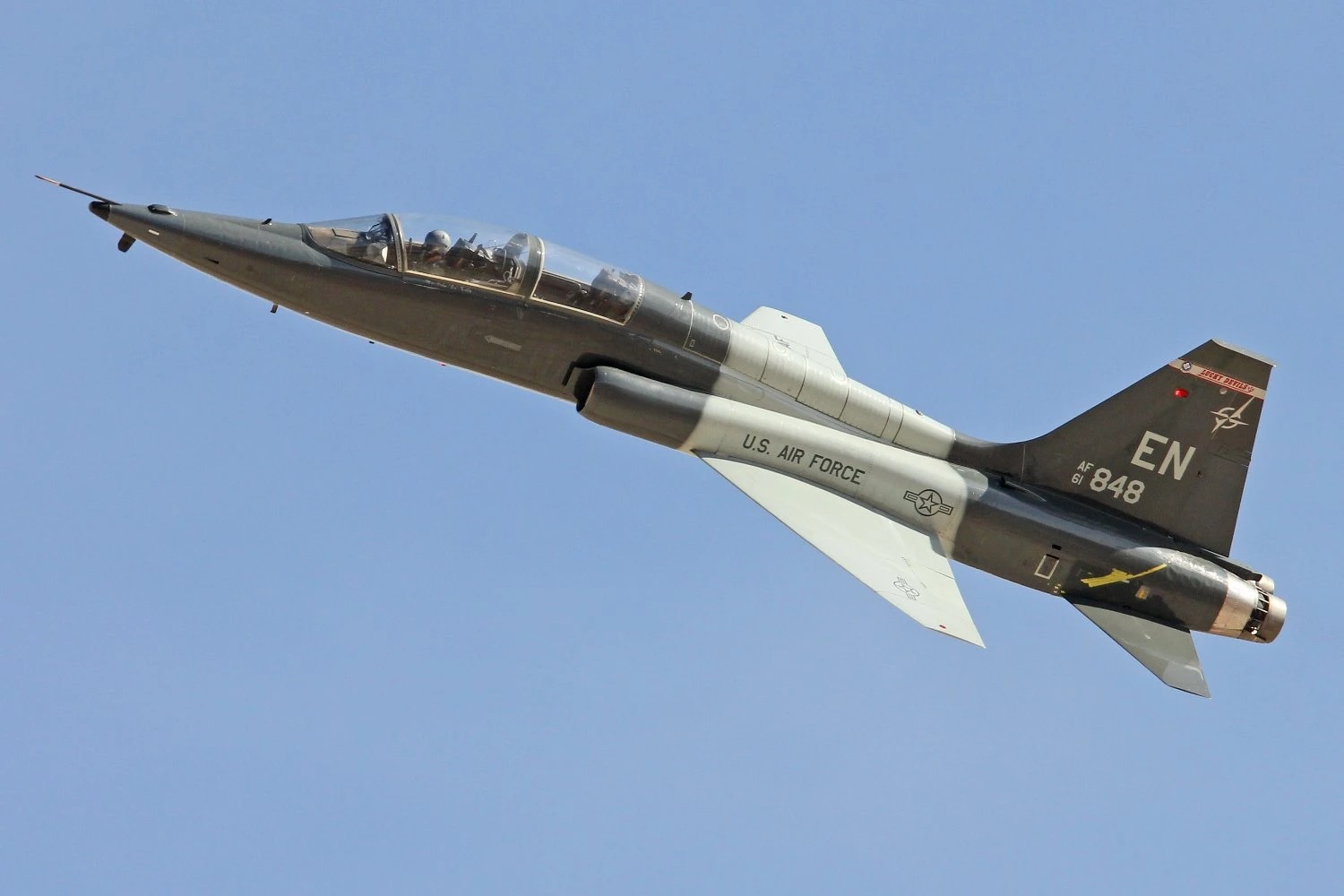
The T-38 Talon, a twin-engine supersonic trainer designed and produced by Northrop Corporation, entered service with the U.S. Air Force in 1961 and became the world’s first supersonic trainer aircraft. More than 70,000 Air Force pilots have trained on the platform since its introduction. Nearly 1,200 aircraft were produced between 1961 and 1972, with approximately 500 remaining in operational service today. Beyond AETC training duties, the aircraft is also used by ACC for fighter lead-in training, AFGSC for bomber pilot preparation, and NASA as a proficiency and companion trainer for astronauts.
Columbus Air Force Base has experienced previous T-38-related incidents in recent years. In November 2022, a T-38C crashed roughly 20 miles from the installation, with the pilot ejecting safely and sustaining non-life-threatening injuries. Two weeks later, another T-38C experienced an in-flight emergency that resulted in a gear-up landing.
As the Air Force works to sustain pilot training capacity, it is continuing the transition toward the Boeing-Saab T-7A Red Hawk, the planned replacement for the aging T-38 fleet. In April 2026, the service approved low-rate initial production after the program achieved Milestone C and placed an initial order for 14 aircraft valued at $219 million. Initial Operational Capability for the T-7A remains scheduled for 2027, with procurement plans calling for 23 aircraft in fiscal year 2027, followed by 36 in 2028 and 42 in 2029. The aircraft is intended to prepare pilots for fourth- and fifth-generation combat platforms, including the F-15EX, F-35A, F-22, B-21 Raider, and future systems such as the F-47.
——— End of Article ———