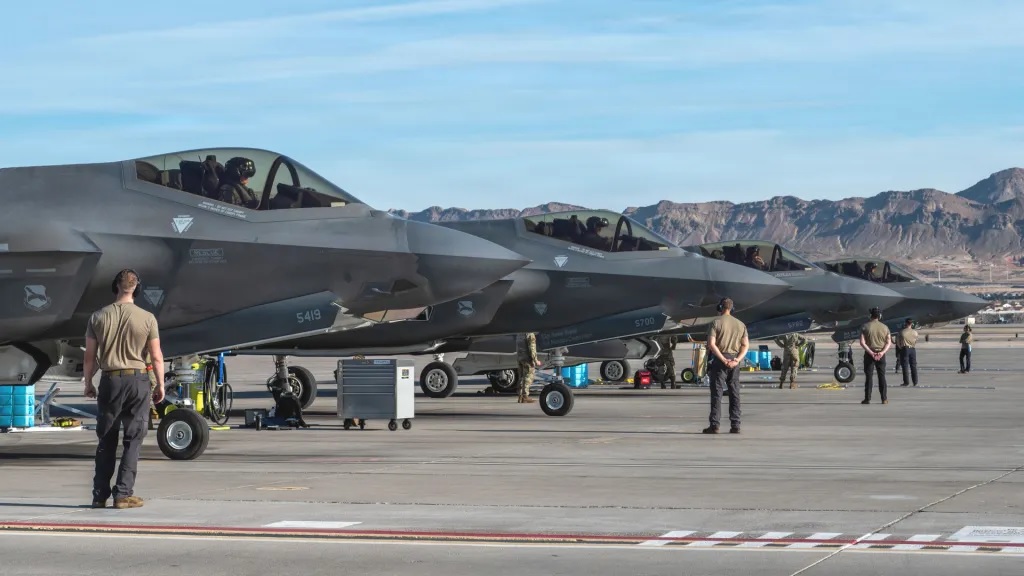
WASHINGTON — The U.S. Air Force has formally rejected reports claiming that newly manufactured F-35A Lightning II fighter aircraft are being delivered without onboard radar systems, stating that all Lot 17 aircraft continue to arrive with their standard AN/APG-81 radar systems installed.
In a statement provided to The War Zone, an Air Force spokesperson said, “Lot 17 F-35A aircraft are being delivered to the U.S. Air Force with AN/APG-81 radars,” directly addressing allegations that surfaced in recent defense media coverage.
Report Alleged Radar Installation Issues
The clarification follows a report by Defense Daily, which cited anonymous sources alleging that beginning in June 2025, F-35A fighters were being accepted without radar units due to development delays involving the next-generation AN/APG-85 radar.
According to the report, delays in the AN/APG-85 program had affected transition plans for newer production lots. It further claimed that the legacy AN/APG-81 radar, produced by Northrop Grumman, could not be installed on Lot 17 airframes due to modifications in mounting configurations. The publication also alleged that, in the absence of radar systems, metal weight ballasts were being installed in the nose section of the aircraft to preserve proper weight distribution and center-of-gravity requirements.
The claims gained attention across online defense forums and social media platforms, particularly after photographs circulated showing an F-35A with disc-shaped metal weights installed in the forward fuselage.
Air Force Identifies Aircraft as Training Platform
The U.S. Air Force stated that the aircraft shown in the widely shared images is not a newly produced operational jet. Instead, officials confirmed that the aircraft is a retired F-35A airframe being used exclusively for ground-based recovery training.
The photographs were taken during the first Course for Damaged Disabled Aircraft Recovery (CDDAR) conducted at Hill Air Force Base, Utah. The course focused on training maintenance and emergency response personnel in aircraft recovery operations under controlled conditions.
According to Air Force officials, the airframe used in the training event is a decommissioned F-35A that sustained significant damage in a 2016 engine fire while assigned to Mountain Home Air Force Base. Following an assessment, repair costs were determined to be economically impractical, and the aircraft was formally written off. It was later repurposed as a dedicated training platform.
Assembly and Training Use
Personnel from the 388th Maintenance Group, working in coordination with the F-35 Joint Program Office, reassembled the damaged aircraft over a three-week period using spare components stored in maintenance depots. The aircraft is not flight-capable and is not part of operational fleet deliveries.
During a recent five-day CDDAR course at Hill Air Force Base, 29 technicians from the United States and allied partner nations participated in recovery training exercises using the retired airframe.
Training activities included:
-
Lifting the aircraft using a heavy-duty crane
-
Performing recovery procedures simulating nose landing gear failure
-
Conducting emergency pilot extraction drills
To ensure accurate simulation of real-world handling conditions, maintenance teams installed precisely calculated metal weight ballasts in the aircraft’s nose section. Officials stated that the weights were designed to replicate the operational weight and center-of-gravity characteristics of a fully equipped F-35A during complex lifting and recovery operations.
No Impact on Operational Deliveries
The Air Force emphasized that operational Lot 17 F-35A aircraft are being delivered with AN/APG-81 radar systems installed and that the training airframe depicted in the photographs is not representative of production aircraft.
The AN/APG-81 active electronically scanned array (AESA) radar remains the standard sensor suite for current F-35A deliveries, while development of the AN/APG-85 radar continues under the broader modernization roadmap.
Air Force officials stated that the circulating claims stemmed from a misinterpretation of training imagery and confirmed that no radar-less operational F-35A aircraft are being delivered to the service.
——— End of Article ———