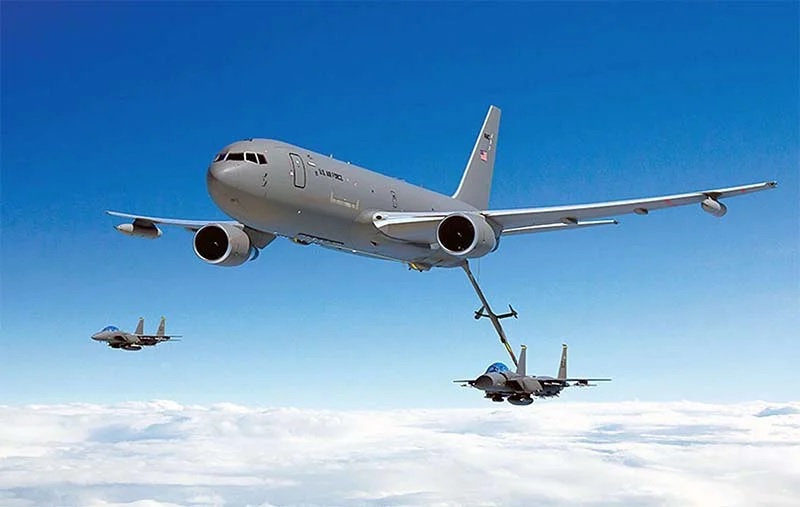
WASHINGTON — May 25, 2026 : The U.S. Air Force has finalized plans to procure 15 additional KC-46A Pegasus aerial refueling aircraft under its Fiscal Year 2027 budget proposal, reinforcing a long-term modernization strategy focused on sustaining global air operations, expanding force mobility, and supporting combat readiness in contested operational environments, particularly across the Indo-Pacific region.
The proposed acquisition, valued at approximately $3.52 billion, forms part of the Department of the Air Force’s broader FY2027 modernization framework and reflects continued investment in aerial refueling capacity, a capability considered essential for extending the operational range of fighters, bombers, surveillance aircraft, and airborne command systems. According to FY2027 Aircraft Procurement budget justification documents released in April 2026, the KC-46A program remains a central pillar of the Air Force’s long-term recapitalization effort aimed at replacing aging tanker aircraft and strengthening global force projection.
The procurement is included within the Department of the Air Force’s FY2027 budget request totaling $338.8 billion, of which $267.7 billion is allocated to the Air Force and $71.1 billion to the Space Force. Aircraft procurement accounts for approximately $73.3 billion and supports multiple modernization programs, including the B-21 Raider long-range bomber, F-35A Lightning II stealth fighter, the F-47 sixth-generation fighter initiative, and the development of Collaborative Combat Aircraft (CCA) designed to operate alongside crewed aircraft.
Strategic Role in Indo-Pacific Operations
The KC-46A procurement aligns with a broader Pentagon strategy focused on strengthening mobility, survivability, and operational endurance in the Indo-Pacific, where vast distances and limited basing infrastructure create significant logistical challenges for sustained air operations.
Aerial refueling enables combat aircraft to remain operational far from forward bases, reducing dependence on fixed regional infrastructure that may become vulnerable during high-intensity conflict. By extending mission endurance, tanker aircraft support long-range bomber missions, persistent fighter patrols, airborne intelligence operations, rapid reinforcement deployments, and command-and-control activities across geographically dispersed theaters.
The Air Force increasingly views aerial refueling as a decisive enabling capability in scenarios involving contested airspace and long-range operations over maritime regions such as the Pacific Ocean, where distance significantly affects combat persistence and operational flexibility.
Addressing an Aging Tanker Fleet
A principal driver behind the modernization effort is the advanced age of the Air Force’s existing tanker inventory, which continues to rely heavily on the KC-135 Stratotanker fleet.
Originally introduced into service during the late 1950s, the KC-135 was derived from the Boeing 367-80 prototype, the same aircraft design that later evolved into the commercial Boeing 707 airliner. The platform played a central role in supporting Strategic Air Command nuclear deterrence operations during the Cold War before becoming an essential logistical asset in military operations across Europe, the Middle East, and the Indo-Pacific.
Today, many of the Air Force’s approximately 370 remaining KC-135 aircraft are more than 60 years old, resulting in increasing sustainment costs, maintenance demands, and readiness concerns that affect long-term operational availability.
To address these limitations, the KC-46A recapitalization program is intended to progressively replace aging tankers while introducing improved fuel transfer capacity, digital avionics, enhanced survivability systems, and longer operational endurance.
Legislative requirements established under the National Defense Authorization Act (NDAA) mandate an expansion of the military tanker fleet from 466 to 502 aircraft by fiscal year 2029. To support this transition, the Air Force plans to retire 20 KC-135 aircraft while simultaneously taking delivery of 20 new KC-46A tankers during the upcoming fiscal cycle to preserve operational capacity.
The service currently operates approximately 105 KC-46A Pegasus aircraft and maintains a long-term acquisition objective of 263 aircraft. Procurement is expected to increase to approximately 18 aircraft annually between fiscal years 2028 and 2031.
Multi-Role Capability and Technical Specifications
Based on the Boeing 767-2C commercial airframe, the KC-46A Pegasus incorporates extensive military modifications designed to support both refueling and transport operations.
The aircraft is equipped with boom and hose-and-drogue aerial refueling systems, allowing it to service a wide range of U.S., NATO, and allied combat aircraft during joint and coalition operations. This dual-system configuration increases operational flexibility by enabling support for fighters, bombers, surveillance aircraft, mobility fleets, and allied aviation platforms.
In addition to aerial refueling, the KC-46A performs passenger transport, cargo delivery, and aeromedical evacuation missions. The aircraft can transport cargo pallets and medical patients, expanding logistical flexibility during both military operations and humanitarian response efforts.
Its multi-role functionality supports the Air Force’s Agile Combat Employment (ACE) concept, which emphasizes distributed deployments, operational mobility, and reduced vulnerability through flexible force positioning.
The KC-46A features a wingspan of 156 feet 1 inch, a length of 159 feet 2 inches, a maximum takeoff weight of 415,000 pounds, and fuel capacity of approximately 212,299 pounds, enabling long-duration missions and sustained operational support across large theaters.
Program Development and Industrial Considerations
The Pegasus program originated from the Air Force’s KC-X tanker replacement competition launched to modernize the aging refueling fleet. Boeing secured the contract in 2011 following a competitive procurement process, though the program subsequently experienced development delays and technical issues during fielding.
One of the most significant modernization priorities remains the aircraft’s Remote Vision System (RVS), used by boom operators to guide aerial refueling operations remotely. Early operational deficiencies affected depth perception and boom alignment under certain environmental and lighting conditions.
To resolve these issues, Boeing and the Air Force developed the upgraded Remote Vision System 2.0 (RVS 2.0), which is expected to improve refueling precision and operational effectiveness. Initial fielding is scheduled for summer 2027, while Air Force planning documents project resolution of major technical deficiencies by 2028 to support full combat certification across the fleet.
From an industrial perspective, continued KC-46A procurement sustains Boeing’s military aircraft production infrastructure and supports specialized aerospace manufacturing capacity across the United States. The Air Force has relied on the Tanker Production Extension program to maintain production continuity and avoid a prolonged interim tanker competition as Boeing continues to manage more than $7 billion in cumulative financial losses tied to the program’s original firm fixed-price development structure.
Long-Term Strategic Importance
The FY2027 procurement request underscores the Air Force’s assessment that aerial refueling is not solely a logistical support function but a strategic operational capability directly tied to deterrence, sustained combat readiness, and global power projection.
As the service advances broader modernization programs—including the B-21 Raider, F-35A Lightning II, F-47 fighter initiative, and Collaborative Combat Aircraft—the KC-46A Pegasus is expected to remain a central component of future U.S. airpower architecture, supporting long-range operations in increasingly contested environments.
——— End of Article ———