WASHINGTON — The U.S. Air Force has awarded Lockheed Martin a $694 million contract to produce and field the AGM-183A Air-Launched Rapid Response Weapon (ARRW), moving the service’s first hypersonic missile from testing into production.
The Department of the Air Force announced the contract on October 26, 2026, after it was signed on September 29 under the Department of War’s Enterprise-Wide Agile Acquisition Contract. Citing operational security, the Air Force has not disclosed the number of missiles ordered or their expected delivery schedule.
AGM-183A ARRW Capabilities
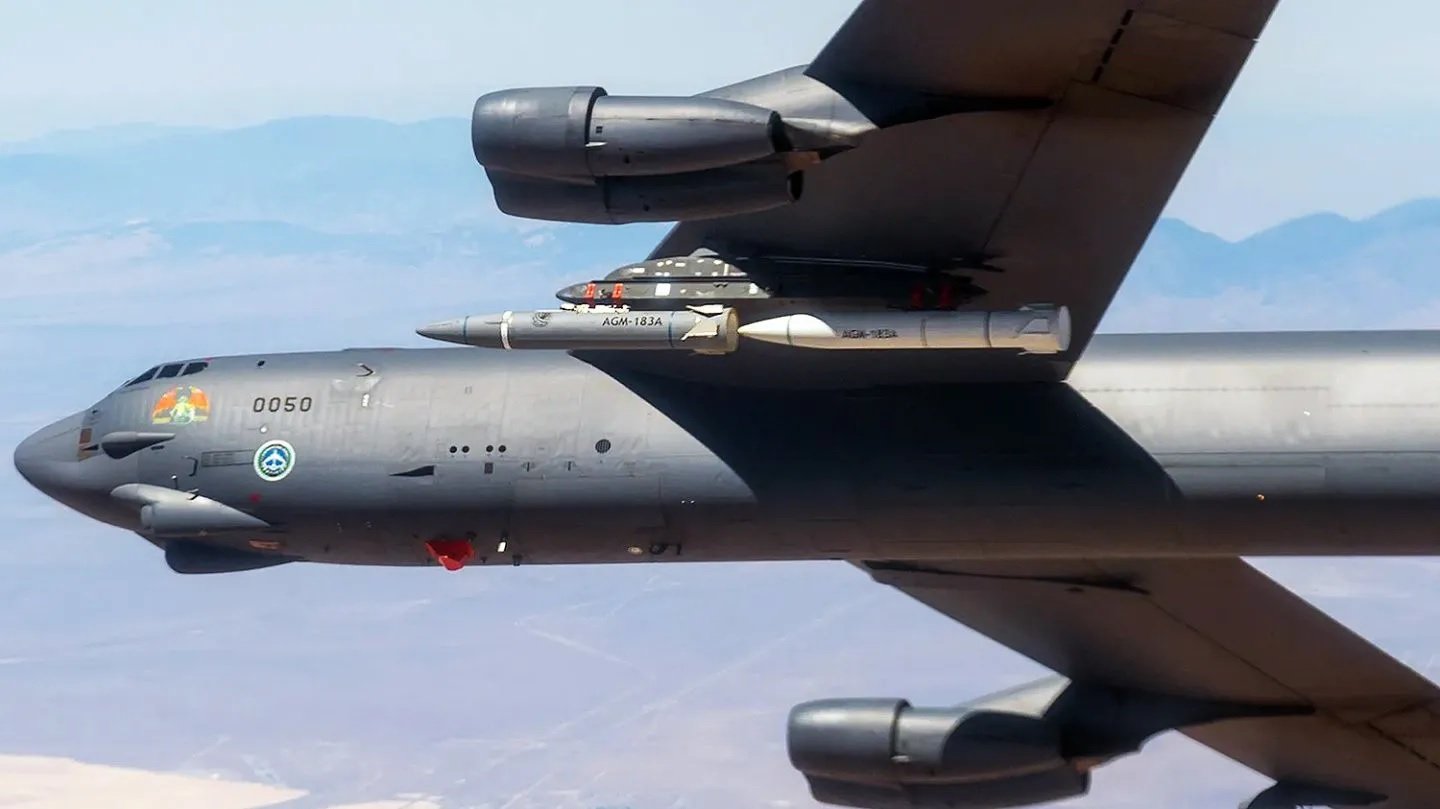
The AGM-183A ARRW is an air-launched boost-glide weapon designed to strike time-sensitive, high-value and heavily defended targets at long range. A solid-fuel rocket booster accelerates the weapon to speeds exceeding Mach 5, approximately 3,800 miles per hour (6,100 km/h), before releasing a hypersonic glide vehicle.
The unpowered glide vehicle manoeuvres towards its target, using its high speed and kinetic energy to destroy it on impact. Its manoeuvring flight path is intended to make interception more difficult for enemy air defence systems. The Air Force has listed the weapon’s range at approximately 1,000 miles.
Because of its size, ARRW cannot be carried by most fighter aircraft. It will initially be deployed on the B-52 Stratofortress bomber. The missile has also been tested on the B-1 Lancer, with integration work continuing for that aircraft.
Secretary of the Air Force Troy Meink said the move into production would provide combatant commanders with a high-speed strike weapon capable of penetrating advanced anti-access and area-denial systems.
Air Force Chief of Staff Gen. Kenneth Wilsbach said the weapon would provide the Joint Force with a flexible, rapid-response option for striking targets in highly contested environments.
Development History and Programme Reversal
The programme began in 2018, when Lockheed Martin received an initial design contract worth up to $480 million, building on earlier joint research by the Air Force and the Defense Advanced Research Projects Agency (DARPA), including work related to the X-51.
In 2019, captive-carry testing began on the B-52, and Lockheed Martin received a $988.8 million contract modification for the critical design review. Early plans called for initial operational capability in 2022.
However, the first three flight tests, beginning in 2021, failed. The first successful flight test took place in May 2022.
The programme subsequently faced funding cuts. Congress removed procurement funding for 12 ARRW missiles from the fiscal 2022 budget, and the Air Force requested no procurement funding for fiscal 2023.
In March 2023, then-acquisition executive Andrew Hunter announced that the programme would conclude without production orders as the Air Force shifted its focus towards the smaller Hypersonic Attack Cruise Missile (HACM) and other systems.
The decision changed in 2025, when then-Chief of Staff Gen. David Allvin informed Congress that the Air Force would procure ARRW.
Budget and Future Funding
ARRW received $362 million in the fiscal 2026 budget, while the Air Force requested an additional $452 million for production in fiscal 2027. That request remains stalled in Congress as the Pentagon operates under a continuing resolution tied to fiscal 2026 funding levels.
The Department of Defense’s future-years budget plans project annual ARRW procurement funding of between $556 million and $621 million from fiscal 2028 through fiscal 2031.
The $694 million contract formalises the transition to production for the Air Force’s first hypersonic weapon. However, the missile quantity and delivery schedule have not been disclosed, with quantities classified as controlled unclassified information.
——— End of Article ———