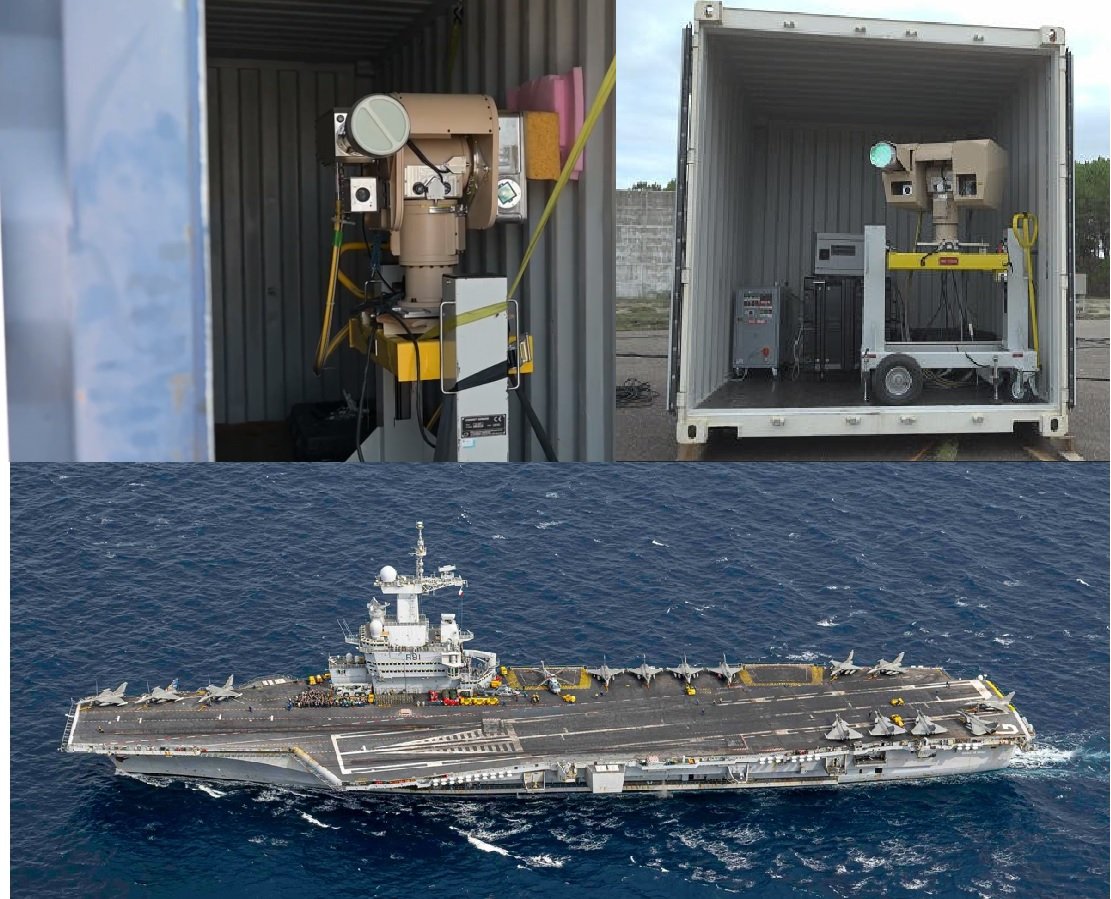
GULF OF OMAN, — The French Navy tested a laser anti-drone system aboard its flagship aircraft carrier, Charles de Gaulle, between June 4 and 8, 2026, during the La Fayette 26 mission. The trial took place on the flight deck while the carrier was docked in the Gulf of Oman.
According to the French Navy’s official magazine, Cols Bleus, as reported by Zone Militaire, a joint team from the Centre for Military Aviation Expertise (CEAM) in Mont-de-Marsan and the ground-based air defense squadron (EDSA) in Istres conducted the trial. Installing the equipment took approximately four hours. The setup included a laser emitter, camera turret, LIDAR sensor, cooling unit, and control console.
Although Cols Bleus described the event as the Navy’s first shipboard test of the system, published photographs matched the equipment to the HELMA-P demonstrator, developed by French company CILAS. The experimental deployment aimed to assess the laser’s performance in maritime conditions, with no indication that the system remained permanently installed aboard the carrier.
HELMA-P Capabilities
HELMA-P (High Energy Laser for Multiple Applications – Power) is a directed-energy weapon designed to counter small drones and other asymmetric threats. Development began in 2017 under France’s L2AD (Laser de lutte antidrone) program, involving CILAS and Ariane Group.
The system weighs approximately 80 kilograms and uses a 2-kilowatt laser combined with automated target detection and tracking. It focuses a laser beam on a target to heat and damage its structure, sensors, or electronics, potentially neutralizing small drones within seconds. Its reported engagement range is approximately one kilometre, depending on conditions. It does not require conventional ammunition for each engagement but needs electrical power and cooling.
Previous Testing and Operational Use
HELMA-P completed ground trials in 2020 and 2021 at the DGA missile testing centre in Biscarrosse. In June 2023, the French Navy tested it aboard the Horizon-class air-defense frigate Forbin in the Mediterranean Sea. The French Ministry of the Armed Forces subsequently highlighted its accuracy and effectiveness in maritime conditions.
The system was also deployed for anti-drone security during the Paris 2024 Olympic Games. The latest trial aboard Charles de Gaulle provided another opportunity to evaluate its potential for naval protection against unmanned aerial vehicles.
La Fayette 26 and International Developments
The La Fayette 26 mission centred on the Charles de Gaulle carrier strike group and lasted 166 days, ending on July 11, 2026, when the carrier returned to Toulon. Operations covered the North Atlantic, Baltic Sea, Mediterranean, and areas near the Gulf of Oman.
Other navies are also testing laser weapons for ship protection. In October 2025, the U.S. Navy conducted live-fire trials of AeroVironment’s palletized LOCUST laser weapon system aboard the aircraft carrier USS George H.W. Bush, reportedly engaging multiple drone targets in the same region.
France is continuing directed-energy weapon development, including the SYDERAL demonstrator, intended for broader short-range air-defense roles in the coming years. The HELMA-P trial forms part of the Navy’s ongoing evaluation of laser weapons for countering small drones and other asymmetric aerial threats.
——— End of Article ———