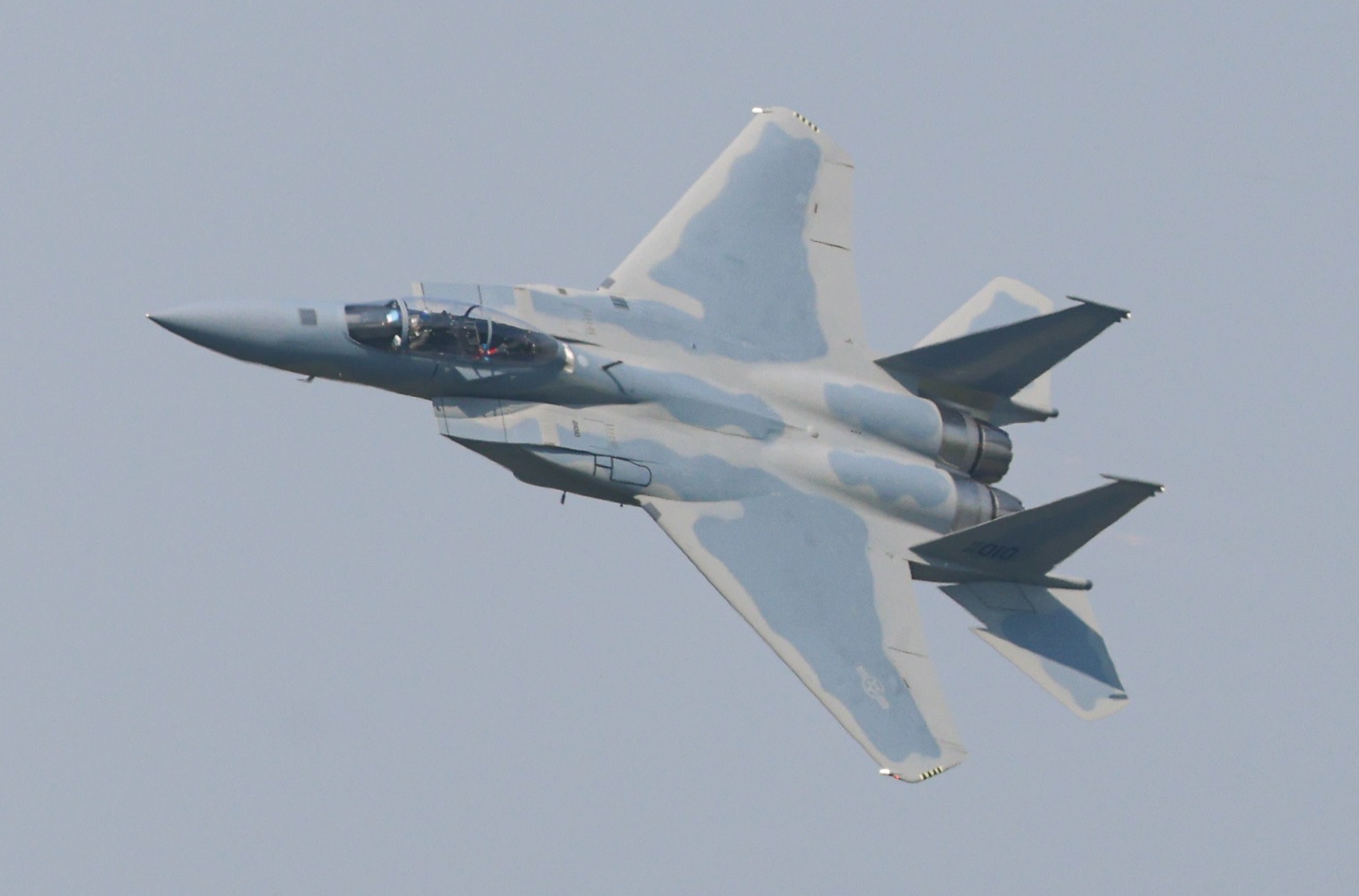
WASHINGTON — May 16, 2026 : The U.S. Air Force has significantly increased its planned procurement of Boeing’s F-15EX Eagle II fighter aircraft, raising the projected fleet size from 129 to 267 aircraft under the fiscal year 2027 budget proposal. Air Force officials said the decision was driven by delays affecting the F-35A Lightning II modernization program, as well as evolving operational requirements tied to the Indo-Pacific region and long-term force structure planning.
The expanded procurement plan marks one of the most substantial revisions to the Air Force’s tactical aviation strategy in recent years and reflects growing concerns over maintaining fighter inventory levels as legacy aircraft age and next-generation modernization programs encounter delays.
F-35 Upgrade Delays Prompt Procurement Shift
Senior Air Force leaders told lawmakers that continued delays involving the F-35’s Technology Refresh 3 (TR-3) and Block 4 modernization efforts highlighted the need for additional fighter capacity.
Testifying before the Senate Armed Services air-land subcommittee on May 12, Lt. Gen. David Tabor, deputy chief of staff for plans and programs, said disruptions affecting F-35 deliveries forced the Air Force to reconsider its fighter acquisition strategy.
“As we encountered some slowdowns in deliveries of F-35s due to the previously discussed TR-3 and Block 4 upgrade issues, it became apparent to us that we needed another fighter capacity,” Tabor said during the hearing.
The TR-3 modernization package is intended to provide upgraded computing power, improved displays, and expanded processing capability for the F-35 fleet, while the Block 4 upgrade program introduces additional weapons integration, sensor enhancements, electronic warfare improvements, and expanded mission capabilities. Delays in integrating and certifying those systems have slowed aircraft deliveries and operational fielding timelines.
According to Air Force officials, the procurement adjustment was also influenced by force design studies focused on what the service describes as the “pacing challenge” posed by China. Service planners concluded that future operations in the Pacific would require a balanced fighter inventory combining stealth platforms with aircraft capable of carrying large weapons loads over extended distances.
Air Force Seeks Balanced Fighter Fleet
Air Force leaders emphasized that the F-15EX and F-35A are intended to serve complementary operational roles rather than compete against one another.
The F-35A remains the service’s primary fifth-generation stealth fighter, designed for penetrating contested airspace using advanced sensor fusion, low observability, and networked targeting capabilities. The F-15EX, meanwhile, provides significantly larger weapons carriage capacity and extended stand-off engagement capability.
The F-15EX is derived from the existing F-15E Strike Eagle platform but incorporates extensive upgrades, including advanced avionics, fly-by-wire flight controls, modern mission systems architecture, upgraded electronic warfare systems, and improved survivability features.
The aircraft can carry up to 29,500 pounds of ordnance and is capable of transporting as many as 12 air-to-air missiles simultaneously. Air Force officials have described the aircraft as particularly valuable for homeland defense missions, long-range strike escort operations, and high-capacity missile carriage in potential Indo-Pacific conflict scenarios.
The aircraft’s open mission systems architecture also allows for faster integration of future weapons, sensors, and software upgrades compared with older legacy platforms.
Expanded Acquisition Broadens Mission Beyond Air National Guard Replacement
The revised procurement target represents another major shift in the Air Force’s evolving F-15EX acquisition strategy.
When Boeing first received the contract award in 2020, the Air Force projected a potential purchase of up to 144 aircraft. Subsequent budget plans later reduced the total to 80 aircraft before gradually increasing the figure to 104, then 129, and now 267 aircraft under the fiscal 2027 proposal.
Tabor told lawmakers that earlier procurement limits were primarily tied to plans for replacing aging F-15C/D aircraft operated by Air National Guard units. He stated that the previous 104-aircraft target had effectively become an artificial limitation based solely on Guard recapitalization requirements.
The newly expanded acquisition plan now extends beyond replacing older Air National Guard fighters and is intended to support recapitalization of portions of the aging F-15E Strike Eagle fleet.
The Air Force currently operates approximately 216 F-15E aircraft. Previous service planning documents had proposed retaining only 99 Strike Eagles equipped with newer F100-PW-229 engines, while older aircraft would eventually be retired.
Officials stated that the active F-15EX production line provides the Air Force with a direct pathway to replace older Strike Eagles without introducing an entirely new aircraft type into service.
Budget Proposal Includes Additional Fighter Funding
As of early 2026, the Air Force had accepted approximately 25 F-15EX aircraft, while more than 100 additional aircraft were already under contract.
The fiscal 2027 budget request includes funding for 24 additional F-15EX fighters at an estimated cost of roughly $3 billion. The request forms part of a broader Air Force budget proposal totaling approximately $267.7 billion, with procurement funding increasing by about 30 percent compared with previous years.
The service has repeatedly stated that it aims to acquire at least 72 new fighter aircraft annually in order to slow and eventually reverse the aging trend affecting the tactical aviation fleet.
Air Force officials argue that expanding F-15EX procurement will help stabilize fighter inventory levels while modernization programs continue across multiple aircraft categories.
Congress Pushes Broader Fighter Expansion
The expanded procurement proposal also aligns with recent legislative efforts aimed at increasing tactical aircraft production capacity.
In April, lawmakers introduced the bipartisan Airpower Acceleration Act, which would authorize the acquisition of up to 329 F-15EX aircraft and permit multiyear procurement contracts designed to reduce long-term acquisition costs while providing greater stability to the defense industrial base.
Supporters of the legislation argue that higher production rates and long-term procurement commitments are necessary to sustain aircraft manufacturing capacity as the U.S. military modernizes its air combat fleet.
The legislation also reflects broader concerns within Congress regarding fighter inventory shortfalls, aircraft aging trends, and the industrial challenges associated with maintaining large-scale tactical aircraft production.
Production Challenges Continue at Boeing Facility
Despite the expanded demand, the F-15EX program has faced production and delivery delays of its own.
Aircraft deliveries were disrupted during a months-long labor strike in 2025 at Boeing’s manufacturing facility in St. Louis, Missouri, where the F-15EX is assembled. The strike affected assembly schedules and slowed planned aircraft deliveries to the Air Force.
Those delays forced temporary operational adjustments, including the deployment of F-22 Raptor aircraft to Kadena Air Base while the installation awaited its planned permanent F-15EX squadrons.
Air Force acquisition officials said the Pentagon and Boeing are currently negotiating measures intended to accelerate fighter production and align manufacturing capacity with the larger procurement target.
Lt. Gen. Luke Cropsey, military deputy to the Assistant Secretary of the Air Force for Acquisition, Technology and Logistics, told lawmakers that Boeing has not yet reached the contractually required production rate of two aircraft per month on its current single production line.
Cropsey stated that Boeing has presented what he described as a “well thought-out plan” to achieve the required production rate and has also outlined options for increasing output to three or four aircraft per month in the future.
According to Air Force officials, reaching those production targets would require additional infrastructure development and capital investment at Boeing’s St. Louis facility, potentially including the construction of one or two additional production lines.
“From an acquisition standpoint, we’ve got some work to do ahead of us to be able to get to the ramp rates that we’re talking about,” Cropsey said. “But I think Boeing is actively in good faith working with us to figure out what that would look like.”
Long-Term Role in Air Force Modernization
Under the revised procurement structure, the Air Force expects the expanded fleet of 267 F-15EX aircraft to support up to 13 operational squadrons consisting of approximately 21 aircraft each, in addition to test and training units.
Air Force leaders continue to describe the F-15EX as a central element of the service’s broader fighter modernization strategy alongside ongoing F-35A procurement efforts.
Officials have repeatedly stressed that the expanded F-15EX acquisition is intended to supplement, rather than replace, the F-35 program by ensuring the Air Force maintains sufficient fighter capacity, operational flexibility, and long-range strike capability during a period of modernization transition and increasing strategic competition in the Indo-Pacific region.
——— End of Article ———