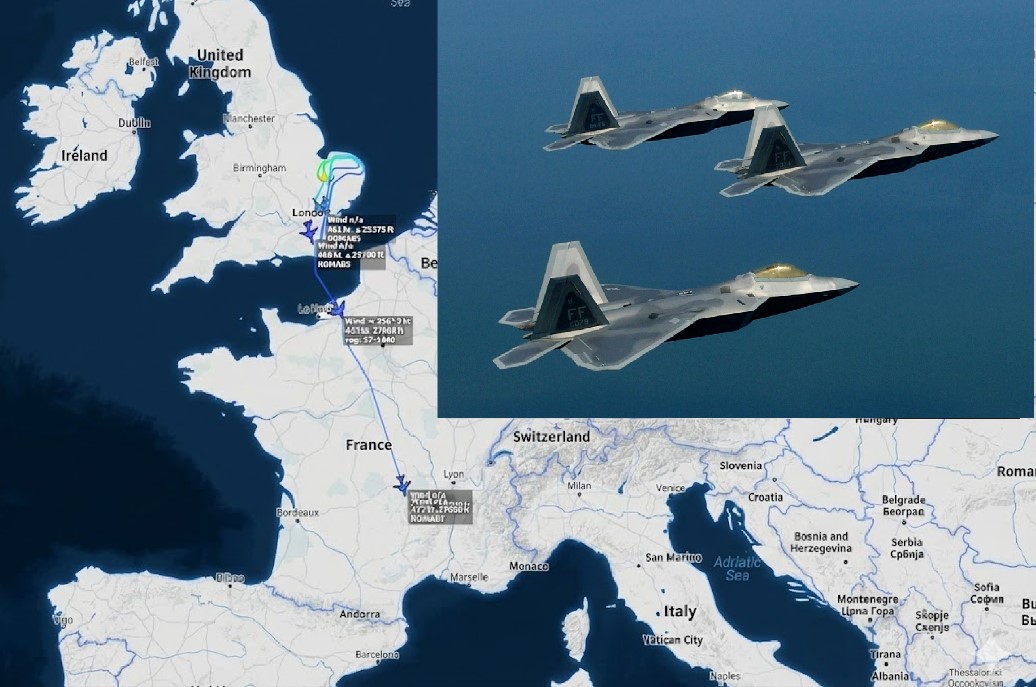
LAKENHEATH, United Kingdom, February 24, 2026 : Twelve F-22 Raptor fighter aircraft of the United States Air Force departed RAF Lakenheath on February 24, 2026, transferring to the United States Central Command (CENTCOM) area of responsibility in the Middle East. The movement follows the collapse of nuclear negotiations between the United States and Iran in Geneva and forms part of a broader increase in U.S. airpower presence across Europe and the Middle East.
The aircraft are assigned to the 1st Fighter Wing at Joint Base Langley-Eustis. According to open-source flight-tracking data and defense observers, the fighter formation departed the United Kingdom under escort from four aerial refueling aircraft operating from RAF Mildenhall.
The tanker support package included three KC-46A Pegasus aircraft using callsigns ROMA02 (tail 21-46095), ROMA03 (tail 22-46100), and ROMA05 (tail 21-46093), along with one KC-135 Stratotanker operating under callsign ROMA04 (tail 57-1440). The integration of both tanker types enabled sustained transcontinental flight operations during the onward transit to the Middle East.
Transatlantic Deployment Process
The movement was conducted as a “Coronet” mission, the U.S. military term for long-distance, transoceanic fighter deployments requiring coordinated tanker support. Fighter aircraft such as the F-22 do not have the range to cross the Atlantic Ocean without multiple refueling events. As part of standard procedures, the aircraft crossed the Atlantic in waves beginning February 17, 2026, staging through RAF Lakenheath before departing for CENTCOM on February 24.
RAF Lakenheath is routinely used as an intermediate stop for U.S. fighter deployments because of its infrastructure and proximity to tanker assets at RAF Mildenhall. The February 24 departure marks the final leg of the transfer to operational bases within the CENTCOM theater. Potential destinations include installations such as Muwaffaq Salti Air Base in Jordan or other established facilities in the region, though no official confirmation of the exact basing location has been released.
The transit from the United Kingdom to the Middle East typically requires between eight and twelve hours of flight time, depending on routing and refueling schedules. Aircraft involved in the deployment carried external fuel tanks to support extended-range operations.
Broader Regional Force Posture
Defense analysts assess the deployment as part of one of the largest U.S. regional force repositionings in recent decades. The United States is currently positioning more than 150 aircraft across Europe and the Middle East. The broader posture includes additional deployments of F-35 and F-16 fighter aircraft, surveillance and airborne early warning platforms, and the presence of two U.S. Navy carrier strike groups in the wider region.
The repositioning also follows the evacuation of non-essential U.S. diplomatic personnel from Lebanon. Collectively, these measures increase available airpower and force protection capabilities within rapid reach of multiple regional flashpoints.
The F-22 has previously operated within CENTCOM from bases including Al Dhafra Air Base in the United Arab Emirates. In earlier deployments, the aircraft conducted deterrence patrols over Syria and the Gulf region and responded to unsafe interactions involving Russian aircraft. F-22s were also deployed to the Middle East in August 2024 amid concerns over Iranian missile and drone activity.
Aircraft Capabilities and Operational Role
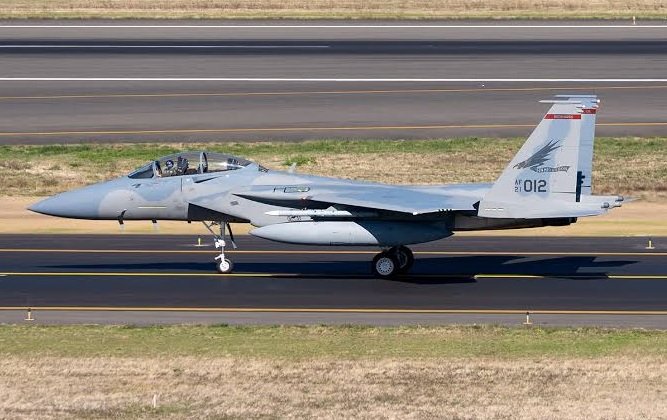
The F-22 Raptor serves as the U.S. Air Force’s primary air superiority fighter. It is designed for operations in contested airspace and incorporates low-observable characteristics, supercruise capability, advanced radar systems, and sensor fusion. The aircraft carries AIM-120 AMRAAM and AIM-9 infrared-guided missiles in internal weapons bays to preserve its radar signature. In addition to air-to-air missions, the platform retains secondary ground-attack capability.
Within the CENTCOM environment, F-22 aircraft are typically tasked with defensive counter-air missions and air superiority patrols. Their operational scope can include escorting strike packages, protecting high-value airborne assets, and countering hostile aircraft, cruise missiles, and unmanned aerial systems. The aircraft are also capable of operating over maritime chokepoints such as the Strait of Hormuz and the Bab el-Mandeb, as well as air approaches to partner states in the Gulf and Israel.
The KC-46A Pegasus, derived from the Boeing 767 platform, provides both boom and hose-and-drogue refueling capability in a single sortie and can carry more than 212,000 pounds of fuel. It also retains cargo and personnel transport capacity. The KC-135 Stratotanker, in service for more than six decades, continues to provide core aerial refueling capability for long-range fighter movements.
Open-Source Confirmation
The February 24 movement was tracked using publicly available flight transponder data and radio communications monitoring. Defense observers, including the account Archer83Able on X, identified the aircraft and tanker tail numbers involved in the mission. No formal U.S. Air Force press release has specified the final destination, mission duration, or operational timeline.
The deployment positions twelve fifth-generation fighters within the U.S. Central Command theater at a time of heightened regional tension following the breakdown of diplomatic discussions over Iran’s nuclear program. The aircraft remain under U.S. Air Force command and will operate from established bases within the CENTCOM area of responsibility.
——— End of Article ———