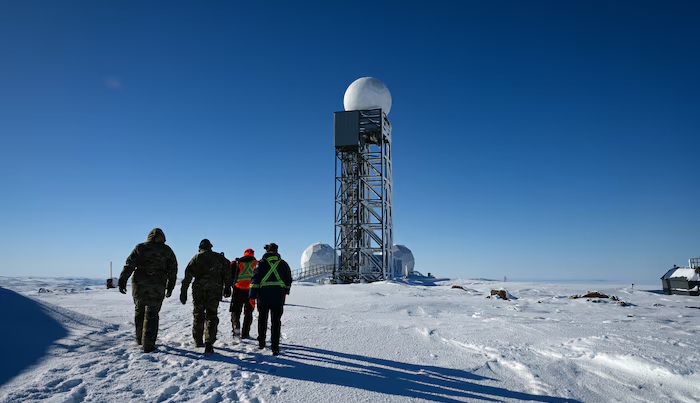
HILL AIR FORCE BASE, Utah — May 20, 2026 : The U.S. Air Force has awarded a $40 million indefinite-delivery/indefinite-quantity (IDIQ) contract to IAP World Services for the replacement of aging radomes protecting AN/FPS-124 short-range radar systems across the North Warning System (NWS) in northern Canada.
The contract, announced on May 19, covers the production, transportation, installation, removal, and disposal of 28-foot composite radome assemblies through May 20, 2035. Work will be conducted at multiple locations across Canada and Florida under the management of the Air Force Life Cycle Management Center’s Homeland Surveillance Branch at Hill Air Force Base.
The program is intended to restore and sustain protective infrastructure for unattended AN/FPS-124 low-altitude surveillance radars that form part of the binational North Warning System jointly operated by the United States and Canada under North American Aerospace Defense Command. The radar network provides early-warning coverage against low-flying aircraft and cruise missile threats approaching North America through Arctic routes
North Warning System Infrastructure
The North Warning System consists of approximately 15 AN/FPS-117 long-range radar sites and between 36 and 39 AN/FPS-124 short-range radar installations distributed across Alaska, Yukon, the Northwest Territories, Nunavut, Labrador, and other Arctic regions.
The AN/FPS-124 systems serve as gap-filler radars designed to detect low-altitude targets beneath the coverage envelope of long-range radar systems affected by terrain masking and radar horizon limitations. The sites support continuous surveillance along the polar approaches to North America.
Most of the existing radome structures were installed between 1990 and 1992 during the modernization effort that replaced the earlier Distant Early Warning (DEW) Line infrastructure.
Arctic Environmental Degradation
After more than three decades of exposure to Arctic operating conditions, the radomes have experienced structural degradation caused by extreme wind loading, repeated freeze-thaw cycles, icing, ultraviolet exposure, thermal cycling, and sea salt corrosion at coastal locations.
According to contract documentation, the Air Force determined that complete replacement of the radome assemblies is required rather than localized repair work due to the condition of the structures.
The program includes the disassembly and disposal of existing assemblies, installation of new composite radomes, and replacement of SCR-T28D zenith panels incorporating OSHA 1910.140-compliant fall-arrest anchor systems. Existing infrastructure components, including lightning protection systems, acrylic domes, photocell assemblies, and antenna interfaces, will remain in service where applicable.
Contract Structure and Procurement
The contract combines fixed-price and cost-reimbursement elements to account for operational uncertainties associated with Arctic sustainment work, including weather disruptions, transportation constraints, and limited seasonal access to remote radar sites.
The contract also includes provisions for spare parts, technical data packages, installation and maintenance training materials, and contractor support services.
Procurement activities began with a presolicitation notice issued on May 27, 2025, followed by a formal request for proposals released on August 5, 2025. Four proposals were submitted during the competition process.
Initial planning documents estimated the effort at approximately $21.7 million, though the final contract ceiling increased to $40 million as sustainment and logistics requirements expanded. At the time of award, $4.576 million in fiscal years 2025 and 2026 funding had been obligated.
AN/FPS-124 Radar Capabilities
The AN/FPS-124 radar was specifically developed for unattended Arctic operations and low-altitude target detection during the late Cold War period.
The radar operates within the 1218–1398 MHz frequency band using six selectable frequencies and provides 360-degree surveillance coverage ranging from approximately 3.2 kilometers to 113 kilometers.
The system incorporates an electronically scanned stripline antenna array, eliminating the need for large rotating mechanical assemblies. Additional features include pulse compression, Doppler filtering, clutter cancellation, zero-Doppler detection capability, and Kalman-filter-based target tracking.
The radar is capable of processing up to 200 target tracks every six seconds while maintaining high operational reliability in remote Arctic conditions.
Remote Arctic Operations
Radar data collected at the sites is processed locally and transmitted through satellite communications links to NORAD command centers, including Regional Operations Control Centers at Elmendorf Air Force Base and CFB North Bay.
Many North Warning System locations operate without permanent on-site personnel and rely on autonomous power systems, remote diagnostics, and periodic maintenance visits supported by helicopter lift or seasonal air transport.
Operational locations within the network include Hall Beach, Cambridge Bay, Cape Dyer, Saglek, Resolution Island, Dewar Lakes, Shepherd Bay, Brevoort Island, Cartwright, and Rowley Island.
The sustainment effort will support continued operation of the North Warning System while future over-the-horizon radar networks, distributed sensing systems, and next-generation Arctic surveillance capabilities remain under development by the United States and Canada.
——— End of Article ———