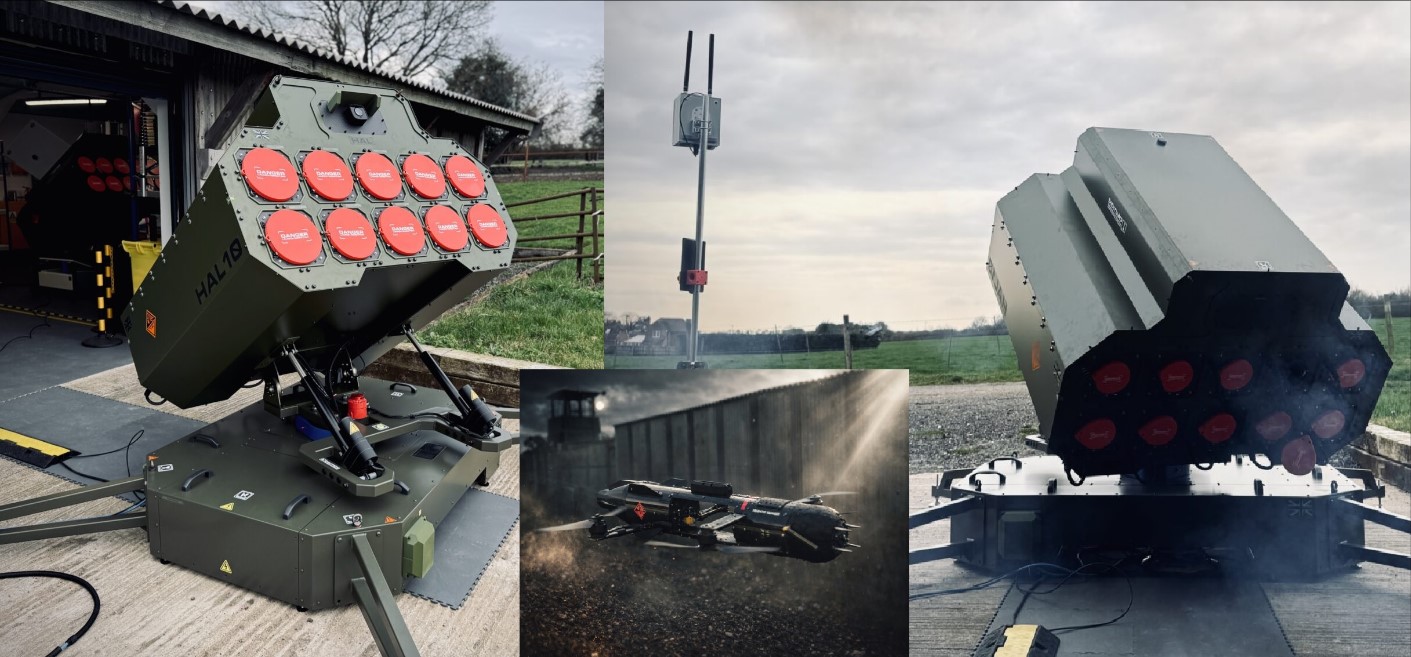
CHIEVELEY, UNITED KINGDOM — April 3, 2026 : UK-based uncrewed systems developer ISS Aerospace has introduced the HAL10 Hybrid Air-Systems Launcher, a modular cassette-based launch system designed to store, manage, and autonomously deploy multiple small uncrewed aerial systems (UAS) in operational environments.
System Architecture and Design
The HAL10 is configured as a 10-bay cassette launcher arranged in a 5 × 2 structure. It is engineered to securely house and deploy UAS platforms while operating across a wide temperature range from −32°C to +45°C. The system has a reported net weight of 555 kg and a gross weight of 350 kg.
Designed as a platform-agnostic solution, the launcher is compatible with various small UAS platforms, enabling integration into fixed installations, mobile units, or forward-operating environments. It supports both standalone and networked mission profiles.
A central feature of the HAL10 is its autonomous launch sequencing capability. The integrated system allows operators to deploy individual drones or multiple air vehicles with minimal manual input. This enables three primary operational modes: rapid saturation through simultaneous launches, staggered deployment at pre-programmed intervals, and sustained operations through continuous, overlapping sorties.
Operational Roles and Mission Applications
The HAL10 is intended to support a range of tactical and operational missions. These include multi-UAS deployment for expanded surveillance and operational reach, counter-UAS (C-UAS) missions involving interceptor or effector launches, and distributed strike operations such as precision engagement, decoy deployment, or suppression tasks in contested environments.
The system is designed to provide centralized and repeatable launch capabilities, reducing manpower requirements while enabling rapid-response operations.
Integration with WASP Tactical UAS
The HAL10 is optimized for integration with the WASP tactical UAS, developed under the ISSOS Technologies joint venture between ISS Aerospace and OSL Technology.
The WASP is a tube-launched, rocket-assisted drone designed for rapid deployment in time-sensitive missions. It can be launched in under three seconds and transitions autonomously from rocket-assisted flight into conventional multi-rotor operation.
WASP Specifications and Performance
The platform has a maximum take-off weight (MTOW) of 5 kg, with tube dimensions of 146 × 760 mm. It supports a modular payload capacity of up to 1.5 kg, with standard configurations including a gimbal-mounted electro-optical/infrared (EO/IR) camera and a laser rangefinder.
In terms of performance, the WASP can reach speeds of up to 35 m/s (approximately 126 km/h) and operate in wind conditions of up to 18 m/s. It offers an endurance of up to 30 minutes without payload and approximately 22 minutes when fully loaded.
The system has an operational range between 40 and 45 kilometers, with tested accuracy for effector payload delivery at distances of up to 24 kilometers.
Network Integration and Partnerships
In February 2026, ISS Aerospace announced a partnership with Anduril UK to integrate the WASP as a launched effect within Anduril’s Lattice command-and-control platform. The integration was completed within a single day and validated through a flight test conducted at the company’s Oxford facility.
The WASP is positioned as a shorter-range, attritable system complementing platforms such as Anduril’s Altius, with an open-architecture flight system supporting ISR, counter-UAS, and strike missions.
Company Background and Capabilities
Founded in 2015, ISS Aerospace specializes in the development of autonomous UAV systems for defense, security, and commercial applications, including oil and gas, construction, and agriculture.
The company focuses on resilient navigation capabilities in RF- and GPS-denied environments, integrating onboard edge computing, modular open architectures, and multi-modal sensor systems. Its portfolio includes the Sensus series of multi-mission UAV platforms.
ISS Aerospace conducts in-house prototyping, field testing, and command-and-control system development within the United Kingdom.
System Positioning
The HAL10 launcher is positioned as a scalable and flexible solution for modern unmanned operations, enabling coordinated multi-UAS deployment from a single system. While detailed information on power requirements, exact external dimensions, and specific launch mechanisms has not been disclosed, the system emphasizes autonomous operation, modularity, and compatibility across a range of mission scenarios.
——— End of Article ———