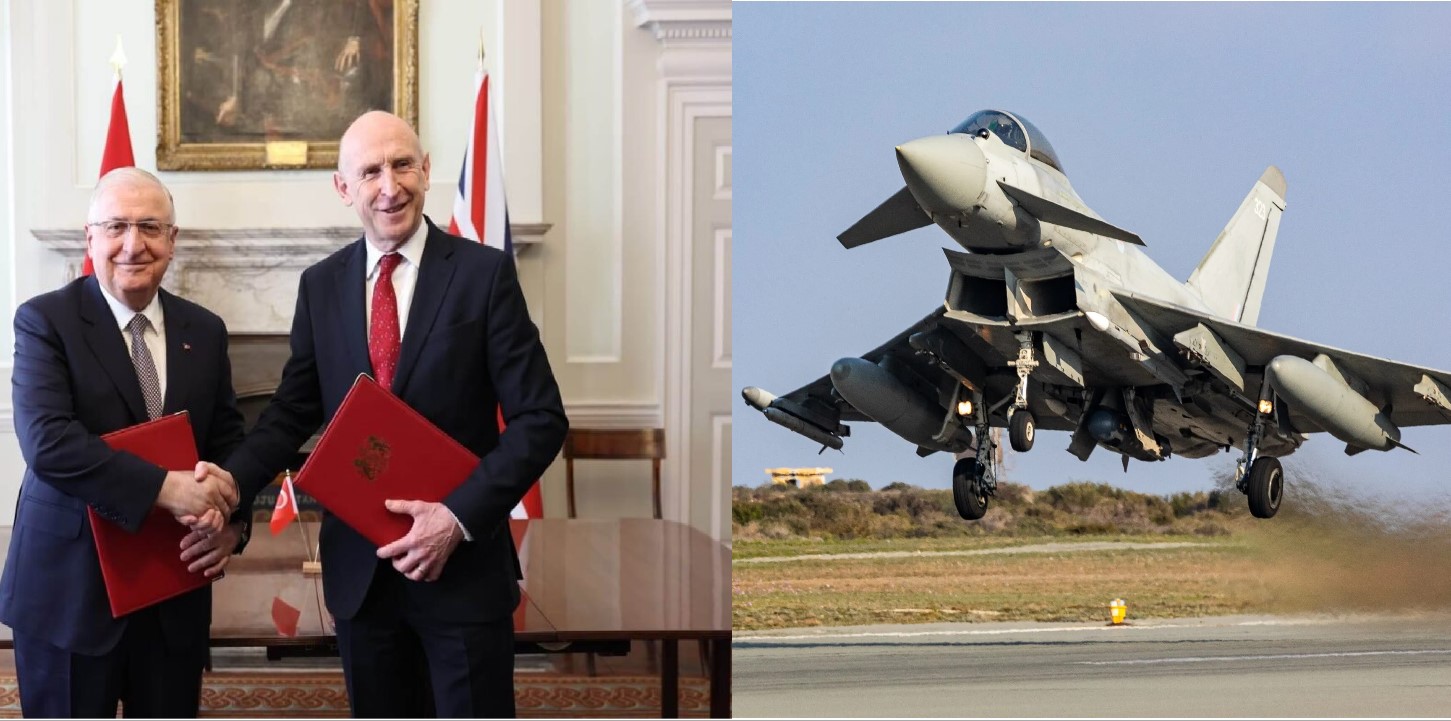
LONDON, — March 26, 2026 : The United Kingdom and Türkiye have signed a multi-billion-pound Government-to-Government (G2G) agreement covering training, maintenance, and long-term technical support for Türkiye’s incoming fleet of Eurofighter Typhoon fighter aircraft. The agreement was formalized in London on March 25, 2026, by UK Defence Secretary John Healey and Turkish National Defence Minister Yaşar Güler.
The deal represents the operational implementation phase of the broader £8 billion (approximately $10.7–11 billion) export contract announced in October 2025, under which Türkiye will procure 20 Eurofighter Typhoon aircraft.
Training, Maintenance and Capability Development
The newly signed agreement establishes the foundational training and logistical framework required before the aircraft enter operational service.
Under the programme, the United Kingdom—supported by the Royal Air Force (RAF)—will train 10 Turkish instructor pilots along with nearly 100 ground crew personnel. The technical training will cover mechanical systems, avionics, weapons integration, and mission systems associated with the Typhoon platform.
The training model is structured to enable Türkiye to gradually build an indigenous support ecosystem. The objective is to allow the Turkish Air Force to independently conduct pilot training, manage sustainment, and perform depot-level maintenance within the country over time.
The support package also includes:
- Provision of spare parts and ground support equipment
- Delivery of high-fidelity flight simulators
- Integration of electronic warfare systems
- Technical and engineering support for an initial three-year period following the aircraft’s entry into service
BAE Systems is the principal contractor responsible for delivering infrastructure, systems, and technical services under the agreement, working in coordination with key European defence suppliers.
Industrial Participation and Manufacturing
Production of Türkiye’s Typhoon aircraft is already underway across the United Kingdom and Eurofighter partner nations. Final assembly will take place at BAE Systems’ Warton facility in Lancashire, with the first aircraft scheduled for delivery in 2030.
More than 37 percent of each Eurofighter Typhoon is manufactured within the UK. The programme involves approximately 330 companies across the British supply chain, with major industrial activity concentrated in Scotland, Lancashire, and Bristol.
The wider £8 billion programme is expected to support around 20,000 jobs across the UK, including:
- Approximately 6,000 positions at BAE Systems facilities in Warton and Samlesbury
- Around 1,100 roles in South West England, including at Rolls-Royce in Bristol, which produces key components for the EJ200 engines
- Roughly 800 jobs in Scotland
Additional contributions come from major defence firms including Leonardo UK, MBDA, and Martin-Baker, all of which are involved in subsystems, avionics, weapons integration, and ejection systems.
Strategic and NATO Context
Türkiye’s acquisition of the Eurofighter Typhoon is expected to strengthen NATO’s combat air capabilities, particularly along the alliance’s eastern and southeastern regions. The procurement followed Türkiye’s removal from the U.S.-led F-35 programme in 2019 and extended negotiations with Washington over F-16 aircraft.
The October 2025 agreement for the Typhoon purchase was enabled after Germany lifted its earlier objection to the export, allowing the multinational Eurofighter consortium to proceed.
Officials view the agreement as part of a broader effort to enhance interoperability within NATO. UK-operated Typhoon aircraft continue to conduct operational and defensive missions over the Middle East, and the joint training framework will bring Turkish personnel into closer operational alignment with RAF standards and procedures.
Official Statements
UK Defence Secretary John Healey stated that the agreement combines industrial, economic, and strategic objectives.
“This partnership does not just export world-leading British built jets, it builds alliances, grows our economy, and makes NATO stronger,” Healey said. “Türkiye’s decision to acquire Typhoon is a vote of confidence in British industry and British jobs, and this agreement brings the UK-Türkiye partnership to life.”
He added that the training component reflects deeper operational cooperation: “As UK Typhoon pilots continue to fly defensive missions over the Middle East, Turkish pilots and engineers will train alongside RAF personnel to strengthen collective security.”
Simon Barnes, Group Managing Director of BAE Systems’ Air sector, emphasized the role of the agreement in enabling operational readiness.
“We’re proud to support the UK’s partnership with Türkiye by delivering a defence capability that deepens collaboration and reinforces shared security commitments,” Barnes said. “This agreement supports Türkiye’s readiness to operate the aircraft while enabling the development of sovereign support capabilities over time.”
Programme Outlook
The training and support agreement is designed to ensure that Türkiye’s Eurofighter Typhoon fleet is supported by a structured transition from initial external assistance to long-term domestic capability. With deliveries scheduled to begin in 2030, the programme is expected to progress in parallel across training, infrastructure development, and industrial production.
The agreement also reinforces long-term defence cooperation between the United Kingdom and Türkiye while supporting the UK’s defence industrial base and sustaining employment across its aerospace sector.
——— End of Article ———