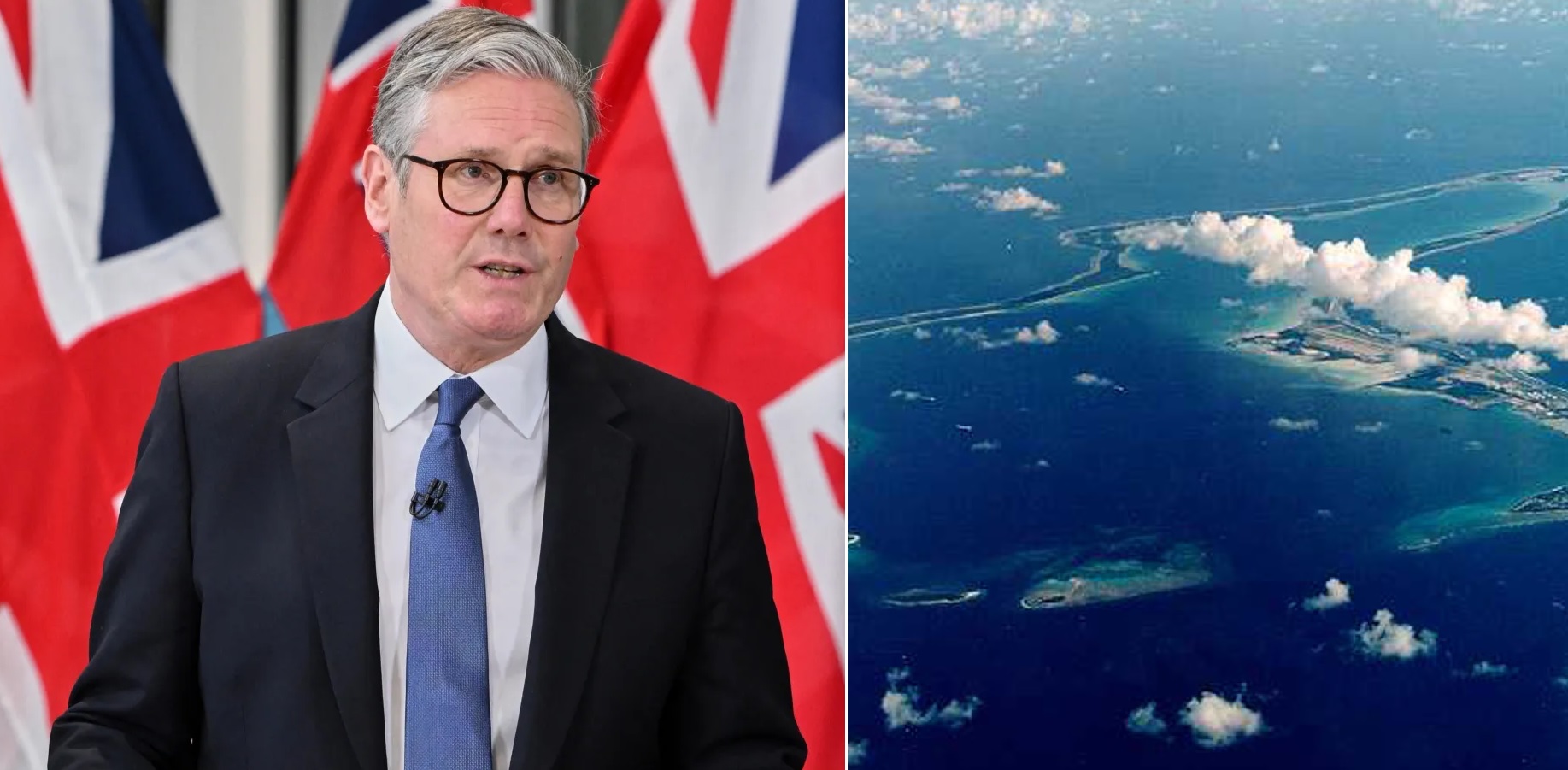
LONDON : Prime Minister Keir Starmer has withdrawn draft legislation that would have transferred sovereignty over the Chagos Islands to Mauritius, reversing course after mounting political pressure at home and abroad and renewed concerns over Britain’s defence commitments to the United States.
Government officials said the bill was pulled from the parliamentary agenda following warnings that the proposal could conflict with the 1966 UK–US defence agreement governing the British Indian Ocean Territory (BIOT), which underpins the operation of the Diego Garcia military base — one of the most strategically significant US installations outside American territory.
Strategic Concerns and Treaty Obligations
At the heart of the controversy lies Diego Garcia, the largest island in the Chagos archipelago, which hosts a joint US–UK military base used for operations across the Middle East, Africa and the Indo-Pacific. The 1966 exchange of notes between London and Washington guarantees continued British sovereignty over the territory in return for granting the United States long-term defence access.
Senior defence figures reportedly warned Downing Street that transferring sovereignty to Mauritius could place the UK in breach of those commitments or require a complex renegotiation with Washington at a time of heightened global tensions. Critics within the British security establishment argued that any ambiguity over control of the islands could undermine operational certainty at Diego Garcia.
Trump Intervention Adds Pressure
The proposed legislation also drew sharp criticism from US President Donald Trump, according to officials familiar with the discussions. Trump is said to have privately and publicly questioned the wisdom of altering the status of territory hosting a critical American military base, framing the issue as a matter of alliance credibility and strategic stability.
His intervention added to concerns within the Starmer government that the bill risked straining relations with Washington at a moment when London is seeking to reinforce defence and intelligence ties amid conflicts in Ukraine, the Middle East, and rising tensions in the Indo-Pacific.
A Long-Running Dispute
The sovereignty of the Chagos Islands has been disputed for decades. Britain separated the territory from Mauritius in 1965, three years before Mauritius gained independence. Between the late 1960s and early 1970s, the UK forcibly removed the Chagossian population to facilitate the construction of the military base, a move later acknowledged by British courts as morally wrong.
In 2019, the International Court of Justice (ICJ) issued a non-binding advisory opinion stating that the UK’s continued administration of the islands was unlawful and that Britain should end its control “as rapidly as possible.” The same year, the United Nations General Assembly backed the opinion, increasing diplomatic pressure on London to negotiate a transfer to Mauritius.
Successive British governments have resisted an unconditional handover, citing defence requirements, but talks with Mauritius have continued intermittently. Starmer’s Labour government had signalled a renewed willingness to resolve the dispute through legislation and negotiation, raising expectations of a breakthrough.
Political Fallout at Home
Opposition figures and several Labour backbenchers criticised the now-withdrawn bill as rushed and insufficiently protective of UK security interests. Others accused the government of backing down under US pressure and abandoning an opportunity to resolve a long-standing colonial legacy.
The Mauritian government expressed disappointment, reiterating its claim to sovereignty and calling for renewed negotiations. Chagossian advocacy groups, many of whom have campaigned for the right of return and compensation, said the withdrawal prolonged uncertainty over their future.
Downing Street said the government remains committed to a “lawful and durable resolution” of the Chagos dispute but stressed that any settlement must safeguard national security and honour international defence obligations. Officials indicated that talks with Mauritius would continue, though no new timetable has been announced.
For now, the withdrawal underscores the enduring tension between Britain’s legal and moral obligations stemming from its colonial past and the hard realities of modern geopolitics — with Diego Garcia remaining a linchpin of Western military strategy and a decisive factor in London’s calculations.
——— End of Article ———