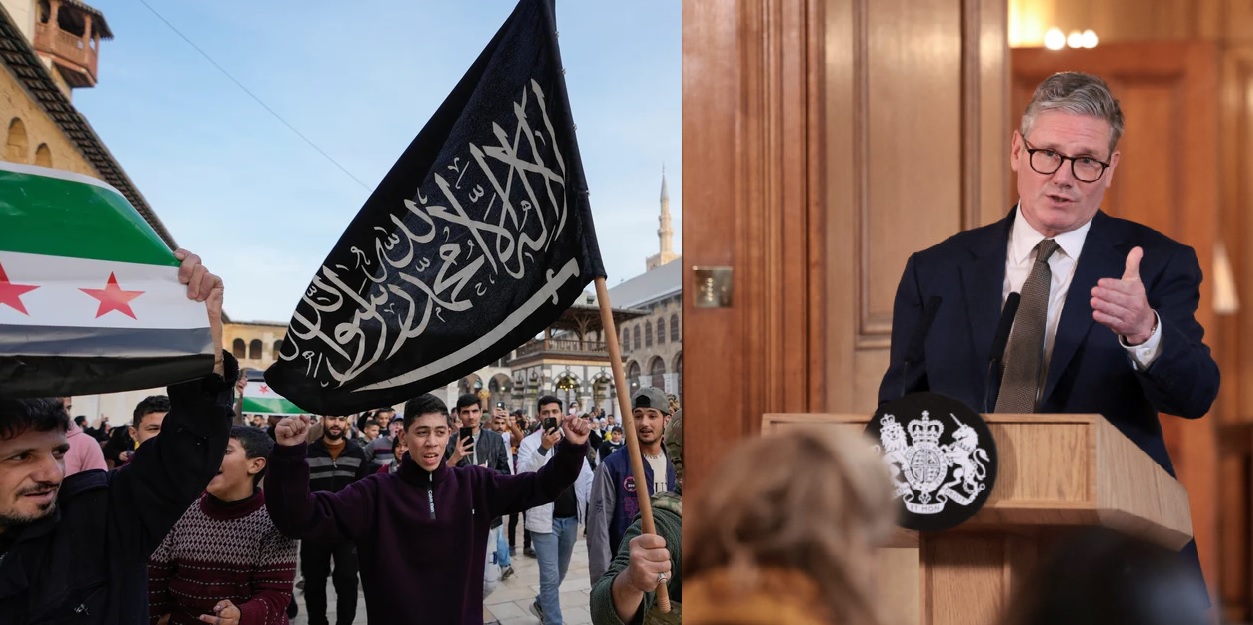
In a landmark decision with major geopolitical implications, the British government on Tuesday formally removed Hay’at Tahrir al-Sham (HTS) — the Islamist group that once led the Syrian rebel coalition — from its list of proscribed terrorist organisations. The move marks a decisive policy shift as London adjusts to the new political reality in Syria following the ouster of President Bashar al-Assad and the rise of a new government led by former HTS figure Ahmed al-Sharaa.
From Al-Qaeda Affiliate to Syria’s Ruling Power
HTS, short for Hay’at Tahrir al-Sham or “Organization for the Liberation of the Levant,” was formed in January 2017 through a merger of several Islamist and jihadist factions — notably Jabhat Fatah al-Sham (formerly known as the Al-Nusra Front, al-Qaeda’s Syrian branch), Ahrar al-Sham elements, and smaller rebel outfits. It emerged amid the chaos of Syria’s long and bloody civil war, initially aiming to topple Assad’s regime and establish an Islamic-governed state.
HTS’s roots trace directly to Al-Nusra Front, which was created in 2012 with backing from al-Qaeda’s central leadership under Ayman al-Zawahiri. Its early campaigns made it one of the most powerful and disciplined forces in the Syrian opposition, feared both by government forces and rival rebels. By 2016, as global pressure mounted, Nusra rebranded itself as Jabhat Fatah al-Sham, claiming to sever ties with al-Qaeda — a move widely seen as an attempt to gain legitimacy and unite Syria’s fragmented insurgency. Months later, it became the nucleus of the newly declared HTS.
While HTS maintained a Salafi-jihadist ideology, over time it sought to present itself as a Syrian nationalist movement rather than a global jihadist enterprise. Under the leadership of Ahmed al-Sharaa (Abu Mohammad al-Jolani), it shifted focus from international terrorism toward local governance and administration in north-western Syria, especially in Idlib province, where it built civil structures, ran courts, and coordinated humanitarian work. This transformation — part ideology, part survival — eventually distinguished HTS from extremist holdouts like Hurras al-Din, which remained loyal to al-Qaeda.
Years of War Against Assad and Beyond
Throughout the Syrian civil war, HTS was among the most formidable opponents of the Assad regime. Its fighters played leading roles in seizing large parts of Aleppo, Idlib, and Hama provinces. However, HTS also clashed with other opposition groups — from ISIS to Western-backed factions — in its bid to dominate the anti-Assad front. Despite internal rivalries, the group maintained its foothold as a military, political, and administrative power in rebel-controlled territories.
Internationally, HTS’s militant past led to terrorist designations across the West. The United Kingdom proscribed the group in 2017, categorising it as a terrorist organisation under the Terrorism Act 2000 — making it a criminal offence to support or associate with it. Similar designations came from the United States, the United Nations, and the European Union, all viewing HTS as an extension of al-Qaeda.
Yet, as the years progressed, the realities on the ground began to change dramatically. HTS’s consolidation in the north and its gradual moderation in rhetoric coincided with the collapse of Assad’s regime, culminating in the 2024 overthrow of Damascus. With Ahmed al-Sharaa assuming Syria’s presidency soon after, the political landscape transformed beyond recognition.
Britain’s Policy Shift
Against this backdrop, London’s decision to remove HTS from its terrorism list represents an acknowledgement of these seismic shifts. In its official statement, the British government said that the delisting would allow “closer engagement with the new Syrian government” and facilitate cooperation “to eliminate Assad’s chemical weapons programme” that remained from the previous regime.
“The UK will continue to press for genuine progress and hold the Syrian government accountable for its actions in fighting terrorism and restoring stability in Syria and the wider region,” the statement added.
This announcement follows Washington’s similar step in July 2025, when the Biden administration revoked the U.S. Foreign Terrorist Organization (FTO) designation for HTS — signalling a coordinated Western rethink. Both capitals have made clear that the move is not a blanket endorsement of HTS’s past but rather a pragmatic adjustment to deal with Syria’s new ruling reality.
Who Created and Controlled HTS
HTS’s creation was spearheaded by Ahmed al-Sharaa (Abu Mohammad al-Jolani), a former Iraqi insurgent who fought against U.S. forces after 2003 and later became al-Qaeda’s top representative in Syria. With battlefield successes and an acute understanding of Syria’s tribal and religious dynamics, al-Sharaa turned HTS into the dominant Sunni faction opposing Assad, balancing ideology with local legitimacy.
HTS originally fought against Syrian government forces, Iran-backed militias, and even rival Islamist groups like ISIS. Over time, it evolved into a proto-state authority, controlling trade crossings with Turkey, collecting taxes, and operating police and judicial systems. Its governance structure became more bureaucratic and less overtly militant, which Western officials have described as “the Taliban model without global jihad.”
The End of Assad and a New Phase
The end of Bashar al-Assad’s rule — one of the longest-standing autocracies in the Middle East — marked a turning point not only for Syria but for regional geopolitics. Britain, the U.S., and several European countries cautiously welcomed the fall of Assad, whose regime had been accused of war crimes and the repeated use of chemical weapons.
In the new order, the Syrian National Transitional Authority, dominated by HTS and allied factions, pledged to dismantle chemical stockpiles, permit international inspectors, and hold local elections within three years. London’s decision to delist HTS reflects its readiness to engage diplomatically and conditionally with this emergent leadership.
Why the UK Acted Now
British officials say the delisting follows an extensive review by the Proscription Review Group, which concluded that HTS no longer meets the legal threshold of an active international terrorist organisation. Instead, it now functions as Syria’s de facto government, responsible for stability, counter-terrorism, and reconstruction.
Removing HTS from the list also enables humanitarian cooperation, opens pathways for economic engagement, and aligns the UK with its allies’ evolving Syria policies. At a London conference earlier Tuesday, Syria’s Economy Minister Mohammad Nidal al-Shaar expressed optimism that U.S. sanctions would soon be lifted, signalling a broader thaw between Damascus and the West.
Caution and Controversy
Despite the pragmatic rationale, Britain’s move remains controversial. Critics warn that HTS’s past atrocities and hardline ideology cannot be ignored, and delisting might embolden other armed groups to seek legitimacy through political transformation. Human rights organisations stress that genuine reconciliation must include accountability for past abuses.
Supporters, however, argue that isolating the new Syrian government would only strengthen extremist remnants and prolong instability. Engagement, they say, is the only path to ensuring Syria’s chemical disarmament and reconstruction, especially after fourteen years of devastation.
A Calculated Gamble
For London, the decision is a calculated geopolitical gamble — one balancing security concerns with realpolitik. Engaging HTS as the ruling authority could give the UK leverage in post-war Syria, where rival powers like Russia, Iran, and Turkey already wield deep influence. It could also help shape the next phase of counter-terrorism cooperation and humanitarian rebuilding.
As Britain’s statement emphasised, the delisting “does not mean the end of scrutiny.” Should HTS revert to extremist violence or support global jihadist activity, the UK retains the right to re-proscribe the organisation at any time.
Looking Ahead
For now, the removal of HTS from the UK’s terrorism list symbolises both the end of an era and the start of a delicate experiment — testing whether a former al-Qaeda affiliate can truly evolve into a legitimate governing power.
Whether this marks a sustainable peace or a temporary pause in Syria’s long cycle of conflict will depend on the actions of the new leadership in Damascus — and on how the world responds to a movement that has travelled the long, unlikely road from insurgency to international recognition.
——— End of Article ———