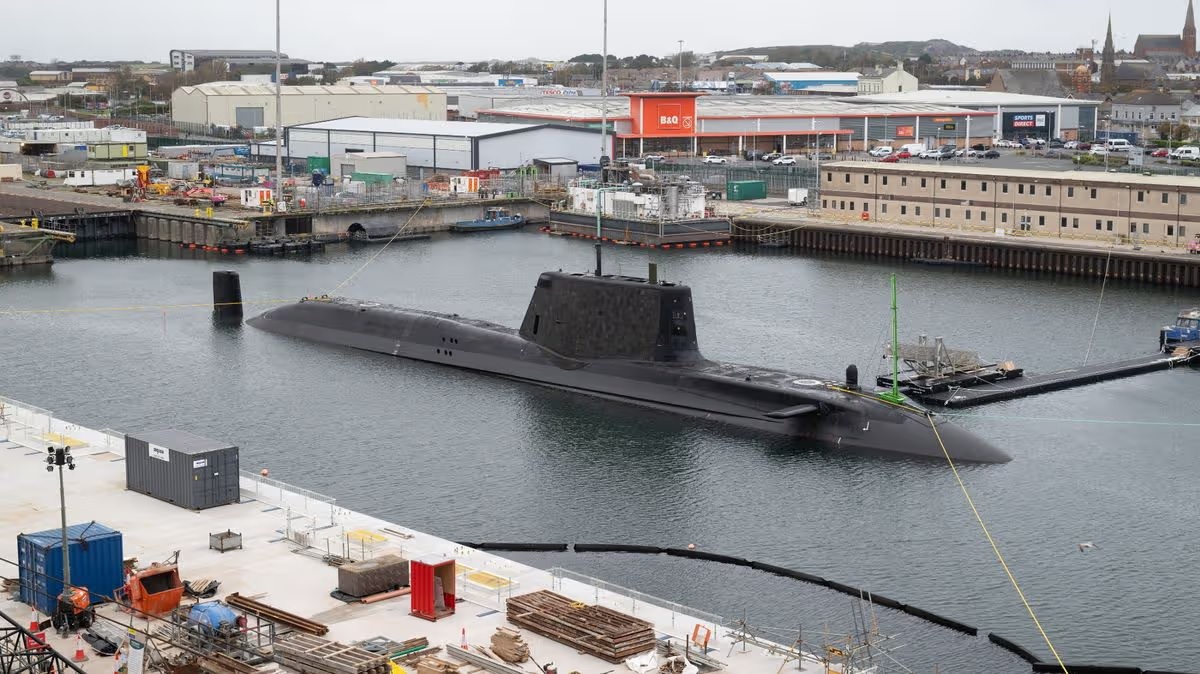
LONDON, — June 08, 2026 : The Royal Navy is currently facing a significant challenge in submarine readiness, with all five operational Astute-class nuclear-powered attack submarines undergoing maintenance, repairs, or dockyard work, leaving the United Kingdom without an active deployable attack submarine force for the time being.
The situation has raised concerns among defence analysts and former naval commanders, who have highlighted the importance of attack submarines in safeguarding British security interests and monitoring increasing underwater activity in the North Atlantic and waters surrounding the UK.
All Operational Astute-Class Submarines in Port
The Royal Navy's active Astute-class fleet consists of HMS Astute, HMS Ambush, HMS Artful, HMS Audacious, and HMS Anson. According to reports, all five vessels are currently unavailable for operations while undergoing scheduled maintenance, repairs, or engineering work.
As a result, the fleet's operational availability has temporarily fallen to zero percent, an unprecedented situation for Britain's attack submarine force.
A sixth submarine, HMS Agamemnon, was commissioned into the fleet last autumn but remains in the sea-trials and testing phase and is not yet ready for operational deployment. Meanwhile, the seventh and final Astute-class submarine, HMS Achilles, remains under construction at BAE Systems' Barrow-in-Furness shipyard and is expected to enter service later in 2026.
Critical Role in National Security
The Astute class represents the Royal Navy's most advanced attack submarine capability. Powered by nuclear reactors, the submarines are designed to conduct anti-submarine warfare, intelligence gathering, surveillance missions, land-attack operations, and maritime security tasks.
Each vessel measures approximately 97 metres in length, displaces around 7,400 tonnes submerged, and is equipped with advanced sonar systems, Spearfish heavyweight torpedoes, and Tomahawk land-attack cruise missiles.
Beyond combat missions, the submarines play a vital role in protecting the UK's strategic nuclear deterrent. Astute-class boats routinely support and escort the Vanguard-class ballistic missile submarines, which carry the nation's Trident nuclear missiles and maintain Britain's continuous at-sea nuclear deterrent.
Defence experts note that the absence of available attack submarines could leave these strategic assets more vulnerable and reduce the Royal Navy's ability to respond quickly to underwater threats.
Concerns Over Increased Russian Naval Activity
Former senior naval officers have warned that the current situation could affect Britain's ability to monitor and track Russian submarine operations in the North Atlantic.
Reports indicate that Russian naval activity around British waters has increased by roughly one-third over the past year, placing greater importance on underwater surveillance and deterrence missions carried out by attack submarines.
Several former commanders have argued that the lack of available hunter-killer submarines weakens Britain's ability to detect, shadow, and deter potential adversaries operating near UK waters and critical maritime routes.
Risks to Undersea Infrastructure
Military analysts have also highlighted the importance of attack submarines in protecting critical undersea infrastructure, including communications cables, internet networks, and energy systems.
The United Kingdom relies heavily on a vast network of subsea internet cables and energy connections, much of which lies on the seabed and remains vulnerable to interference, sabotage, or surveillance activities by hostile actors and deep-sea vehicles.
Attack submarines play an important role in monitoring these areas and contributing to broader maritime security efforts alongside surface warships and maritime patrol aircraft.
Infrastructure and Maintenance Challenges
The current maintenance backlog is not linked to a single technical issue but rather reflects broader industrial and infrastructure constraints that have developed over several years.
The Royal Navy and its industrial partners continue to face a shortage of skilled nuclear engineering personnel, while limited dockyard capacity has slowed maintenance schedules across the submarine fleet.
At His Majesty's Naval Base Clyde (HMNB Clyde) in Faslane, Scotland, a specialised submarine ship-lift system used to remove boats from the water for maintenance has reportedly been unavailable for more than a year.
At the same time, key facilities at HMNB Devonport, Britain's primary submarine maintenance centre, are undergoing major infrastructure upgrades, reducing the number of submarines that can be processed simultaneously for repairs and servicing.
Royal Navy Launches Recovery Plan
Recognising the seriousness of the maintenance bottleneck, First Sea Lord General Sir Gwyn Jenkins has launched the Submarine Maintenance Recovery Plan, an initiative aimed at improving fleet readiness and accelerating maintenance activities.
The programme seeks to streamline repair schedules, improve workforce availability, increase industrial efficiency, and return submarines to operational service as quickly as possible.
The Ministry of Defence (MoD) has declined to discuss the operational status of individual submarines, citing longstanding security policies regarding submarine deployments. However, officials maintain that British waters remain protected through a combination of surface warships, maritime patrol aircraft, surveillance systems, and NATO cooperation.
Broader Strategic Implications
The Royal Navy currently operates nine nuclear-powered submarines, including four Vanguard-class ballistic missile submarines and five active Astute-class attack submarines.
The situation comes as the United Kingdom continues its commitments under the AUKUS security partnership with Australia and the United States, which includes cooperation on future nuclear-powered submarine programmes.
While the Astute-class fleet remains one of the most capable submarine forces in Europe, the current availability gap highlights the challenges of sustaining a relatively small but highly sophisticated submarine fleet amid increasing operational demands and growing strategic competition.
Defence officials are now focused on restoring submarine availability and ensuring that maintenance reforms deliver long-term improvements to fleet readiness as HMS Agamemnon and HMS Achilles move closer to full operational service.
——— End of Article ———