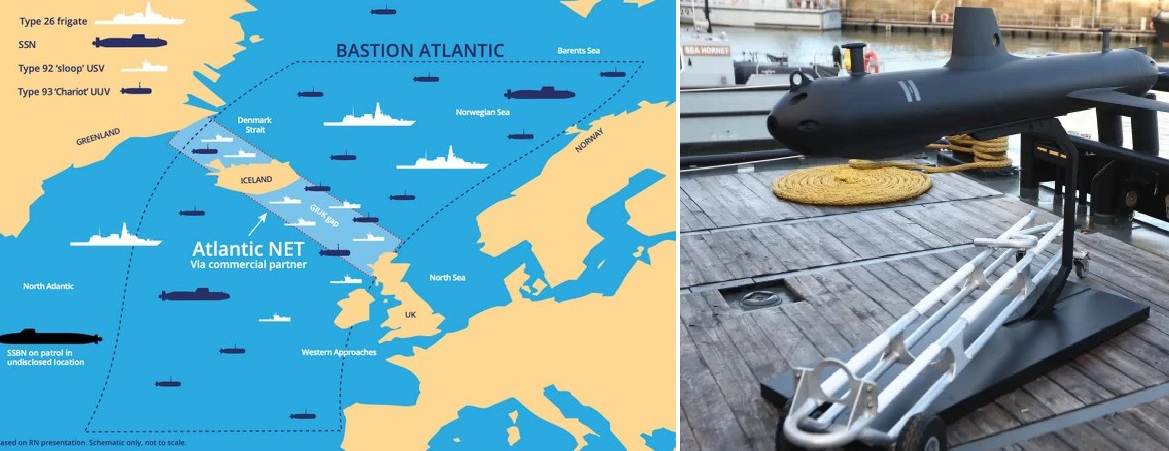
The UK Ministry of Defence has formally begun early work on Atlantic Bastion, an expansive undersea surveillance and targeting initiative unveiled during Defence Secretary John Healey’s visit to HM Naval Base Portsmouth on 8 December 2025. Framed by officials as a flagship outcome of the latest Strategic Defence Review, the programme marks one of the most ambitious transformations of British undersea defence since the Cold War, integrating Royal Navy warships, RAF P-8 Poseidon aircraft, and a new generation of autonomous vessels into a single AI-enabled detection and response web.
A Response to Rising Russian Activity Beneath the Waves
UK defence intelligence has repeatedly warned of a renewed surge in Russian submarine operations, with increased traffic through the GIUK gap—the vital Greenland-Iceland-UK chokepoint that guards NATO’s Atlantic access. Particularly concerning has been the presence of Russia’s specialist research and intelligence ship Yantar, observed multiple times near British seabed cables and offshore energy installations.
Nearly 97% of global digital communications flow through underwater fibre-optic cables, while offshore pipelines and wind farms have become critical to European energy security. British officials argue that these systems are now priority targets for Russian mapping missions and potential sabotage units. The Strategic Defence Review highlighted these vulnerabilities, pushing London to accelerate a modern, mobile successor to the Cold War SOSUS fixed listening arrays.
What Atlantic Bastion Will Look Like
Described by Healey and First Sea Lord General Sir Gwyn Jenkins as a “revolutionary underwater shield,” Atlantic Bastion will build a networked defence system stretching from the Mid-Atlantic Ridge to the Norwegian Sea. It will blend:
-
Crewed ships such as Type 26 frigates and Astute-class submarines
-
RAF P-8 Poseidon maritime patrol aircraft
-
New autonomous underwater vehicles (AUVs)
-
Fixed seabed sensing nodes
-
AI-driven acoustic processing and digital fusion
All assets—crewed or autonomous—will plug into a single digital targeting web, enabling continuous detection, classification, and tracking of hostile submarines or suspicious seabed activity.
Strategic Command’s digital infrastructure is being fused with Royal Navy and RAF systems, aiming to create a real-time, multi-domain operational picture that closes the gap between detection and engagement.
Industry’s Role: Building the Backbone of Atlantic Bastion
The MOD has already seeded more than £14 million into early-stage prototyping, matched by roughly four times as much private-sector investment. Twenty-six firms are participating, led by major defence primes:
BAE Systems – Herne XLAUV
The Herne Extra-Large Autonomous Underwater Vehicle—now a centrepiece of the Bastion architecture—offers multi-week endurance, deep-water operations, modular payload bays, and BAE’s Nautomate autonomy suite. Its missions include covert patrol, long-range sensing, and seabed surveillance.
Helsing – SG-1 “Fathom” Glider
Developed at Helsing’s Plymouth Resilience Factory, the Fathom glider is designed for three-month endurance, drifting silently or sitting on the seabed while its Lura AI analyses acoustic anomalies. The gliders can operate in swarms, creating persistent coverage in high-traffic corridors.
Anduril – Seabed Sentry
A network of fixed seabed sensor nodes, equipped with advanced sonar and integrated through the Lattice AI operating system, providing persistent “tripwires” along vulnerable cable and pipeline routes.
Additional partners such as Sonardyne, QinetiQ, Atlas Elektronik UK, and Northrop Grumman are contributing to underwater communications, acoustic processing, payload development, and multistatic detection technologies.
Reinventing Anti-Submarine Warfare
Atlantic Bastion aims to solve the toughest problem in modern naval warfare: maintaining contact with ultra-quiet submarines designed to hide in a noisy ocean.
New Russian nuclear and diesel-electric boats—such as the Yasen-M class—prioritise low broadband noise signatures and can evade traditional ship-based search patterns. The UK’s answer is persistent dwell time, achieved by:
-
Swarms of low-signature underwater gliders
-
Extra-large AUVs operating continuously
-
Fixed seabed listening grids
-
Multistatic sonar operations where one platform transmits and many listen
-
AI anomaly detection to find subtle disturbances
This creates a constantly refreshed acoustic picture, reducing the gaps adversaries exploit.
How Contact Will Be Handled
If a glider detects an anomaly near a cable route or transit corridor, that contact will be instantly uploaded to the digital network and seamlessly handed off to a crewed Royal Navy asset:
-
A Type 26 ASW frigate may move to localise the contact
-
An Astute-class submarine may shadow it covertly
-
A P-8 Poseidon may conduct wide-area verification
This layered approach allows high-end platforms to focus on engagement and deterrence while low-cost autonomous systems handle broad-area monitoring.
The same network will help protect infrastructure. If unusual activity appears near a wind farm or pipeline, unmanned systems can investigate without exposing high-value manned platforms.
NATO Integration and North Atlantic Strategy
Atlantic Bastion is designed to mesh with new UK-Norway agreements on undersea infrastructure protection and emerging NATO plans to rebuild an integrated barrier across the North Atlantic. Officials say the UK intends to reassert itself as NATO’s premier anti-submarine warfare navy, anchoring the alliance’s northern flank.
NATO commanders have privately welcomed the programme, viewing it as a model for integrating autonomy, AI, and manned platforms across the alliance.
Strategic and Industrial Implications
For the UK, the programme serves multiple national goals:
-
Closing undersea vulnerabilities exposed by Russian seabed mapping
-
Reinforcing NATO deterrence in the GIUK gap
-
Accelerating Britain’s maritime autonomy sector—a market worth over £200 billion
-
Creating new engineering and high-tech jobs across the UK
-
Boosting exports of British underwater drones and AI systems
However, success depends on the Royal Navy generating sufficient frigate and submarine availability, and the RAF providing regular P-8 coverage. Analysts warn that “data overload” will be a major challenge requiring strong AI governance and resilient communications networks.
A New Era of Undersea Deterrence
If fully realised, Atlantic Bastion will redefine how the UK—and NATO—operate beneath the waves. Instead of episodic searches, Britain will maintain continuous, AI-driven visibility over key Atlantic transit routes, infrastructure corridors, and maritime choke points.
Officials describe the strategy as a shift from “anti-submarine warfare” to “undersea domain control”—a concept likely to shape 21st-century maritime security.
Atlantic Bastion’s first operational elements are expected to enter the water next year, marking the start of a new chapter in Britain’s effort to stay ahead of Russian undersea competition.
——— End of Article ———