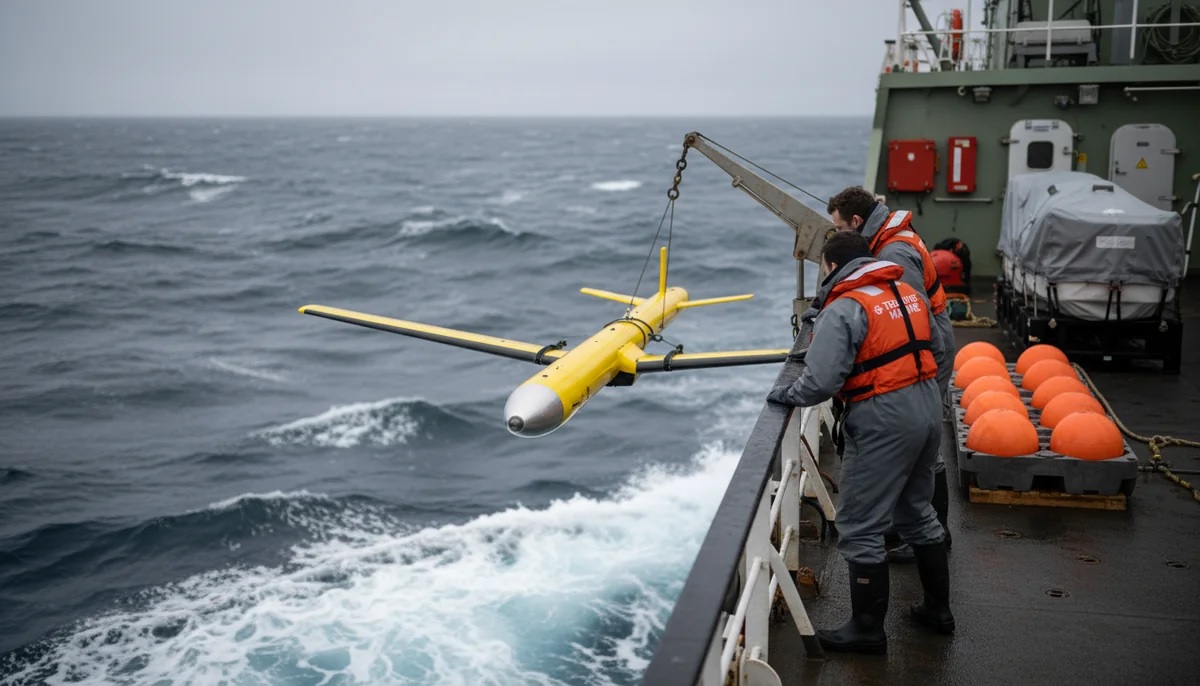
LONDON, — March 31, 2026 : The UK Ministry of Defence (MOD) has awarded a contract to Teledyne Marine, a division of Teledyne Technologies Incorporated, for the supply of autonomous oceanographic data collection systems to the Royal Navy. The procurement falls under the Future Maritime Data Gathering (FMDG) – Persistent Oceanographic Data Collect programme, aimed at strengthening the Navy’s long-endurance environmental monitoring and data-gathering capabilities.
Contract Scope and Value
The contract has been awarded to Teledyne Instruments Inc., operating as Teledyne Webb Research, through a direct-award process. It covers an initial two-year period from March 2026 to March 2028, with a base value of £8 million (including VAT). The agreement includes options to expand the total value to £12 million, with a potential extension of the programme timeline to 2030.
Under the terms of the contract, Teledyne will deliver up to 15 oceanographic gliders, including Sentinel and Slocum models, along with APEX floats and associated support services. These uncrewed systems are designed for long-endurance missions in remote and complex maritime environments, providing continuous subsurface data collection.
Technical Justification and Direct Award
The MOD justified the direct award based on technical compatibility and operational continuity requirements. Teledyne is the original equipment manufacturer (OEM) for the Royal Navy’s existing fleet of nine Slocum gliders and maintains proprietary design frameworks and integration protocols required to interface with the MOD’s underwater battlespace architecture.
According to the MOD, selecting an alternative supplier would require new safety certifications and system integration processes, potentially delaying operational deployment by 12 to 18 months. It would also introduce compatibility challenges with existing command-and-control systems and secure data exchange frameworks. Teledyne currently remains the only supplier with a verified safety case for Royal Navy glider operations.
Operational Role and Strategic Context
The systems acquired under the FMDG programme will be deployed to frontline Information Warfare Meteorological and Oceanographic (IW METOC) operators. The data collected will support maritime safety, operational planning, and broader defence activities by providing detailed environmental intelligence.
Commander Mark Butcher, the Royal Navy’s Capability Sponsor, stated that the investment supports the First Sea Lord’s Hybrid Navy strategy and enhances the service’s ability to operate in contested maritime environments, particularly in the North Atlantic. He noted that persistent oceanographic data improves understanding of the underwater battlespace and enables tactical exploitation of environmental conditions, contributing to operational and informational advantages.
The programme also directly supports the Royal Navy’s Atlantic Bastion strategy, which focuses on maintaining strategic awareness and operational readiness in the North Atlantic region.
Existing Systems and Support Infrastructure
The Royal Navy has operated Teledyne Slocum gliders since 2015 as part of its oceanographic and environmental monitoring framework. In addition to the new contract, Teledyne has secured In-Service Support (ISS) agreements covering Slocum gliders, APEX floats, and Gavia Autonomous Underwater Vehicles (AUVs).
These agreements provide maintenance, repair, and operational support to multiple Royal Navy units, including the Plymouth-based METOC Information Warfare Group, the Hydrographic Exploitation Group, and the Portsmouth-based Mine Threat Exploitation Group.
To support the expanding fleet, Teledyne has increased its UK-based infrastructure. The company has established a repair and support facility in Fareham, co-located with Raymarine, and is preparing to open an additional facility in Plymouth in the first quarter of 2026. The Plymouth site will support operations at His Majesty’s Naval Base Devonport and facilitate engagement with the National Centre for Marine Autonomy.
Teledyne employs approximately 2,700 personnel across 18 principal sites in the United Kingdom, supporting both defence and commercial operations.
Global Deployment and Industry Position
Teledyne’s autonomous ocean systems are widely used by naval, scientific, and commercial organisations worldwide. The company has delivered more than 12,000 APEX floats and nearly 1,300 Slocum gliders to date, with over 600 systems currently in service with NATO naval users.
In addition, Teledyne’s Gavia AUV platforms have been procured by 18 navies globally and remain operational across multiple NATO and AUKUS member states. The company’s systems are designed to operate in demanding conditions and support a range of missions, including environmental monitoring, underwater surveillance, and maritime domain awareness.
Industry and Official Statements
George Bobb, President and CEO of Teledyne, stated that the contract reflects continued confidence in the company’s autonomous underwater technologies and its long-standing partnership with the Royal Navy. He said the company remains focused on delivering mission-ready systems capable of generating high-quality ocean data for defence applications.
The MOD indicated that the FMDG programme builds on more than a decade of operational experience with Teledyne systems and reflects the increasing role of uncrewed technologies in modern naval operations.
——— End of Article ———