LONDON — March 14, 2026 : The United Kingdom has awarded a £53 million contract for the production of 37 artillery weapon assemblies for the British Army’s future RCH 155 Remote Controlled Howitzer systems, forming a key step in the long-term replacement of AS90 self-propelled howitzers previously transferred to Ukraine.
The contract was placed by the Organisation for Joint Armament Cooperation (OCCAR) on behalf of the UK Ministry of Defence and awarded to ARTEC GmbH, the joint venture responsible for the Boxer armored vehicle program. The agreement focuses on the long-lead manufacturing of critical components for the RCH 155’s artillery gun module.
Contract Scope and Weapon System Components
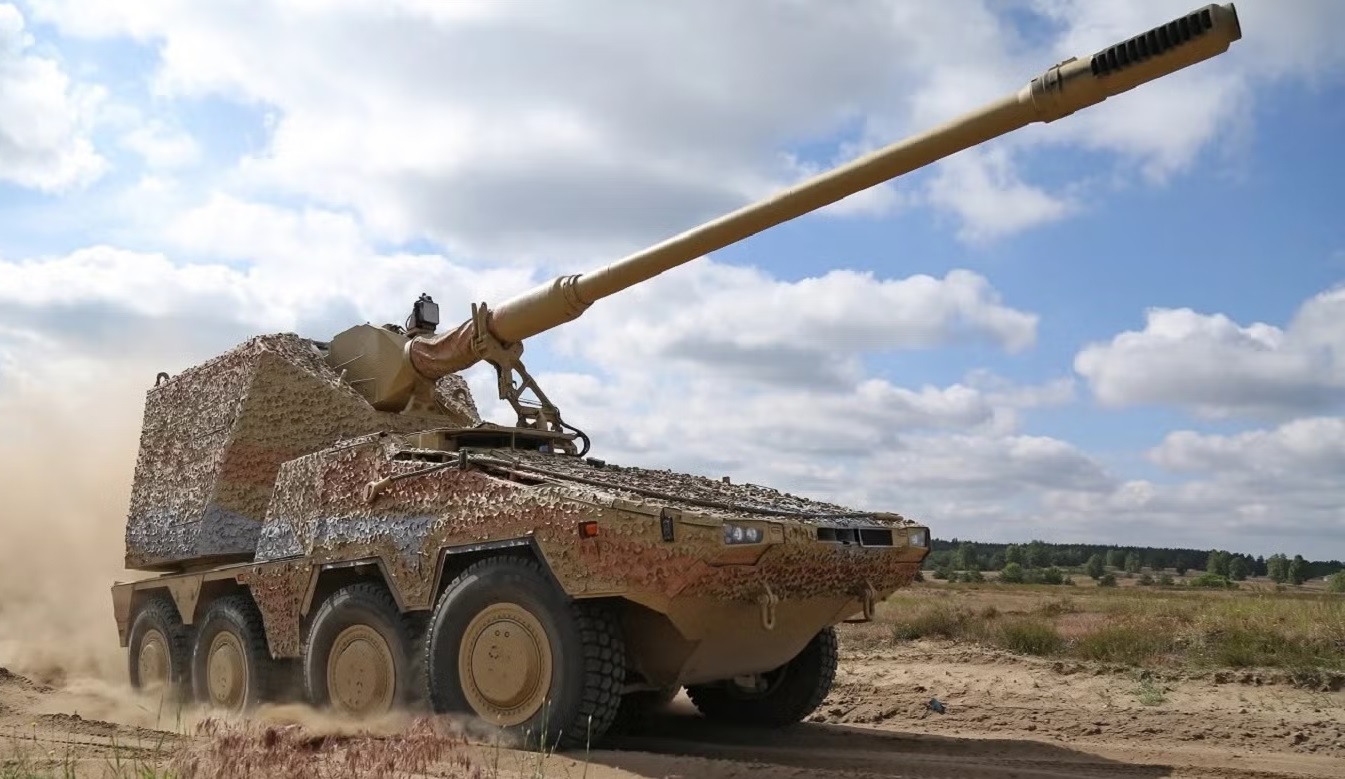
The £53 million contract covers the production of 37 core artillery weapon assemblies, which include several major elements of the RCH 155’s main gun system. These components consist of the artillery barrel, muzzle brake, breech mechanism, recoil system, and gun trunnions used to mount the weapon within the turret structure.
These assemblies will form the core of the unmanned Artillery Gun Module (AGM) integrated into the RCH 155 platform. The system is designed to deliver modernized indirect fire capabilities for the British Army as part of the Mobile Fires Platform (MFP) program.
The RCH 155 combines the drive module of the Boxer 8×8 armored vehicle with an automated artillery turret equipped with a 155 mm L/52 gun. The system is designed to fire up to eight rounds per minute and can reach strike distances of up to 70 kilometers depending on the ammunition used.
Unlike conventional tracked self-propelled artillery systems, the RCH 155 is a wheeled platform capable of traveling at speeds up to 100 kilometers per hour. It can also fire while moving at low speeds, a capability intended to improve survivability against counter-battery detection and enemy artillery responses.
The vehicle operates with a reduced crew of two personnel, with most functions automated through the unmanned artillery module.
Replacement for AS90 Systems Donated to Ukraine
The procurement of the RCH 155 forms part of the British Army’s broader modernization of its artillery capabilities. The program was accelerated after the UK transferred its AS90 self-propelled artillery systems to Ukraine to support Kyiv’s defense operations.
Following the transfer of the AS90 fleet, the British Army introduced a temporary capability bridge by acquiring 14 Archer wheeled artillery systems from Sweden. These Archer systems currently serve as the Army’s interim long-range artillery capability until the RCH 155 platform enters service.
Early Demonstrator Vehicles and Development Timeline
The current contract builds upon a previous £52 million agreement signed in December 2025 covering three RCH 155 Early Capability Demonstrator vehicles.
These demonstrator systems will be used for joint testing, evaluation, and operational assessment by the United Kingdom and Germany under the Trinity House Agreement, a bilateral defense cooperation framework signed in October 2024.
According to current planning, the British Army intends to field its first RCH 155 artillery demonstrator by 2028. The system will undergo testing and validation before decisions are made regarding full-scale production and wider procurement for operational units.
Domestic Industrial Investment and Gun Barrel Manufacturing
A major portion of the contract will support the expansion of domestic defense manufacturing capacity in the United Kingdom.
Approximately £30 million of the contract value will be invested in developing Rheinmetall’s large-caliber barrel production facility in Telford, England, known as the Gun Hall. The site will manufacture artillery and tank barrels using British steel and advanced production technologies.
The Gun Hall facility is scheduled to begin production in 2027 and will manufacture gun barrels for systems including the RCH 155 artillery platform and the Challenger 3 main battle tank.
The project is expected to create around 100 highly skilled manufacturing jobs in Telford and support additional employment across the wider UK defense supply chain.
The establishment of this facility will also restore the United Kingdom’s sovereign capability to manufacture large-caliber gun barrels, a capability that had been lost in 2016.
Additional Artillery Production Capacity
In parallel with the RCH 155 program, the UK Ministry of Defence is working to re-establish further artillery production capabilities within the country.
Plans are underway to resume manufacturing of 155 mm and 105 mm artillery barrels at the Sheffield Forgemasters facility. Initial production will support existing systems including the AS90 self-propelled howitzer and the L119 towed light gun.
These initiatives are intended to strengthen the UK’s domestic defense industrial base while supporting long-term artillery modernization.
UK–Germany Production Arrangement
The RCH 155 program also reflects a division of industrial responsibilities between the United Kingdom and Germany.
Under the production framework, the UK will manufacture the Boxer armored vehicle chassis locally, with production already underway for other British Army Boxer variants. The UK will also produce artillery gun barrels through the Telford facility.
Germany will manufacture the unmanned Artillery Gun Module, which integrates the 155 mm L/52 gun and automated firing system.
The cooperative production structure is designed to support shared development, testing, and cost efficiencies while strengthening European defense industrial collaboration.
Mobile Fires Platform Modernization Program
The RCH 155 forms the centerpiece of the British Army’s Mobile Fires Platform (MFP) initiative, which aims to replace aging artillery systems and deliver a modernized long-range indirect fire capability.
The program focuses on wheeled artillery platforms capable of rapid deployment, improved automation, and extended firing range compared to previous systems.
Once fully developed and approved for production, the RCH 155 is expected to become the British Army’s primary self-propelled artillery platform for long-range ground fire support operations.
——— End of Article ———