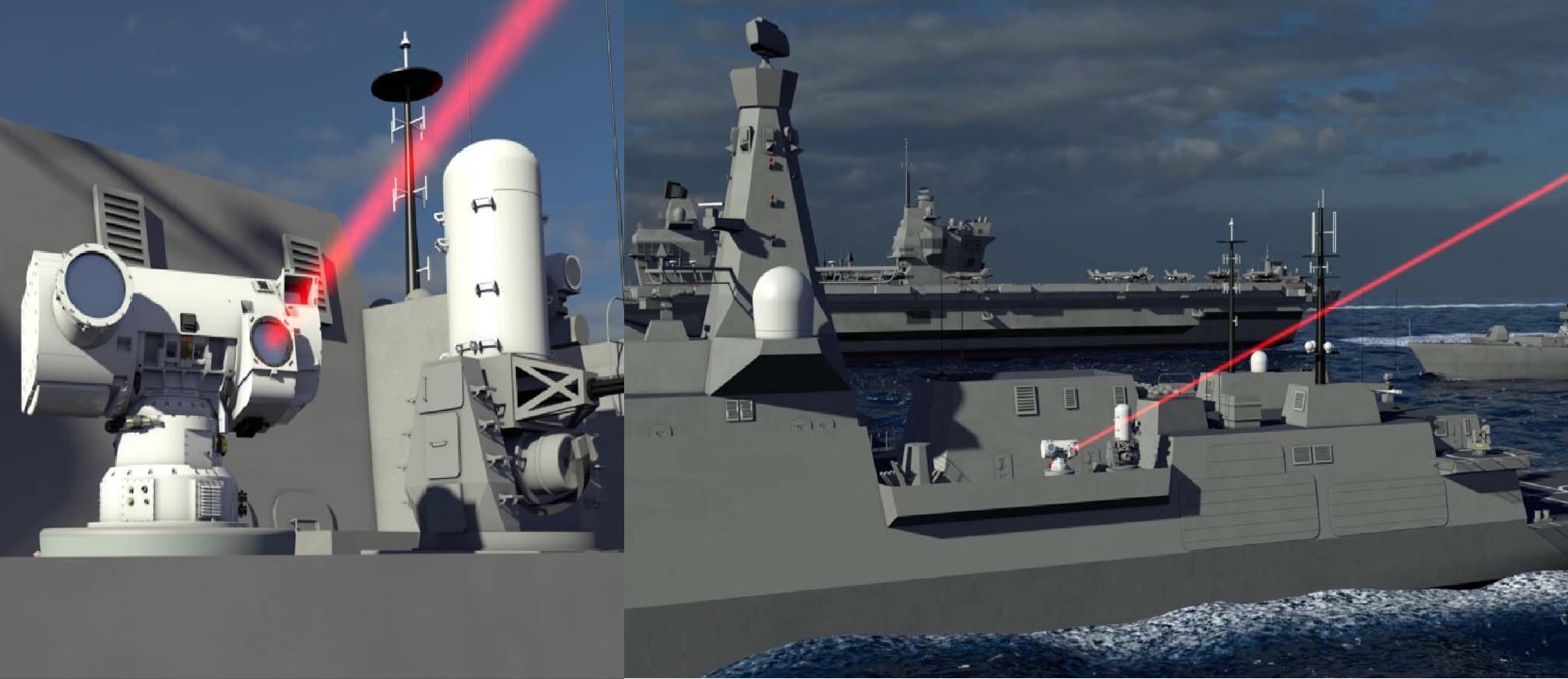
The United Kingdom has taken a major step toward deploying laser weapons at sea, confirming that its DragonFire high-energy laser system successfully destroyed high-speed drones during trials at the Hebrides range and will now enter full production. The announcement, made by the Ministry of Defence, marks Britain's transition from experimental directed-energy technology to front-line naval capability.
The decision comes amid a dramatic rise in drone attacks worldwide — from the Middle East to the Black Sea — and growing concern that traditional missile-based air defence systems are too costly to sustain against mass, low-cost threats. For the Royal Navy, the DragonFire system represents a new defensive tool that can counter drones and missiles at just a few pounds per shot, a fraction of the cost of firing conventional interceptors.
From Trials to Deployment: A Breakthrough Moment
During the latest test campaign at the MoD’s Hebrides range, DragonFire proved it could track and destroy fast-moving aerial targets, including drones travelling at speeds up to 650 km/h. Engineers described the performance as the most advanced British laser intercept yet, with the beam demonstrating precision equivalent to “hitting a £1 coin from a kilometre away.”
Following those results, the MoD awarded a £316 million production contract to MBDA UK, supported by Leonardo UK and QinetiQ. The funding will deliver ship-fitted DragonFire systems starting in 2027, initially planned for Royal Navy destroyers.
What DragonFire Can Do: Specifications and Capabilities
Although many details remain classified, open-source information and MoD releases outline the system’s key features:
-
Power Class: Approximately 50 kW, with scalable architecture for higher power in future variants.
-
Technology: British-developed coherent beam-combining, merging multiple laser beams into one powerful, stable output.
-
Engagement Type: Line-of-sight weapon engaging drones, missiles, UAV swarms, and potentially small surface targets.
-
Speed: Engagement at the speed of light, providing near-instant response to incoming threats.
-
Cost per shot: Estimated at £10 or less, compared to hundreds of thousands for a modern missile.
-
Accuracy: MoD claims precision equal to a “£1 coin at 1 km.”
-
Sensors: Integrated radar cueing with advanced electro-optical and infrared tracking.
These specifications place DragonFire among the most advanced operational laser systems developed by any Western nation.
How the Royal Navy Will Benefit
For the Royal Navy, DragonFire is expected to transform close-in defence:
-
Cost-effective defence against drone swarms: Recent conflicts have shown how inexpensive drones can overwhelm expensive missile systems. A laser’s low cost per shot gives ships a new way to deal with mass attacks.
-
Infinite magazine — powered, not stored: Laser weapons don’t run out of ammunition; they rely on the ship’s power. This gives commanders sustained defensive capability during prolonged engagements.
-
Protection for scarce missile stockpiles: Saving interceptors like Sea Ceptor or Aster 30 for advanced threats strengthens the fleet’s overall resilience.
-
A new layer in multi-tier naval air defence: DragonFire is not a replacement for missiles but an additional shield — one specifically designed for low-cost, fast, low-altitude threats.
The Royal Navy aims to install the system on Type 45 destroyers first, with future plans pointing toward integration on Type 26 and next-generation vessels.
Are Other Navies Using Laser Weapons?
Several navies have experimented with laser systems, including the U.S. Navy, Israeli Navy, and reportedly China. However, very few have moved into full production and deployment planning. The UK’s DragonFire contract is widely viewed as one of the first major commitments to install high-energy lasers on combat ships as an official capability, not an experiment.
This makes the Royal Navy one of the earliest adopters of operational maritime laser defence.
Is This the First Order for MBDA UK?
Yes. This is the first large-scale production order for MBDA’s DragonFire system, following nearly a decade of joint research with QinetiQ and Leonardo. The contract is expected to sustain 600 high-skill jobs across the country and accelerate the UK’s domestic directed-energy technology base.
Work on More Powerful Variants Already Underway
Industry officials say DragonFire has been designed with a modular, upgrade-friendly architecture, making it far easier to scale up in the coming years. They note that work is already underway on more powerful 100 kW-class versions, along with better cooling systems and enhanced tracking technology capable of engaging faster, longer-range missile threats. Engineers are also exploring land-based and airborne variants, which would expand the weapon’s role beyond the Royal Navy. In the long term, they believe that higher-power DragonFire models could eventually take on cruise missiles and even supersonic targets — missions that today’s laser weapons are only beginning to approach.
A Turning Point in Naval Defence
The UK’s decision to move DragonFire into production marks a significant shift in Western naval strategy. With global drone warfare escalating and missile stocks stretched thin, London’s bet on directed-energy weapons is seen as both practical and forward-looking.
By 2027, Royal Navy ships could become among the world’s first to sail with a combat-ready, ship-mounted laser — a development that promises to reshape naval defence for the next generation.
As drone warfare evolves, the DragonFire system positions Britain at the forefront of an emerging class of weapons that could eventually become as common at sea as missiles are today.
——— End of Article ———