ABU DHABI — March 5, 2026 : The United Arab Emirates Armed Forces confirmed that national air defense systems intercepted and destroyed multiple Iranian missiles and drones targeting the country during coordinated attacks in early March 2026. Emirati officials stated that the majority of incoming projectiles were neutralized before reaching their intended targets, which included energy infrastructure, military facilities, and populated areas.
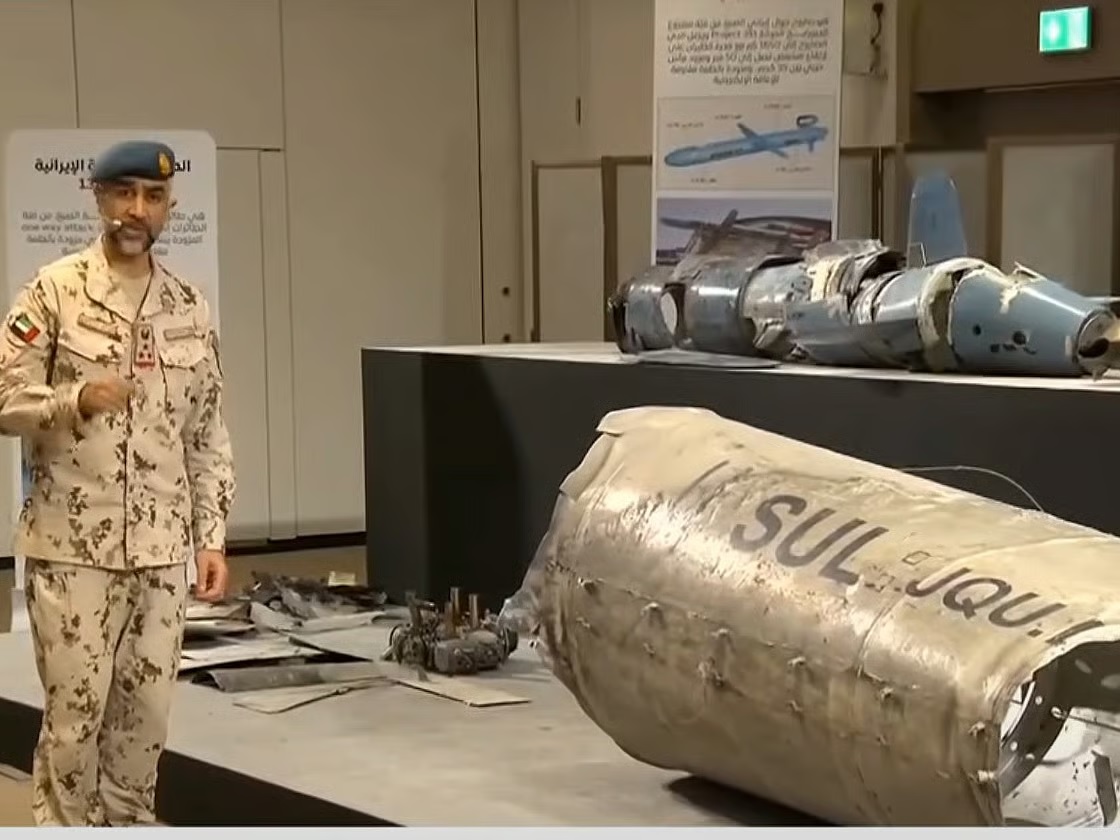
The UAE Ministry of Defence disclosed the details during a press briefing held in Abu Dhabi on March 3, 2026. Brigadier General Staff Pilot Abdulnasser Al Humaidi, the ministry’s official spokesperson, presented operational updates and displayed remnants of intercepted Iranian weapons, including fragments identified as parts of a Qiam ballistic missile, a Paveh (Bafeh) cruise missile, and several unmanned aerial systems from the Shahed drone family, including the Shahed-136, Shahed-107, and Shahed-238.
Officials stated that early detection by the country’s integrated air defense network allowed interceptor systems to activate within seconds of identifying the incoming threats. According to the ministry, most projectiles were destroyed in flight before they could reach their designated targets.
Scale of the Missile and Drone Attacks
According to data released by the UAE Ministry of Defence, Iranian strikes against Emirati territory began on February 28, 2026, as part of a broader regional escalation linked to military operations involving Iran, the United States, and Israel.
Between February 28 and March 3, the UAE detected the following aerial threats:
-
186 ballistic missiles detected
-
812 drones detected
-
8 cruise missiles detected
Air defense systems intercepted the majority of these projectiles:
-
172 ballistic missiles intercepted
-
13 ballistic missiles fell into the sea
-
1 ballistic missile impacted Emirati territory
For drone attacks:
-
755 drones intercepted
-
57 drones impacted within the UAE
All 8 cruise missiles were reported destroyed before reaching their targets.
Additional operational updates released by the ministry indicated that interception operations continued on March 4, 2026, when air defenses detected 3 ballistic missiles and 129 drones. Of these, 121 drones were intercepted, while 8 drones fell within Emirati territory.
Cumulative operational figures cited in subsequent briefings indicated:
-
189 ballistic missiles detected
-
175 ballistic missiles intercepted
-
941 drones detected
-
876 drones intercepted
-
8 cruise missiles intercepted and destroyed
Officials stated that over 90 percent of incoming aerial threats were neutralized, with air defense systems maintaining continuous operational readiness throughout the attacks.
The UAE Ministry of Foreign Affairs condemned the strikes as violations of the country’s sovereignty and reaffirmed the UAE’s right to self-defense under international law. Emirati officials also reiterated that the UAE had not participated in military operations against Iran and described its posture as strictly defensive.
Iranian Weapons Identified in the Attack
Fragments presented during the March 3 briefing indicated that several types of Iranian weapons were involved in the attacks.
One of the principal ballistic threats was the Qiam-1 short-range ballistic missile, an Iranian system first publicly revealed around 2010. The missile is derived from the Shahab-2, which itself originates from the Soviet Scud missile family.
Technical characteristics of the Qiam-1 include:
-
Length: approximately 11.5 meters
-
Launch weight: around 6 metric tons
-
Propulsion: single-stage liquid-fueled rocket engine
-
Warhead payload: up to 750 kilograms
-
Range: approximately 700–800 kilometers, enabling strikes across much of the Arabian Gulf from Iranian territory
Unlike earlier Scud variants, the Qiam features a finless base design, which improves aerodynamic performance and may reduce radar detectability. Some versions are also believed to incorporate separable warheads during the terminal phase of flight, a modification intended to complicate interception attempts.
The missile uses inertial navigation guidance, and later variants reportedly include improved guidance packages with an estimated circular error probable (CEP) between 100 and 500 meters.
Ballistic missiles such as the Qiam reach terminal velocities of several kilometers per second, requiring defensive systems to rapidly calculate interception points within a limited engagement window.
In addition to ballistic missiles, debris recovered from the attacks confirmed the use of Shahed-series drones, including the Shahed-136 loitering munition, as well as the Shahed-107 and Shahed-238 variants. Officials also displayed fragments of a Paveh cruise missile, indicating that cruise missile capabilities were also employed during the attacks.
UAE Integrated Air and Missile Defense System
The successful interceptions were attributed to the UAE’s multi-layered air and missile defense architecture, which integrates systems developed in the United States, Europe, Israel, Russia, and the UAE’s domestic defense industry.
Upper-Tier Defense
The Terminal High Altitude Area Defense (THAAD) system forms the highest defensive layer. The UAE became the first foreign country to deploy THAAD following a procurement agreement valued at approximately $3.5 billion.
THAAD is designed to intercept short- and medium-range ballistic missiles in the terminal phase of flight at altitudes exceeding 150 kilometers. The system uses hit-to-kill kinetic interceptors, destroying incoming warheads through direct collision rather than explosive warheads.
Mid-Tier Defense
Below THAAD, the MIM-104 Patriot system, particularly configurations equipped with PAC-3 interceptors, engages ballistic missiles that penetrate the upper layer. Patriot systems can also intercept cruise missiles and aircraft, providing a critical mid-range defense capability.
Medium-Range Layer
The UAE also operates the Barak-8 surface-to-air missile system, developed jointly by Israel Aerospace Industries and India. This system is capable of intercepting cruise missiles, aircraft, and anti-ship missiles at ranges exceeding 70 kilometers.
Short-Range Defense
Close-range protection against drones and low-flying threats is provided by the Pantsir-S1 system, which combines 30-millimeter cannons with short-range surface-to-air missiles to engage helicopters, drones, and other low-altitude targets.
The UAE also deploys SkyKnight, a domestically developed interceptor produced by EDGE Group in cooperation with international partners. SkyKnight is designed to protect critical facilities from rockets, artillery shells, and unmanned aerial systems.
Integrated Command and Control Network
All air defense layers are connected through a centralized command-and-control network that integrates radar sensors, command centers, and interceptor launch systems. This architecture allows simultaneous detection, tracking, and engagement of multiple aerial threats.
Officials stated that this integration enabled rapid identification of the March attacks and coordinated engagement across several defensive tiers.
Limited Damage and Casualties
Despite the large number of incoming projectiles, Emirati authorities reported limited physical damage to national infrastructure.
Some debris and a small number of projectiles landed in populated areas of Abu Dhabi and Dubai, resulting in three reported fatalities — individuals identified as Pakistani, Nepali, and Bangladeshi nationals — along with dozens of minor injuries.
Government officials stated that the incidents were largely caused by falling debris or limited impacts from projectiles that penetrated defenses. No major disruptions were reported at energy facilities, transportation hubs, or military installations.
Regional Context
The missile and drone strikes occurred amid a broader regional escalation following U.S. and Israeli strikes on Iranian territory beginning February 28, 2026.
Emirati authorities emphasized that the UAE has not participated in offensive operations against Iran and reiterated their support for diplomatic solutions to regional tensions.
Defense officials stated that the events highlight the increasing role of ballistic missiles, cruise missiles, and unmanned aerial systems in modern conflicts and the importance of integrated air defense networks in protecting national infrastructure and civilian populations.
——— End of Article ———