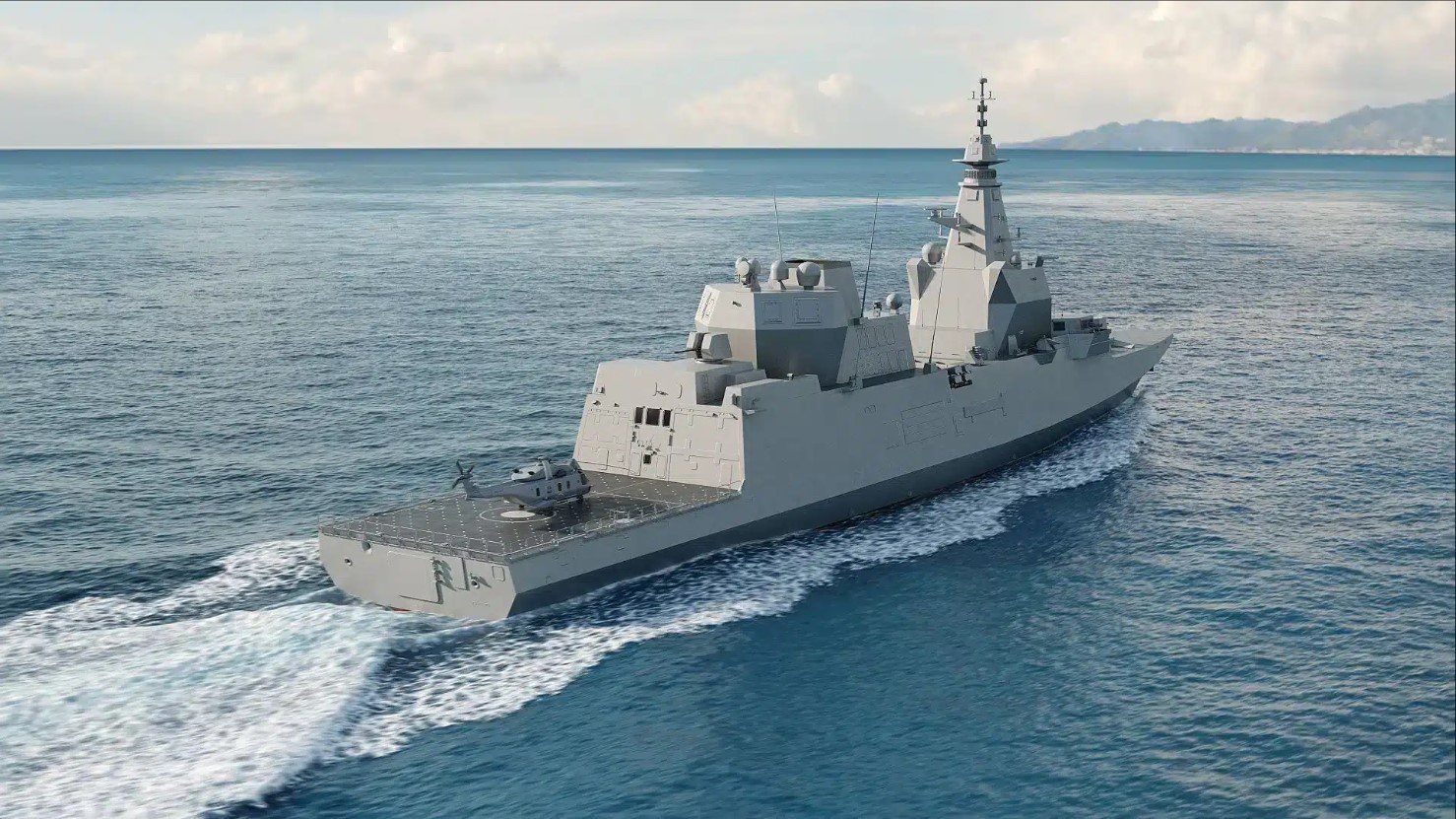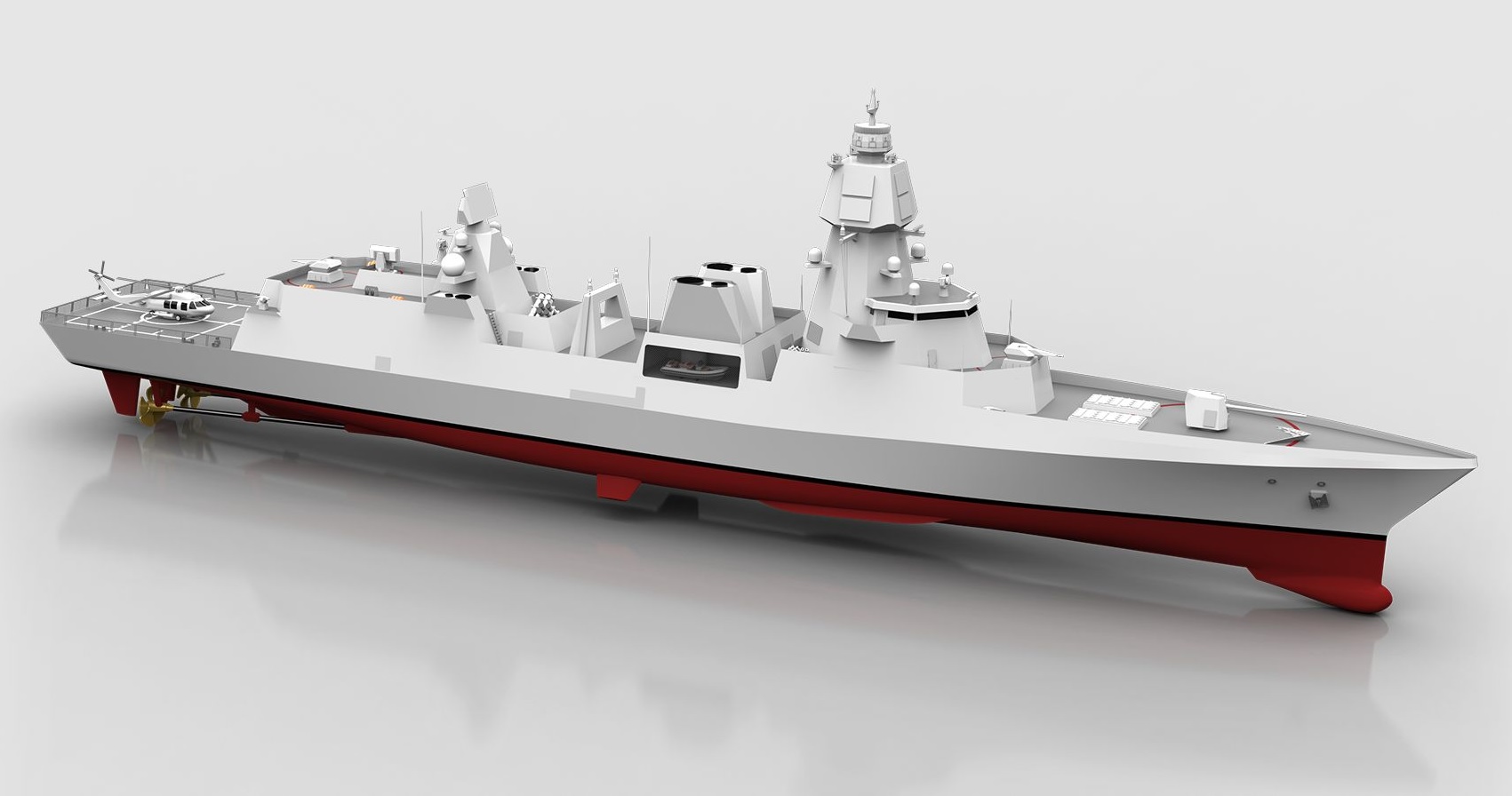
ISTANBUL — March 5, 2026 : Turkish naval engineering and design firm Kuasar Marin Engineering Inc. has released official specifications and technical details for its new KM-F148 air defense frigate, a 148-meter warship concept developed for fleet-level area air defense missions.
The platform is designed to operate in the capability range between lighter multi-role frigates and heavily armed guided-missile destroyers, offering a high-capacity air defense capability within a mid-size displacement class intended for international naval procurement programs.
Platform Design and Crew Configuration
According to design data released by Kuasar Marin, the KM-F148 has an overall length of 148 meters, a beam of 18.25 meters, and a baseline displacement of approximately 5,500 tons.
The vessel’s internal layout is configured to accommodate 229 personnel, consisting of 35 officers, 108 petty officers, and 86 ratings. The crew structure is intended to support sustained fleet operations including command coordination, air defense management, and aviation activities.
The ship’s hull incorporates stealth-optimized shaping designed to reduce radar cross-section and improve survivability in contested environments.
Propulsion and Performance
The KM-F148 employs a Combined Diesel and Gas (CODAG) propulsion system integrating both gas turbines and diesel engines.
The propulsion configuration includes:
-
Two 23,500-kilowatt gas turbines
-
Two 4,300-kilowatt diesel engines
-
Controllable pitch propellers
This arrangement allows the ship to balance high-speed maneuverability with fuel-efficient cruising operations.
According to the manufacturer’s specifications, the propulsion system provides:
-
Maximum speed: 30 knots
-
Cruising speed: 18 knots
-
Operational range: 5,000 nautical miles at cruising speed
Electrical power for onboard systems is supplied by four auxiliary generators rated at 1,800 kilowatts each.
Armament Configuration and Combat Role
The frigate is primarily designed as an area air defense platform capable of protecting naval task groups against aerial threats including aircraft, cruise missiles, and drones.
The central air defense system is based on two 24-cell vertical launch systems, providing a total of 48 vertical launch cells for surface-to-air missiles.
This missile capability forms the outer layer of a multi-tiered defensive system supported by:
-
A point-defense missile system
-
Two Close-In Weapon Systems (CIWS) for terminal interception
For surface warfare, the KM-F148 includes:
-
Eight anti-ship missiles, installed in two launchers carrying four missiles each
-
A single 127-millimeter naval gun mounted on the bow for naval gunfire support and surface engagements
-
Four stabilized 12.7-millimeter machine guns for close-range defensive operations
Sub-surface warfare capabilities are addressed through torpedo launchers and a hull-mounted sonar system designed for underwater threat detection.
Sensor and Radar Systems
The KM-F148’s combat management architecture integrates multiple radar and sensor technologies to support its air defense mission.
The sensor suite outlined in the design documentation includes:
-
A three-dimensional air search radar
-
Active Electronically Scanned Array (AESA) illuminating and tracking radars
-
A fire control radar
-
A navigation radar
-
Low Probability of Intercept (LPI) radar systems
These systems are designed to provide long-range detection, target tracking, and missile guidance capabilities while reducing the likelihood of detection by adversary electronic surveillance systems.
The vessel also incorporates a hull-mounted sonar to enhance anti-submarine detection and situational awareness.
Aviation and Boat Operations
The frigate includes an aviation facility designed to support both manned and unmanned aircraft operations.
The stern section features a flight deck rated for a 10-ton helicopter, while the superstructure houses a combined hangar capable of accommodating both helicopters and unmanned aerial vehicles (UAVs).
An automated helicopter handling and transfer system is integrated to assist with aircraft movement between the hangar and flight deck.
For maritime security and boarding operations, the design also includes two rigid-hulled inflatable boats (RHIBs).
These aviation and boat facilities are intended to support extended fleet protection, reconnaissance, and operational endurance.
Industrial Collaboration in Turkey
The introduction of the KM-F148 coincides with expanded industrial partnerships within the Turkish naval sector.
In September 2025, Kuasar Marin signed a strategic cooperation agreement with Turkish shipbuilder RMK Marine Inc..
The partnership aims to combine RMK Marine’s shipbuilding infrastructure and manufacturing standards with Kuasar Marin’s naval design expertise.
During the announcement of the collaboration, RMK Marine General Manager Dr. Utku Alanç stated that the agreement is structured to support joint business development and naval export opportunities.
The arrangement allows Kuasar Marin’s design concepts to be paired with RMK Marine’s production facilities and shipyard capabilities.
Expansion into the United Kingdom
As part of its international growth strategy, the company established Kuasar UK Ltd. in January 2025 in Glasgow, United Kingdom.
The British branch focuses on naval, offshore, and commercial marine engineering activities and is intended to strengthen the firm’s integration with Western maritime markets.
Kuasar UK draws on more than 25 years of experience from its Turkish founders and operates in coordination with the parent company through a collaboration framework for naval architecture and ship design.
In September 2025, the UK subsidiary joined the maritime research and innovation network MarRI‑UK, enabling participation in collaborative maritime research and development initiatives.
Position in the Global Frigate Market
The KM-F148 is positioned within the 5,000- to 6,000-ton frigate segment, a category widely used by modern navies seeking balanced multi-mission warships.
This market currently includes several established designs such as:
-
FREMM‑class frigate developed by Fincantieri and Naval Group
-
F‑110 frigate produced by Navantia
-
Mogami‑class frigate operated by the Japan Maritime Self‑Defense Force
By integrating 48 vertical launch missile cells within a 5,500-ton platform, Kuasar Marin’s concept targets navies seeking higher air defense capacity than typical general-purpose frigates while remaining smaller than destroyer-class vessels.
Company Background
Kuasar Marin, headquartered in Istanbul, Turkey, specializes in naval ship design and marine engineering.
The company’s portfolio includes design concepts for frigates, fast attack craft, and naval support vessels, with a focus on export-oriented naval platforms.
The KM-F148 air defense frigate represents one of the firm’s latest design offerings within the air defense domain and reflects broader developments within Turkey’s expanding defense shipbuilding sector.
——— End of Article ———