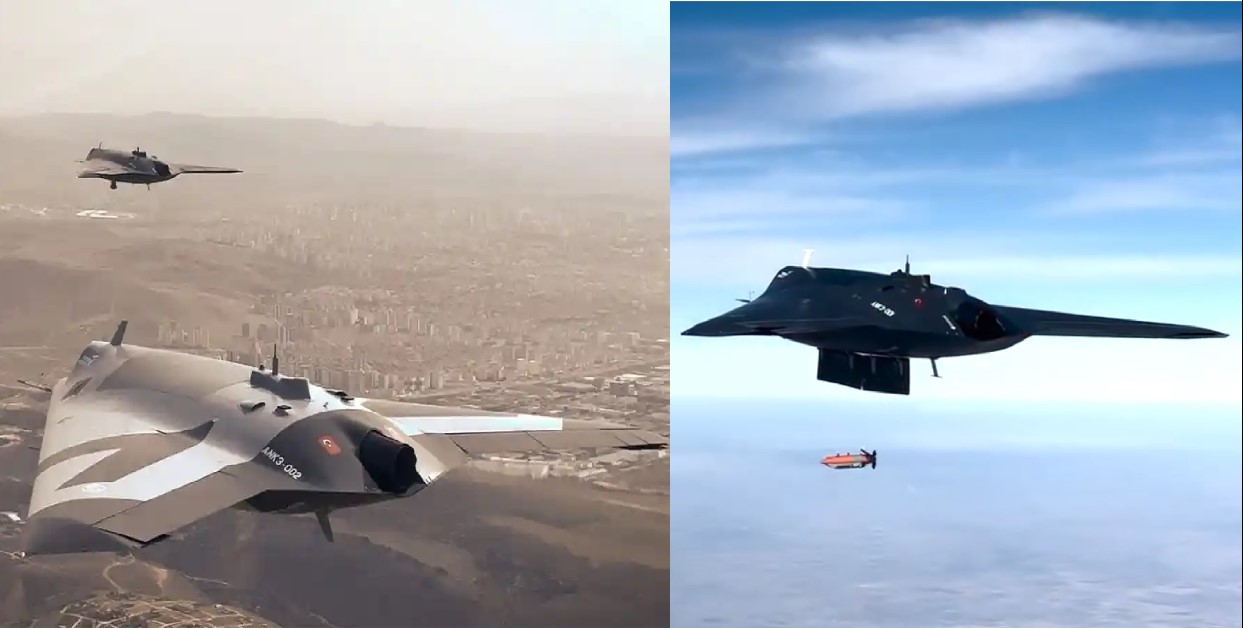
ANKARA : Turkish Aerospace Industries (TAI) has moved its next-generation stealth unmanned combat aircraft into the production phase after finalizing its design, marking a significant acceleration in Türkiye’s indigenous airpower ambitions.
TAI Chief Executive Officer Mehmet Demiroğlu confirmed that the ANKA-3 unmanned combat aerial vehicle (UCAV) has successfully completed its Critical Design Review (CDR), formally freezing the aircraft’s configuration and clearing the path for serial manufacturing. Speaking in an interview with SAHA Istanbul, Demiroğlu said production work has already begun, with the Turkish Air Force expected to place an order exceeding 50 aircraft within the year.
Design Frozen, Serial Production Begins
According to Demiroğlu, the ANKA-3’s final form was determined after extensive evaluation of data collected from two flying prototypes. Design refinements derived from real-world flight testing have now been fully incorporated into the production configuration.
“We finalized the critical design review phase two months ago and froze the design. We started production,” Demiroğlu said, emphasizing that feedback from flight tests played a decisive role in shaping the aircraft’s final structure.
Two additional prototypes reflecting the finalized configuration are scheduled to be built in 2026, while serial production activities will continue in parallel, allowing TAI to shorten the transition from development to operational deployment.
Automotive-Style Manufacturing Model
TAI plans to adopt automotive-industry production methods for the ANKA-3 program, aiming to reduce unit costs and increase manufacturing speed. Demiroğlu said this approach is intended to support higher production volumes while maintaining consistency and quality.
“We are looking at the automotive industry. If we can bring our approaches closer to that—faster and more cost-effective—our numbers will increase,” he noted.
The CEO expressed strong confidence in the platform’s future, citing growing international interest. According to Demiroğlu, multiple foreign delegations have shown interest not only in acquiring the aircraft but also in joint production and co-development of future variants, though domestic requirements remain TAI’s top priority.
Major Turkish Air Force Order Expected
Demiroğlu provided the clearest confirmation to date regarding the scale of the program, stating that the Turkish Air Force is expected to order more than 50 ANKA-3 UCAVs this year alone.
Once inducted into service, ANKA-3 is planned to operate within Türkiye’s manned-unmanned teaming (MUT) doctrine, flying in coordination with advanced crewed aircraft such as the HÜRJET jet trainer/light attack aircraft and the KAAN fifth-generation fighter.
“After it comes into inventory, I believe ANKA-3’s path will open up the way HÜRJET’s did,” Demiroğlu said, suggesting the aircraft could become a major export platform once domestic deployment is secured.
Engine Supply Secured Despite Ukraine War
Addressing concerns over propulsion, Demiroğlu confirmed that Ukrainian engine deliveries continue without disruption, despite the ongoing war.
“We don’t see any problems right now. Ukraine was able to produce and deliver engines to us even while under war,” he said.
At the same time, TAI is maintaining contingency plans. Demiroğlu noted that Türkiye’s domestically developed TF6000 turbofan engine, produced by TEI, could be adapted for ANKA-3 if required, potentially with increased thrust configurations.
Twin-Engine Variant Studied, Not Prioritized
TAI has previously explored a twin-engine concept for the platform, sometimes informally referred to as ANKA-4. Demiroğlu confirmed that conceptual studies were conducted but stressed that current efforts are focused exclusively on bringing the single-engine ANKA-3 into full-rate production.
“We studied it. But our first priority is ANKA-3. Let’s get ANKA-3 into production first,” he said, adding that twin-engine configurations significantly increase cost and complexity.
Engine choice, Demiroğlu explained, directly affects aircraft size, payload capacity, and operational cost, making any future twin-engine version dependent on clearly defined military requirements.
Rapid Flight Test Progress and Combat Trials
ANKA-3 conducted its first engine run in 2023 and achieved its maiden flight on December 28, completing a fully autonomous sortie lasting more than an hour, including an automatic landing.
Since then, the aircraft has rapidly expanded its test envelope. During its 12th sortie, ANKA-3 successfully struck a ground target using the TEBER-82 guidance kit, followed by another successful live-fire test employing the TOLUN precision munition. The program’s second prototype has also entered flight testing.
TAI highlighted the unusually fast pace of development, noting that nearly 250 engineers and technicians employed AI-supported modeling, simulation, and autonomous flight-control technologies to move the aircraft from concept to combat-capable testing in a compressed timeline.
Stealth Design and Multi-Role Capability
Designed as a low-observable flying-wing UCAV, ANKA-3 emphasizes survivability, internal weapons carriage, and high-speed penetration. Its turbofan engine provides a significant performance increase over earlier Turkish drones, enabling operations in contested airspace.
Key technical specifications include:
-
Length: 7.9 meters
-
Wingspan: 12.5 meters
-
Height: 2.5 meters
-
Maximum takeoff weight: 6,500 kg
-
Payload capacity: 1,200 kg (internal)
-
Service ceiling: 40,000 feet
-
Endurance: 10 hours at 30,000 feet
-
Maximum speed: 425 knots (Mach 0.7)
-
Cruise speed: 250 knots (Mach 0.42)
-
Propulsion: Turbofan engine
Mission Systems and Payloads
ANKA-3 is designed as a multi-mission platform, capable of operating across strike, intelligence, surveillance, reconnaissance, and electronic warfare roles.
Its payload options include:
-
ISR: EO/IR sensors, SAR radar, GMTI-ISAR
-
Electronic warfare: COMINT, ELINT, ESM, electronic attack, jamming
-
Weapons: Precision-guided bombs, laser-guided rockets, anti-tank missiles
-
Operational support: SATCOM, radio relay, air-launched drones, AIS, personnel location systems, emergency locator transmitters, real-time video transmission, TCAS
Strategic Implications
With its design finalized and serial production underway, ANKA-3 represents one of the most ambitious steps yet in Türkiye’s push toward independent, high-end unmanned combat aviation. The expected large-scale Turkish Air Force order, combined with growing foreign interest, positions the platform as a cornerstone of Türkiye’s future air combat ecosystem—bridging stealth unmanned strike capability with next-generation manned fighters.
As production ramps up, ANKA-3 is set to become not just another drone, but a central pillar of Türkiye’s evolving airpower doctrine.
——— End of Article ———