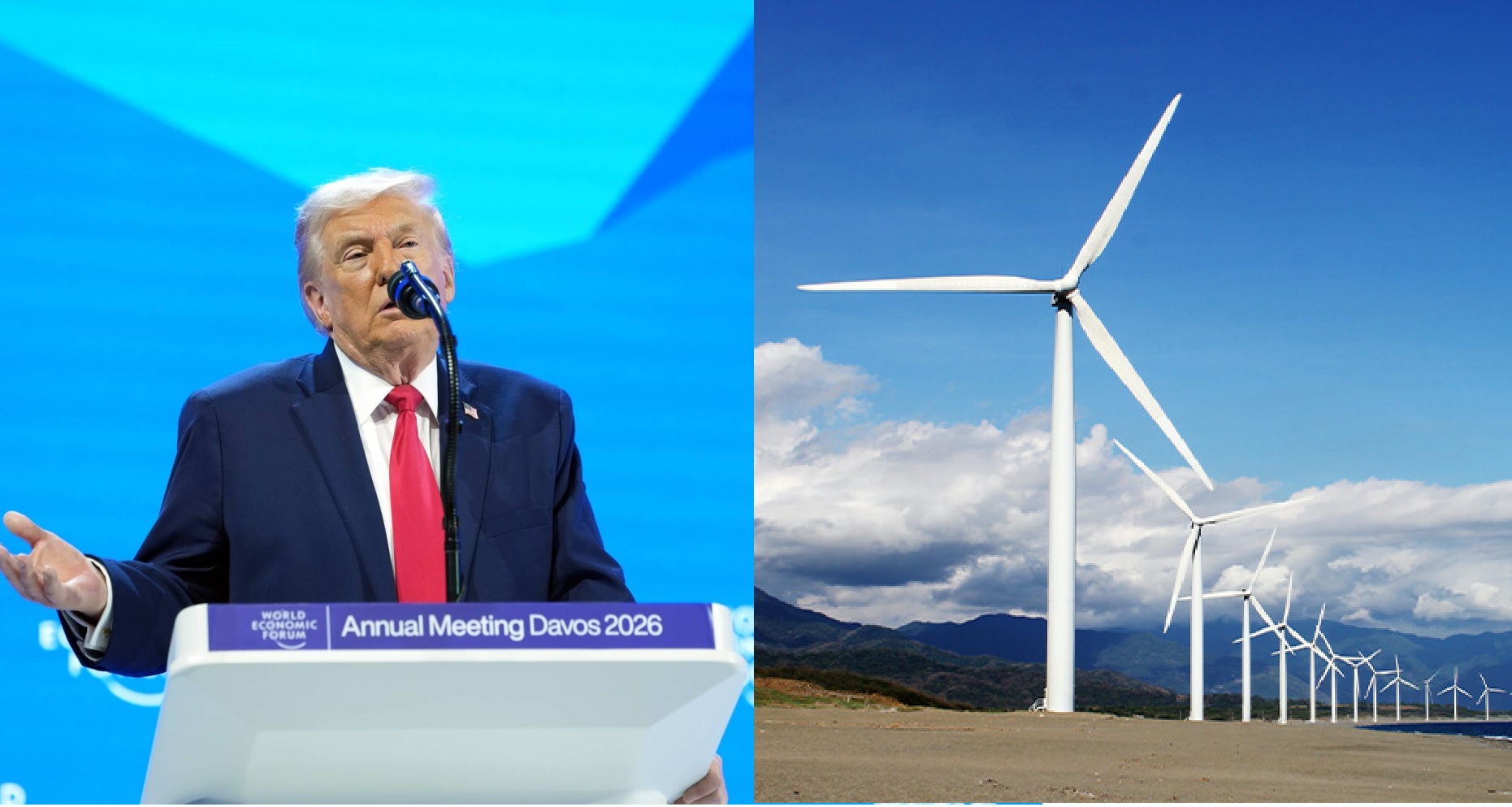
DAVOS, Switzerland : President Donald Trump delivered one of the most confrontational speeches of this year’s World Economic Forum, using the Davos stage to attack European renewable energy policies and to criticize China’s dominance in clean-energy manufacturing. However, several of the President’s claims—particularly regarding China’s use of wind power—conflicted sharply with established global energy data.
Speaking before an audience of political leaders, executives and financiers, Trump dismissed wind power as economically damaging and argued that Western investment in renewables has weakened Europe while enriching China. The remarks highlighted Trump’s broader second-term emphasis on fossil fuels, nuclear power and energy security as the foundation of economic strength.
A Direct Assault on Europe’s Energy Strategy
Trump framed his critique of renewable energy as an economic argument, portraying large-scale wind deployment as a strategic mistake that has eroded Europe’s industrial competitiveness.
“China is smart,” Trump said during the address. “They make windmills, sell them for a fortune, and sell them to the stupid people that buy them. But they don’t use them themselves.”
He cited Germany and the United Kingdom as examples of what he described as the economic consequences of aggressive renewable policies, arguing that wind power has coincided with higher electricity prices and industrial strain. The comments drew visible unease among European officials, many of whom view renewables as central to energy independence and climate commitments.
Claims About China’s Wind Power Use Disputed by Data
The most contentious portion of Trump’s speech centered on China. While the President correctly noted China’s dominance in global wind-turbine manufacturing, he claimed the country does not meaningfully rely on wind power itself—a statement contradicted by international energy data.
According to the latest figures from the International Energy Agency (IEA) and the Global Wind Energy Council (GWEC), China is not only the world’s largest producer of wind turbines but also the world’s largest user of wind energy.
As of late 2025, China operates approximately 6,619 utility-scale wind farms, accounting for roughly 40 percent of global wind electricity generation. The country’s installed wind capacity exceeds 600 gigawatts (GW), surpassing the combined wind capacity of the United States and Europe. Wind power, alongside solar energy, now represents more than one-third of China’s total installed electricity generation capacity.
While China continues to expand coal and nuclear power to meet rising demand, wind energy has become a central pillar of its power system rather than a marginal or symbolic one.
Manufacturing Dominance, Consumption Reality
A review of IEA and GWEC data confirms that Trump’s broader assertion about China’s manufacturing dominance is largely accurate. Chinese companies supply the majority of the world’s wind turbines and related components, giving Beijing significant leverage in global clean-energy supply chains.
However, the claim that China does not use wind power domestically is demonstrably false. Analysts note that China’s energy strategy combines large-scale renewable deployment with conventional energy sources to balance reliability, economic growth and emissions reduction.
The Economic Debate Over Wind Power
Trump’s broader argument—that wind energy undermines economic performance—touches on a long-running debate among economists and energy experts.
Critics argue that the intermittent nature of wind power imposes hidden costs on power systems, requiring backup generation and grid upgrades. Germany’s energy transition is frequently cited as an example where high renewable penetration has coincided with elevated household electricity prices.
Supporters counter that wind energy offers long-term price stability because it has zero fuel costs and reduces exposure to volatile oil and gas markets. They also emphasize that electricity prices are shaped by taxes, grid fees, market design and geopolitical shocks—not renewables alone.
Beijing Responds
China responded swiftly to Trump’s remarks. At a briefing on Thursday, Foreign Ministry spokesperson Guo Jiakun rejected the characterization of China’s energy policy.
“China’s commitment to renewable energy development is evident,” Guo said, noting that China has maintained the world’s largest renewable power system for more than a decade. He emphasized that Beijing views renewables, nuclear power and fossil fuels as complementary components of energy security.
AI, Power Demand and U.S. Policy Direction
Beyond renewables, Trump used the Davos platform to highlight what he described as the growing electricity demands of artificial intelligence (AI). He said U.S. technology companies are being encouraged to build dedicated power plants—including gas-fired and nuclear facilities—to support data-center expansion.
“You can’t run that scale of AI on unreliable power,” Trump said, arguing that renewables alone cannot meet surging demand.
The comments underscored a broader shift in U.S. energy policy under Trump, prioritizing reliability, scale and speed over emissions targets, particularly amid strategic competition with China in advanced technologies.
A Clear Signal, With Contested Facts
Trump’s Davos address sent a clear signal to global markets and U.S. allies that Washington intends to pursue a sharply different energy course from Europe. At the same time, it highlighted how energy debates are increasingly shaped by political narratives that clash with empirical data.
While Trump’s critique of renewable economics remains contested, one conclusion from the data is unambiguous: China is not only the world’s largest wind-turbine manufacturer—it is also the world’s largest wind-power user, making wind energy a central, not symbolic, part of its national power system.
——— End of Article ———