WASHINGTON, — April 5, 2026 : U.S. President Donald Trump stated on Sunday that the United States supplied firearms to anti-government protesters in Iran earlier this year, with the weapons routed through Kurdish militia groups that he said ultimately retained the arms.
Speaking in a telephone interview with Fox News, Trump described the administration’s approach during the wave of protests that began in late December 2025 and continued into January 2026. The demonstrations, driven by economic grievances and broader opposition to the government, spread across multiple provinces, including significant activity in Kurdish-populated regions of northwestern Iran.
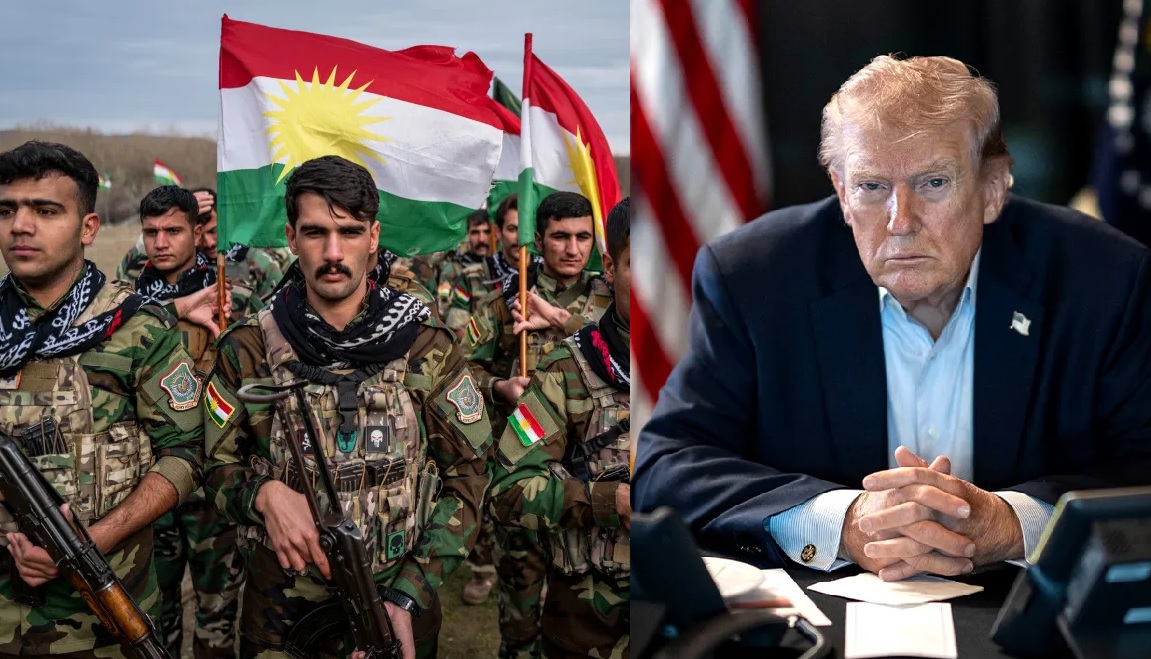
According to Trump, the U.S. initiated a covert effort to arm demonstrators following a violent crackdown by Iranian authorities. “We sent guns to the protesters, a lot of them,” he said, adding that the delivery relied on Kurdish intermediaries. “We sent them to the Kurds, and I think the Kurds kept them.”
Crackdown and Disputed Casualty Figures
Iranian security forces, including the Islamic Revolutionary Guard Corps (IRGC) and the Basij militia, responded to the unrest with force, deploying snipers, conducting mass arrests, and enforcing restrictions on communications, including internet shutdowns that limited independent verification.
Trump stated that the Iranian government “slaughtered” 45,000 civilians during the crackdown. However, casualty estimates vary widely. Iranian authorities have acknowledged more than 3,000 deaths. The Human Rights Activists News Agency (HRANA) has reported verified fatalities exceeding 6,000, with additional cases under review. Other activist and exile sources have cited figures ranging from approximately 7,000 to over 30,000. The differing estimates reflect the difficulty of confirming information amid restricted access and state controls.
Reported Role of Kurdish Groups
The reported transfer of weapons involved Kurdish factions operating along Iran’s western borders, including groups such as the Kurdistan Free Life Party (PJAK). U.S. and Israeli planners were reportedly seeking to apply pressure on the IRGC by encouraging unrest in border regions, particularly in the Zagros mountain areas, to compel Iranian forces to divert resources away from major urban centers where protests were concentrated.
Analysts note that Kurdish populations in Iran, estimated between 7 million and 15 million people, have historically been involved in regional proxy dynamics. According to Trump’s account, however, the weapons did not reach protesters. Kurdish intermediaries may have retained the arms due to concerns over long-term U.S. support, operational risks, and the potential for retaliation.
The IRGC has previously conducted artillery and drone strikes against Kurdish positions in neighboring Iraq, highlighting the risks faced by such groups in cross-border operations.
Earlier Reports and U.S. Position
Trump’s remarks are consistent with reporting from March 2026 indicating that U.S. officials and intelligence contacts had explored engagement with Kurdish factions as part of broader efforts to support opposition activity in Iran. At the time, the White House did not confirm approval of any plan for Kurdish forces to initiate an insurgency inside Iran.
Reports suggested that small arms may have been provided to Iranian Kurdish groups based in Iraq, with the objective of stretching Iranian security forces or encouraging internal resistance. Kurdish organizations have generally denied involvement in cross-border armed operations during this period.
No additional official U.S. confirmation has been issued regarding the scale, execution, or outcome of any such transfers beyond Trump’s April 5 statements.
Strategic Context and Regional Developments
The disclosure comes amid escalating tensions between the United States, Israel, and Iran. Over the weekend, Trump issued a 48-hour ultimatum to Tehran to reopen the Strait of Hormuz, a key global energy transit route that Iranian forces have restricted. He warned that failure to comply could result in strikes on Iranian infrastructure, including energy facilities and bridges.
At the same time, U.S. military activity in the region has expanded. Over the weekend, U.S. forces conducted a recovery operation inside Iranian territory, successfully extracting a U.S. F-15E crew member whose aircraft had been downed in an earlier engagement.
Potential Impact on Iran’s Internal Security
The reported attempt to supply weapons to protesters represents an external effort to influence internal dynamics within Iran. If successfully delivered, such arms could have enabled limited armed resistance or prolonged unrest, potentially forcing the IRGC to reallocate resources toward internal security operations.
However, with the weapons reportedly not reaching protesters, the immediate operational impact appears limited. The longer-term effects may include increased scrutiny of ethnic minority regions, particularly Kurdish areas, and expanded security measures by Iranian authorities.
The events also highlight the challenges associated with coordinating covert support through proxy groups, as well as the broader implications for U.S.-Iran relations. For the IRGC, which maintains a central role in both domestic control and external military operations, the situation underscores ongoing concerns regarding external influence and internal stability.
The full extent of any arms transfers and their outcomes remains unclear due to the covert nature of the reported activities and limited independent verification.
——— End of Article ———