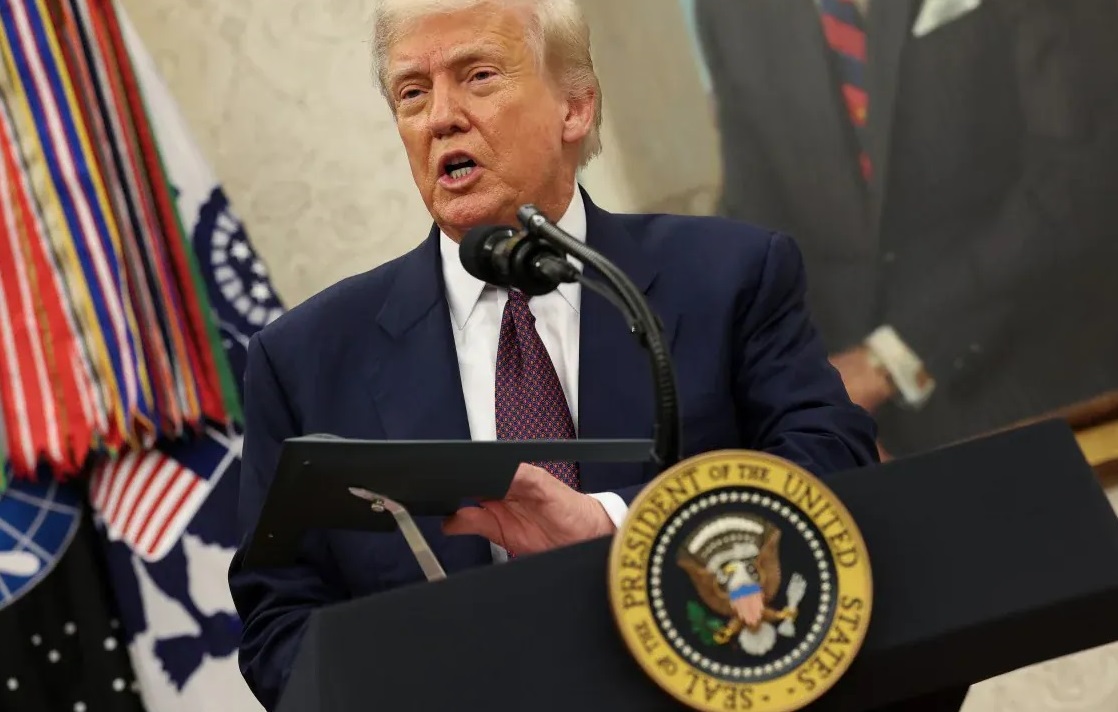
Washington : President Donald Trump on Monday signed the Consolidated Appropriations Act of 2026 into law, enacting what the administration has repeatedly described as the “America First Bill.” The legislation brings an end to most forms of traditional U.S. foreign civilian assistance, formally shutters the U.S. Agency for International Development (USAID), and redirects tens of billions of dollars toward domestic priorities, border enforcement, and selected security commitments.
The bill passed the House of Representatives by a narrow 217–214 vote and cleared the Senate shortly thereafter, ending a brief partial government shutdown. Its enactment represents the most significant restructuring of U.S. discretionary spending in decades and a decisive shift in how Washington defines its role in international development and aid.
Closure of USAID and Scope of Aid Terminations
At the core of the legislation is the statutory termination of USAID, which since 1961 has overseen the bulk of U.S. civilian foreign aid, humanitarian relief, and development assistance. The law dissolves the agency’s operational authority, transfers a limited number of security-related functions to the State Department and Department of Defense, and eliminates the majority of USAID-managed grant programs.
The act explicitly ends taxpayer funding for global diversity, equity, and inclusion (DEI) initiatives, climate mitigation and adaptation projects in developing countries, gender-focused social programs, and governance and civil society assistance not tied to direct U.S. strategic objectives. Administration officials said these programs were classified as non-essential or misaligned with domestic priorities.
In fiscal terms, the legislation cuts approximately $10 billion in foreign assistance in the current fiscal year alone. This reduction builds on earlier budget actions, with humanitarian and development funding in FY2026 falling by roughly 37 percent compared with recent annual averages. Base foreign aid spending, which previously stood near $60 billion annually, is significantly reduced under the new framework.
Redistribution Toward Domestic Priorities
Savings generated by the elimination of foreign aid programs are reallocated across several domestic and security-focused areas. The Department of Defense receives funding to implement a 3.8 percent pay raise for all service members, with an additional 10 percent increase for junior enlisted personnel. The administration said the increases are intended to offset inflation and improve retention.
The Department of Homeland Security is allocated new, dedicated funding for deportation logistics, including expanded use of chartered and military-assisted removal flights. These funds are earmarked for transportation, detention coordination, and interagency operations tied to immigration enforcement.
The bill also establishes a federal crime reduction fund for Washington, D.C., placing resources under enhanced federal oversight to support law enforcement staffing, infrastructure, and targeted anti-crime initiatives in the capital.
In place of traditional development aid, the legislation creates the America First Opportunity Fund, a $2.9 billion program restricted to expenditures that directly advance U.S. economic or national security interests. Eligible uses include securing critical mineral supply chains, strategic infrastructure investments, and limited assistance to selected partners where clear benefits to U.S. industries or defense planning can be demonstrated.
Effects on Ukraine, Israel, and Multilateral Commitments
The act sharply differentiates between categories of foreign assistance, particularly with respect to ongoing conflicts and long-standing security partnerships.
For Ukraine, the bill scales back U.S. involvement by limiting assistance largely to military support. Economic stabilization and civilian reconstruction aid are curtailed. Annual assistance for Ukraine is set at $400 million, a substantial reduction from the multi-billion-dollar aid packages approved in 2024 and 2025.
U.S. support for Israel remains largely intact. The legislation preserves the existing Memorandum of Understanding (MOU), continuing $3.3 billion annually in Foreign Military Financing (FMF) and allocating an additional $500 million for missile defense systems, including Iron Dome and David’s Sling. Lawmakers backing the bill said Israel’s funding falls under core defense cooperation rather than discretionary foreign aid.
The law also terminates U.S. contributions to several United Nations bodies and programs. Funding is ended for UNESCO and select initiatives under the UN Relief and Works Agency (UNRWA), with the administration citing concerns over oversight, effectiveness, and alignment with U.S. policy objectives.
Fiscal Impact and Budgetary Outlook
According to White House and congressional budget documents, the Consolidated Appropriations Act of 2026 delivers approximately $20 billion in immediate savings during the current fiscal year through the elimination of foreign assistance programs identified as inefficient or non-essential by the Department of Government Efficiency.
Over a ten-year horizon, the administration projects that the spending restraints established by the bill will contribute to trillions of dollars in cumulative deficit reduction, though long-term estimates depend on future appropriations and economic conditions.
At the same time, the act increases overall defense spending to $1.01 trillion for FY2026. Funds are directed toward modernization of the nuclear triad, expansion of missile defense initiatives, including the proposed “Golden Dome” system, and broader force readiness investments.
Structural Shift in U.S. Spending Policy
By formally ending USAID operations, reducing civilian foreign aid, and reorienting federal spending toward domestic enforcement and defense priorities, the America First Bill establishes a new baseline for U.S. fiscal and foreign policy. Supporters describe the law as a recalibration of taxpayer obligations, while critics argue it diminishes U.S. influence abroad.
With the Consolidated Appropriations Act of 2026 now in force, federal agencies are expected to begin implementing program closures and fund reallocations immediately, marking a definitive change in how the United States deploys its financial resources at home and overseas.
——— End of Article ———