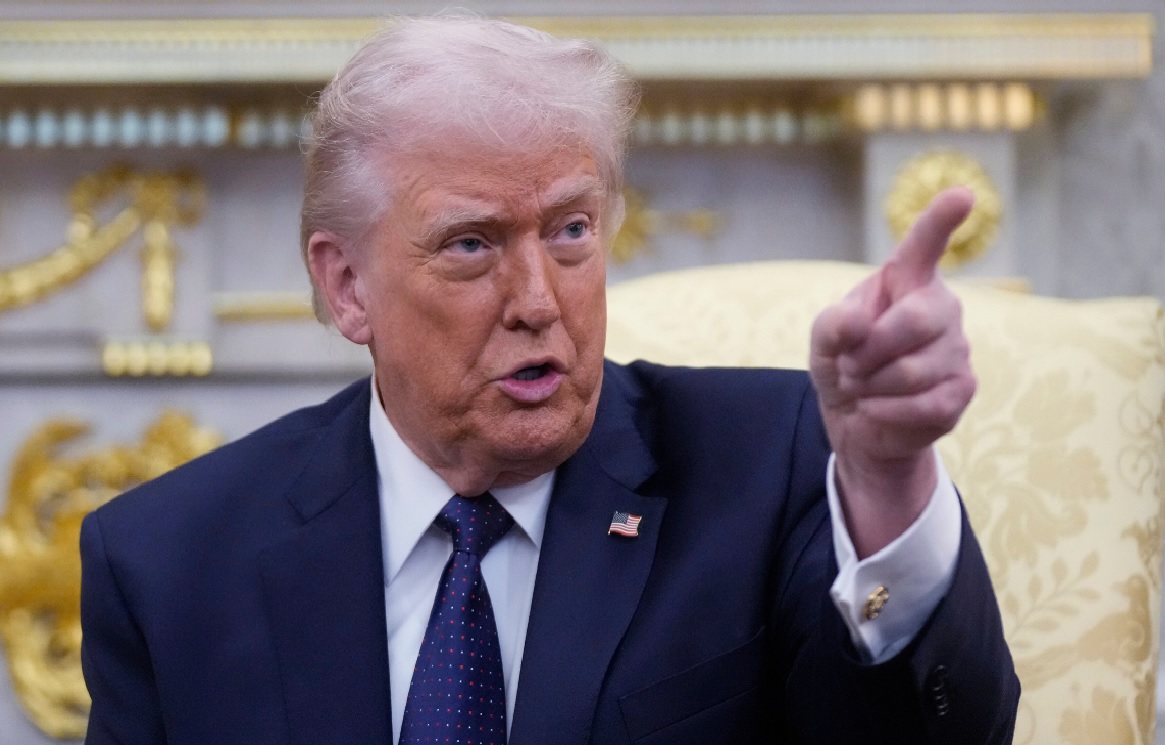
WASHINGTON, March 5, 2026 : U.S. President Donald Trump has sharply criticized Spain and the United Kingdom following disagreements over NATO defense spending and military cooperation related to recent U.S.-led operations against Iran. The dispute centers on Spain’s refusal to allow the United States to use jointly operated bases for strikes on Iran and broader tensions within NATO over increased defense spending targets.
Dispute Over NATO Spending Targets
The comments come amid a continuing debate within the North Atlantic Treaty Organization (NATO) regarding defense spending commitments agreed upon during a summit held in The Hague in June 2025.
At that meeting, NATO members endorsed a new long-term goal of raising defense spending to 5 percent of gross domestic product (GDP) by 2035, a significant increase from the 2 percent guideline adopted in 2014. The proposal was strongly supported by President Trump, who argued that European allies should contribute more toward collective defense.
Most alliance members agreed to the higher target, but Spain, led by Prime Minister Pedro Sánchez, declined to commit to the 5 percent level. Madrid stated it would pursue its military capability goals while spending approximately 2.1 percent of GDP instead.
Spain’s defense spending currently stands at roughly 1.3 percent of GDP in 2025, according to publicly available NATO estimates, placing it below both the previous 2 percent benchmark and the newly proposed long-term target.
Trump has repeatedly criticized the Spanish position, arguing that Madrid is not contributing sufficiently to the alliance. Speaking at the White House on March 5, he stated that Spain had been “hostile to NATO” and highlighted the country’s refusal to support the 5 percent spending target.
Military Base Access and Iran Operations
The diplomatic dispute intensified following Spain’s decision to deny U.S. requests to use the Naval Station Rota and Morón Air Base in southern Spain during recent operations targeting Iranian military infrastructure.
The United States and Israel launched coordinated strikes against Iranian targets beginning February 28, 2026, citing intelligence indicating a potential Iranian attack. Several NATO countries provided logistical support or access to facilities for the operation.
Spain, however, declined to allow the use of its jointly operated bases for missions linked to the strikes. Spanish Foreign Minister José Manuel Albares stated that the bases could not be used for operations that were not covered by existing bilateral agreements or the framework of the United Nations Charter.
Following Spain’s decision, U.S. forces relocated 15 aircraft, including aerial refueling tankers, from Spanish bases. At least seven aircraft were moved to Ramstein Air Base in Germany to support ongoing regional operations.
Trump’s Trade Threats Toward Spain
During a March 3 meeting with German Chancellor Friedrich Merz in the Oval Office, Trump threatened potential economic retaliation against Spain.
He directed Treasury Secretary Scott Bessent to examine options to suspend commercial dealings with Madrid, stating that the United States could cut off trade ties if Spain continued to oppose U.S. military cooperation.
Trump argued that the United States technically retained the ability to operate from the bases but emphasized that Washington could choose not to maintain economic engagement with Spain.
As of March 5, no formal sanctions or tariffs have been implemented, and U.S. officials have not announced specific measures that could affect bilateral trade.
Trade between the United States and Spain includes Spanish exports such as olive oil, automotive components, steel, and chemical products. Spanish financial markets reacted cautiously to the statements, with fluctuations reported in the Ibex 35 stock index shortly after Trump’s remarks.
United Kingdom Also Criticized
Trump also criticized the United Kingdom during the same discussions, describing the country as “very disappointing” and “uncooperative.”
The criticism relates in part to Britain’s reported refusal to allow the use of the joint U.S.–UK military facility at Naval Support Facility Diego Garcia for operations connected to the strikes on Iran.
The UK currently spends roughly 2.3 percent of GDP on defense, meeting NATO’s previous benchmark but not yet committing to the 5 percent target proposed for 2035.
British officials have expressed concern about escalation in the Middle East and have shown caution toward direct involvement in the military campaign.
European Responses
Spanish Prime Minister Pedro Sánchez defended Madrid’s position in a nationally televised address, stating that Spain would not participate in actions it considers destabilizing.
He criticized the strikes on Iran as unjustified and warned that further military escalation could increase global instability. Spain maintains that its position remains consistent with its commitments to NATO while emphasizing diplomatic solutions.
European Union officials also responded to Trump’s threat of unilateral trade measures. Representatives of the European Commission noted that trade policy is negotiated collectively by the European Union, meaning any attempt to isolate Spain commercially would affect the broader EU-U.S. trade framework.
Chancellor Friedrich Merz stated that European countries would approach trade negotiations with the United States collectively, emphasizing that the bloc would negotiate “together or not at all.”
NATO Leadership Calls for Unity
NATO Secretary-General Mark Rutte has called for unity within the alliance as disagreements over spending and operational support continue.
Merz indicated that Germany and other NATO members are attempting to persuade Spain to move toward intermediate spending targets between 3 percent and 3.5 percent of GDP, even if Madrid does not immediately adopt the full 5 percent goal.
The dispute highlights ongoing tensions within NATO over burden-sharing and the extent of member involvement in military operations beyond the alliance’s core defense mission.
Regional Developments Amid Iran Conflict
The diplomatic tensions occur alongside continuing instability in the Middle East following the U.S. and Israeli strikes on Iran.
U.S. officials report that nearly 20,000 American citizens have returned from the Middle East since the beginning of the conflict, while regional incidents have included explosions near Abu Dhabi’s airport and attacks on industrial facilities in Bahrain.
Although these events are not directly linked to the NATO dispute, they have contributed to heightened international concern over the broader consequences of the conflict.
As of March 5, discussions between the United States, Spain, and other NATO allies continue, with no confirmed economic measures enacted and no formal changes to NATO commitments announced.
——— End of Article ———