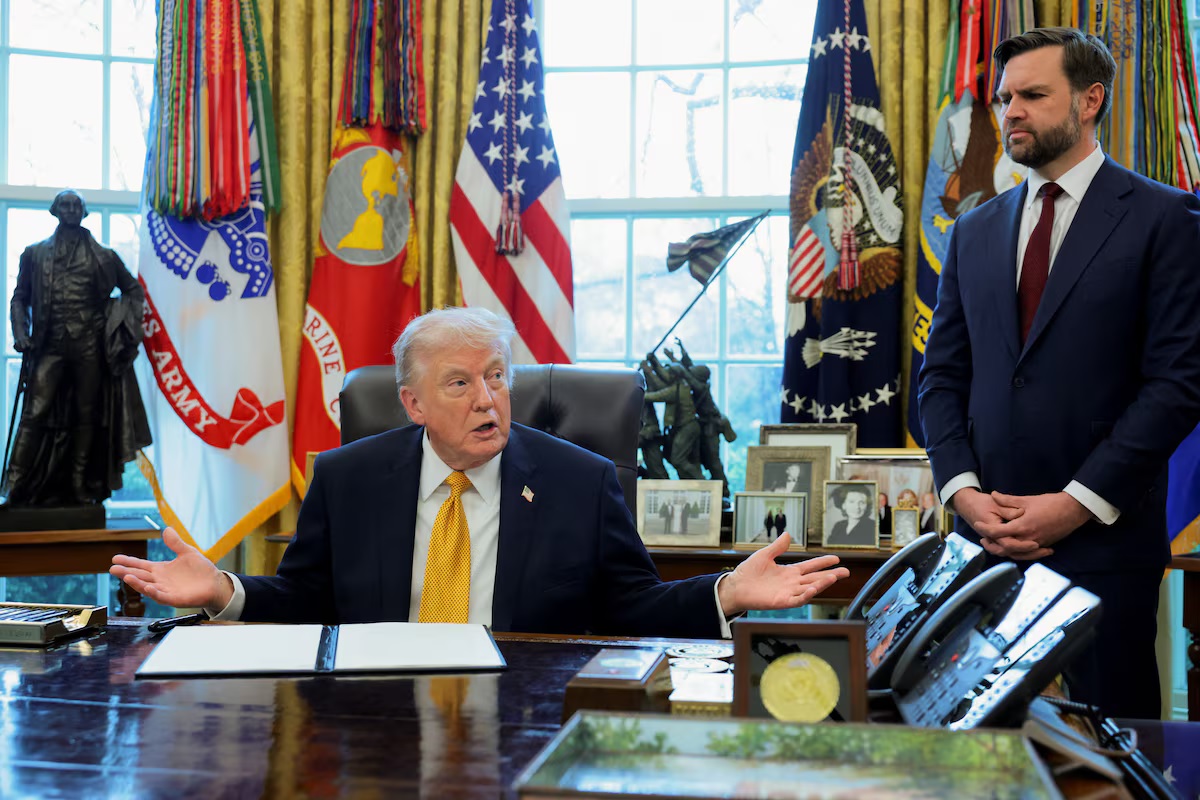
Washington, D.C. — April 3, 2026 : U.S. President Donald Trump has designated Vice President JD Vance to lead a nationwide initiative targeting fraud in federal benefit programs, formally assigning him the role informally described as “Fraud Czar.” The announcement was made on April 3 via the president’s Truth Social platform and coincided with ongoing federal enforcement actions in California.
Appointment and Scope of Responsibility
According to the president’s statement, Vance will oversee efforts to identify and address fraud across federal programs, working alongside multiple agencies within the administration. Trump described fraud in government spending as “massive and pervasive,” adding that the initiative would operate nationwide but with a particular focus on states led by Democratic administrations.
In his statement, Trump said the initiative would concentrate “everywhere,” while emphasizing states such as California, Illinois, Minnesota, Maine, and New York as priority areas. He also asserted that the scale of alleged financial losses is significant enough that successful recovery efforts could impact the federal budget balance.
Task Force Structure and Mandate
The appointment builds on an executive order signed on March 16, 2026, establishing the Task Force to Eliminate Fraud within the Executive Office of the President. The task force is chaired by Vice President JD Vance, with Federal Trade Commission Chairman Andrew Ferguson serving as vice chairman.
The interagency body includes cabinet secretaries and heads of relevant federal agencies. Its mandate covers auditing, investigating, and preventing fraud, waste, and abuse in federal benefit programs, including Medicaid, Medicare, housing assistance, food assistance, and cash-based welfare programs administered in coordination with state and local governments.
The executive order directs participating agencies to strengthen eligibility verification systems, introduce pre-payment safeguards, identify high-risk fraud patterns, and dismantle organized fraud networks. Agencies were instructed to submit measurable implementation plans within 90 days. The task force convened its first meeting in late March 2026.
California Enforcement Actions
Federal enforcement activity tied to the initiative was carried out on April 2, 2026, in the Los Angeles area under an operation identified as “Operation Never Say Die.” Federal agents executed search warrants and arrests targeting alleged hospice and healthcare fraud schemes.
Authorities charged 11 defendants and arrested eight individuals across multiple locations, including Covina, Anaheim, and Glendale. Prosecutors allege that the schemes involved fraudulent hospice providers billing Medicare for services rendered to patients who were not terminally ill. The total alleged fraud amount exceeds $50 million.
The cases were announced by the U.S. Attorney’s Office for the Central District of California. First Assistant U.S. Attorney Bill Essayli stated that the enforcement actions were conducted in coordination with the Task Force to Eliminate Fraud.
In addition to the arrests, authorities reported that 221 hospice and healthcare providers in Los Angeles County were suspended due to suspected fraudulent activity. Officials noted that this represents an increase of more than 200 percent within a one-week period.
Coordination and Early Operations
Administration officials indicated that the California cases are among the first enforcement actions linked to the newly established task force. Vice President JD Vance commented following the arrests that the initiative had begun operations without delay and would continue to pursue fraud cases nationwide.
Trump also referenced the California activity in his public remarks, stating that federal “raids have already started” in Los Angeles as part of the broader effort.
Broader Geographic Focus
Prior to the California actions, the task force had examined fraud-related concerns in Minnesota, particularly involving Medicaid and public assistance programs. A White House fact sheet issued alongside the March executive order identified California, Illinois, New York, Maine, and Colorado as states where federal officials believe vulnerabilities in oversight mechanisms may exist.
The California enforcement actions represent an expansion into large-scale healthcare fraud investigations.
Political Response
The initiative has prompted criticism from political opponents, including members of the Democratic Party, who argue that the stated focus on “Blue States” suggests a politically targeted approach. Critics have raised concerns that federal law enforcement resources could be used in a manner that disproportionately targets political jurisdictions.
Some lawmakers have also accused the administration of attempting to shift attention away from ongoing scrutiny of financial activities associated with Trump-linked businesses and foreign investments during his current term.
Current Status
As of April 3, 2026, federal authorities have not released additional details regarding the full scope of ongoing investigations or potential enforcement actions in other states. The Task Force to Eliminate Fraud continues to operate under the leadership of Vice President JD Vance, coordinating with federal prosecutors, the Department of Justice, and other agencies on active and future cases.
——— End of Article ———