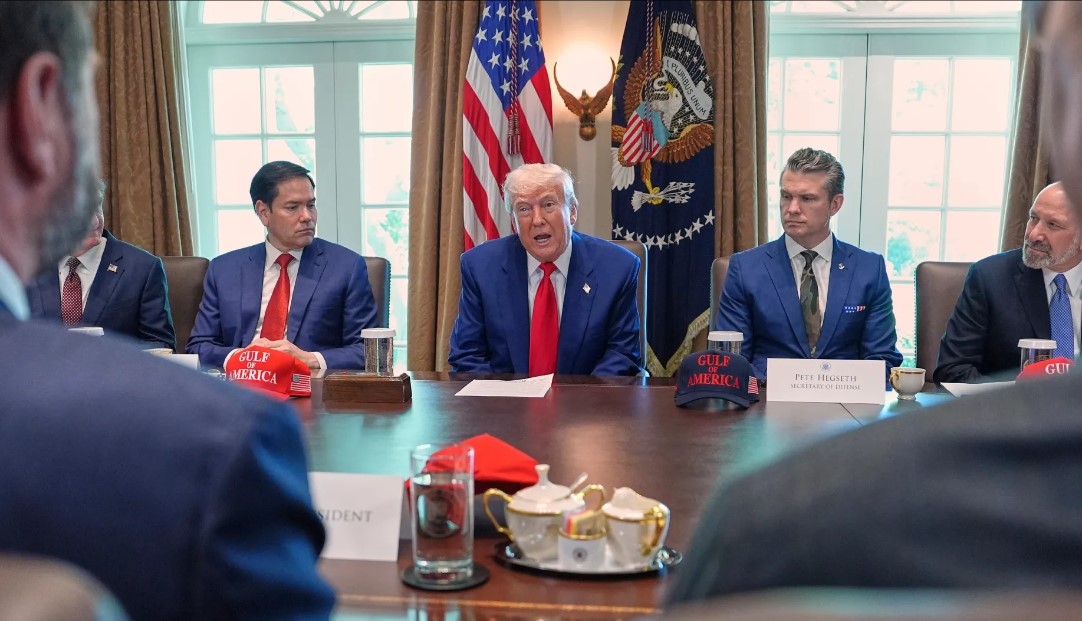
WASHINGTON, February 26, 2026 : Senior advisers to President Donald Trump have privately expressed a preference for Israel to initiate any potential military strike against Iran, according to multiple sources familiar with internal administration discussions. The approach is being evaluated as part of broader contingency planning tied to Iran’s nuclear program and regional security dynamics.
Officials cited in a February 25 report by Politico said some advisers believe that if Israel were to conduct an initial strike independently, and Iran subsequently retaliated against U.S. forces or interests, it would create stronger domestic justification for American military involvement. The assessment reflects concern within the administration that the American public remains cautious about initiating a new conflict in the Middle East.
One person familiar with the discussions stated that there is “thinking in and around the administration that the politics are a lot better if the Israelis go first and alone and the Iranians retaliate against us, and give us more reason to take action.” According to sources, advisers believe public support would likely increase if the United States or its forces were directly targeted following an Israeli action.
Political and Military Calculations
The internal deliberations are focused in part on domestic political considerations, including the potential impact of a military confrontation ahead of upcoming midterm elections. Officials involved in the discussions reportedly view an Iranian strike on American assets as providing clearer grounds for congressional and public backing of a broader campaign.
Sources indicated that U.S. military installations in the region could be exposed in the event of retaliation. Unlike Israel, which relies on layered air defense systems including the Iron Dome, many American facilities in the Middle East do not have equivalent comprehensive protective coverage. Advisers acknowledge that retaliatory strikes could result in U.S. casualties, a factor that is part of the broader strategic calculus under review.
At the same time, officials said a coordinated U.S.-Israeli operation remains the more likely outcome if military action is ultimately authorized. No final decision has been announced.
Diplomatic Engagements Continue in Geneva
The military planning is unfolding alongside ongoing indirect nuclear negotiations in Geneva. U.S. envoys Steve Witkoff and Jared Kushner are engaged in talks with Iranian Foreign Minister Abbas Araghchi. The discussions are being mediated by Omani officials and overseen in part by Rafael Grossi, Director General of the International Atomic Energy Agency.
Administration officials have stated that the diplomatic track remains active. However, President Trump has simultaneously overseen an expansion of U.S. naval and air deployments in the region, signaling that military options remain under consideration if negotiations fail to produce an agreement acceptable to Washington.
On February 26, the USS Gerald R. Ford carrier strike group departed Souda Bay, Crete, for the eastern Mediterranean, further increasing the U.S. military presence near the potential theater of operations.
Context of Previous Hostilities
The current deliberations follow the June 2025 conflict that culminated in a U.S. strike operation known as Operation Midnight Hammer. During that episode, the United States conducted attacks on Iranian nuclear facilities at the Fordow Fuel Enrichment Plant, Natanz Nuclear Facility, and Isfahan Nuclear Technology Center. The exchange followed Israeli-initiated military action earlier in the escalation cycle.
In contrast to that sequence of events, current and former Israeli officials have indicated that Jerusalem’s present posture differs from last year’s conflict. Prime Minister Benjamin Netanyahu has stated publicly that Israel is coordinating closely with Washington. Israeli officials have signaled a preference for the United States to take the lead in any renewed confrontation unless Israeli territory is directly targeted by Iranian forces.
No Decision Announced
Administration officials emphasized that no final determination has been made regarding military action. The discussions remain part of contingency planning as negotiations in Geneva continue.
The White House has not publicly confirmed the reported internal preference for an Israel-first strike scenario. Officials maintain that diplomatic efforts are ongoing, while reiterating that the United States retains military options should talks with Tehran fail.
——— End of Article ———