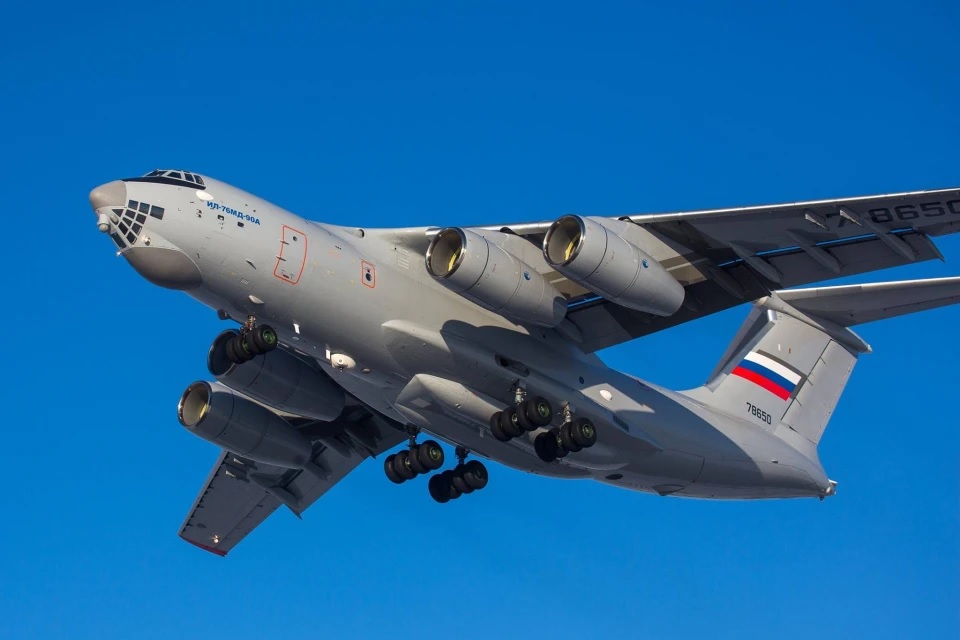
KARAJ, IRAN : Flight tracking data over the past 72 hours shows three Russian Ilyushin Il-76TD strategic transport aircraft arriving at Karaj Airport (Kerej), west of Tehran. The aircraft departed from Mineralnye Vody in southern Russia, indicating a concentrated airlift operation linked to ongoing defense cooperation between Moscow and Tehran.
The Il-76TD is a heavy-lift transport aircraft capable of carrying up to 50 tons of cargo per sortie. Aviation data indicates the flights were conducted within a compressed timeframe, suggesting coordinated logistical planning. The aircraft involved are civilian-registered variants, a configuration that allows use of established civil aviation corridors across the Caucasus region.
Cargo Assessment and Helicopter Deliveries
Defense analysts and local reporting indicate that the cargo associated with the recent flights includes the Mi-28NE attack helicopter. Visual material circulating from the Pars Aerospace Services Company (PASC) facility in Tehran shows partially disassembled Mi-28NE airframes painted in a digital desert camouflage scheme. The helicopters appear to be undergoing assembly and integration procedures.
The Mi-28NE, an export version of Russia’s Mi-28 “Havoc,” is designed for anti-armor and close air support missions. It is equipped with a 30mm automatic cannon and can deploy anti-tank guided missiles. The platform also features mast-mounted radar and infrared sensor systems intended for night and all-weather operations. Crew protection includes reinforced cockpit armor and shock-absorbing landing gear.
If fully operational, the addition of Mi-28NE helicopters would mark a modernization step for the Iranian Army Aviation (IRAA), which has historically relied on legacy AH-1J SeaCobra helicopters acquired prior to 1979. The integration process is expected to involve pilot conversion training, weapons system calibration, and local maintenance adaptation.
Broader Defense Agreement
The airlift activity is understood to be part of a broader multi-billion-dollar defense agreement between Russia and Iran. Intelligence assessments have previously indicated potential transfers of Su-35 multirole fighter aircraft and S-400 air defense systems as part of expanded military-technical cooperation.
In parallel, Iran has continued to supply Russia with unmanned aerial systems (UAS) and loitering munitions. These systems have been documented in use in ongoing European conflict zones. The bilateral defense relationship has therefore developed into a reciprocal arrangement involving conventional and unmanned systems.
Strategic Context
The increase in Russian airlift activity occurs amid heightened regional tensions. In early February 2026, the United States and Israel reportedly shifted toward a posture of increased direct military pressure on Iran.
The United States has deployed a second aircraft carrier strike group to the Middle East. President Donald Trump has stated that while indirect nuclear negotiations in Geneva are ongoing, military options remain available if diplomatic efforts do not produce results.
Israel has maintained a high readiness level, citing concerns over Iran’s nuclear and missile programs. Recent assessments suggest that earlier strikes damaged portions of Iran’s ballistic missile infrastructure, though reconstruction efforts are ongoing.
Operational Considerations
The use of civilian-registered Il-76TD aircraft for strategic deliveries reduces the visibility typically associated with overt military transport operations. Aviation specialists note that this approach allows logistical continuity while remaining within established commercial flight frameworks.
Karaj’s proximity to Tehran and associated aerospace facilities makes it a suitable hub for equipment transfer and assembly. The Pars Aerospace Services Company facility has historically been linked to aircraft maintenance and integration activities, providing infrastructure for assembling partially disassembled airframes delivered by transport aircraft.
The recent sequence of flights, combined with visual evidence from Tehran-based facilities, indicates continued progression of Russian-Iranian military cooperation under current regional conditions.
——— End of Article ———