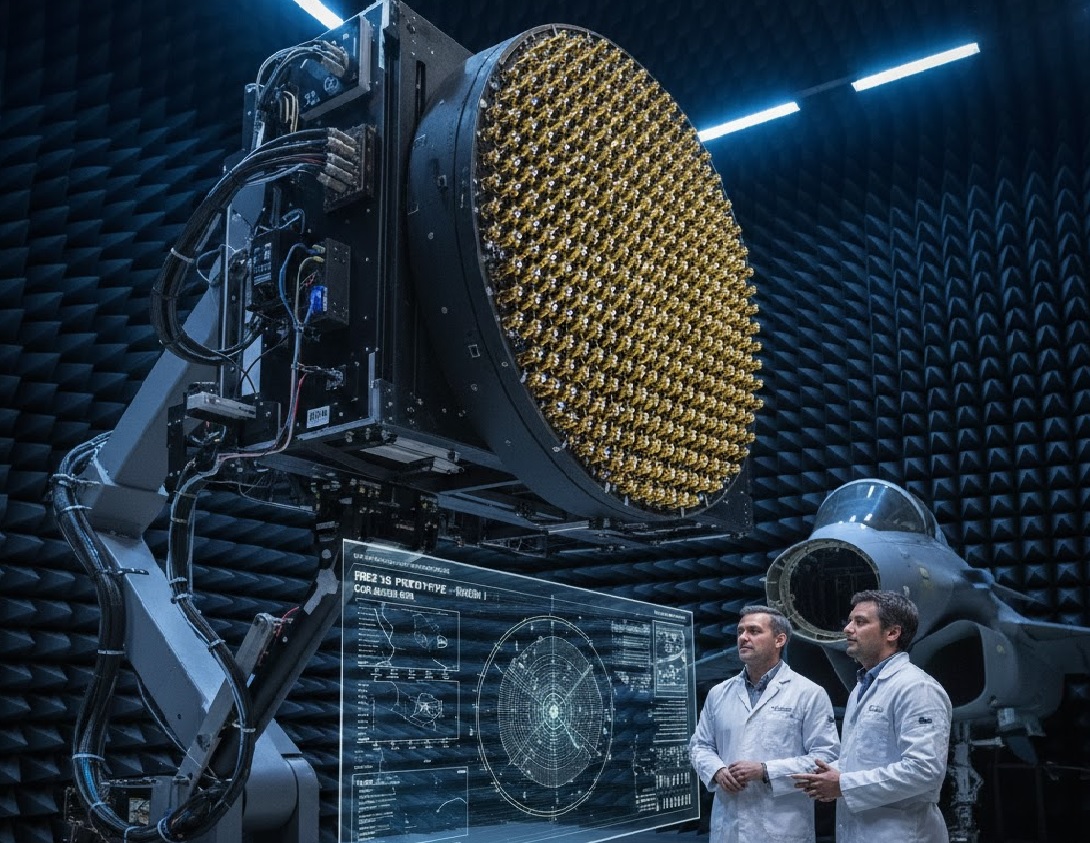
PARIS : The Dassault Rafale combat aircraft is entering a new phase of capability development as France advances work on the Rafale F5 standard, centered on the introduction of the Gallium Nitride-based RBE2-XG active electronically scanned array (AESA) radar. As of February 2026, the program has moved beyond initial design stages and is progressing through hardware prototyping and ground validation, with flight trials scheduled later in the decade.
The RBE2-XG radar is being developed by Thales under contract from France’s Direction générale de l’armement (DGA). It represents an evolution of the existing RBE2-AA AESA radar currently fielded on Rafale F3-R and F4 aircraft.
Transition from Gallium Arsenide to Gallium Nitride
The current RBE2-AA radar uses Gallium Arsenide (GaAs) transmit/receive modules. While GaAs-based AESA systems have delivered reliable multirole performance, power density and thermal constraints limit further performance growth within the same material architecture.
The RBE2-XG replaces GaAs with Gallium Nitride (GaN) semiconductor technology. GaN modules are capable of operating at higher voltages and temperatures, enabling increased power output and improved energy efficiency. According to program estimates, the shift to GaN could extend radar detection ranges by approximately 30% to 70%, depending on target characteristics and engagement conditions.
GaN technology also allows improved thermal management. Higher efficiency per watt reduces cooling demands while permitting greater transmitted power. This enables a more capable radar array without exceeding the aircraft’s environmental control system limits.
In addition to extended range, the wider frequency agility and higher power output of the RBE2-XG are intended to improve detection and tracking performance against low-observable aircraft, including platforms such as the Chengdu J-20 and the Sukhoi Su-57. Enhanced resistance to electronic jamming and improved signal processing are also central design objectives.
Development Status as of February 2026
The RBE2-XG program formally entered Phase 1 development in June 2023 following notification of the initial contract by the DGA. In late 2024, France’s Ministry of Armed Forces announced the official launch of the Rafale F5 standard, which incorporates the extended-generation radar as a core component.
In the third quarter of 2024, Thales received notification for the second tranche of development. This phase focuses on detailed design, hardware prototyping, and preparation for system integration.
Throughout 2025 and into early 2026, prototype GaN arrays have been undergoing validation in ground-based test facilities, including anechoic chamber trials. Testing is aimed at verifying high-power output performance, electronic counter-countermeasure resistance, and overall reliability under operational stress conditions.
Parallel to radar development, the Rafale F5 configuration is receiving upgrades to its internal architecture. A new fiber-optic cabling backbone is being introduced to manage increased data throughput generated by the RBE2-XG and other upgraded onboard systems. The revised digital infrastructure is designed to support higher bandwidth sensor fusion and future software-driven enhancements.
Industrial Participation and India’s Role
In December 2025, Thales awarded a contract to SFO Technologies, based in Kochi, India, for the production of complex wired structures associated with the RBE2 radar family.
The agreement supports the broader Rafale industrial ecosystem and aligns with India’s acquisition of 26 Rafale Marine aircraft for the Indian Navy. The localization of certain radar-related manufacturing activities positions India as a production partner within the Rafale supply chain, rather than solely as an end user.
While the current contract concerns RBE2 radar components, the industrial base established through such partnerships may be relevant as the radar architecture evolves toward the XG standard in future upgrades.
Roadmap to Operational Service
The RBE2-XG and Rafale F5 development schedule follows a phased roadmap extending to the end of the decade:
-
June 2023: Phase 1 development contract notification by DGA.
-
October 2024: Official launch of the Rafale F5 standard by the French Minister of Armed Forces.
-
Third Quarter 2024: Notification of Phase 2 (detailed design and prototyping).
-
2025–2026: Ground-based validation of GaN modules and integration testing (current stage).
-
2027: Acceleration of F5-related technological elements as referenced in French defense budget planning.
-
2028: Planned first flight trials of the RBE2-XG on a flying testbed.
-
2030 and beyond: Targeted entry into operational service on Rafale F5 aircraft.
Flight trials will validate airborne performance, electromagnetic compatibility, and integration with other onboard systems before full fleet deployment.
Integration with Broader F5 Capabilities
The RBE2-XG radar is one element of the broader Rafale F5 modernization package. The upgraded aircraft is designed to support expanded collaborative combat functions, including control of unmanned combat aerial vehicles derived from the nEUROn program.
The enhanced radar processing capacity, combined with updates to mission computers and data links, is intended to improve sensor fusion between the RBE2-XG, the SPECTRA electronic warfare suite, and the Front Sector Optronics (FSO) system. The objective is to deliver a consolidated tactical picture for the pilot while enabling coordinated operations with manned and unmanned assets.
By integrating higher-power GaN radar technology, upgraded digital architecture, and expanded network capabilities, the Rafale F5 standard is structured to maintain operational relevance into the 2040s. The RBE2-XG radar forms the central sensor upgrade underpinning this long-term modernization strategy.
——— End of Article ———