ANKARA : Turkish Aerospace Industries (TAI) is advancing flight testing and systems integration for its indigenous TF-X KAAN fighter program, positioning the aircraft as Turkey’s entry into the fifth-generation combat aircraft category. As development progresses, aerospace analysts are conducting detailed evaluations of the aircraft’s stealth architecture, propulsion configuration, radar cross-section (RCS) targets, materials engineering, and sensor integration to benchmark it against global standards set by the United States’ F-35 Lightning II and F-22 Raptor.
Current technical projections indicate that early KAAN variants align more closely with the Low Observable (LO) classification rather than the Very Low Observable (VLO) standard associated with operational U.S. fifth-generation platforms.
Stealth Classification Framework: LO Versus VLO
Stealth performance is assessed across multiple signature domains, including radar, infrared (IR), and electronic emissions. It is defined by a comprehensive integration of airframe shaping, materials science, propulsion engineering, manufacturing tolerances, and avionics control.
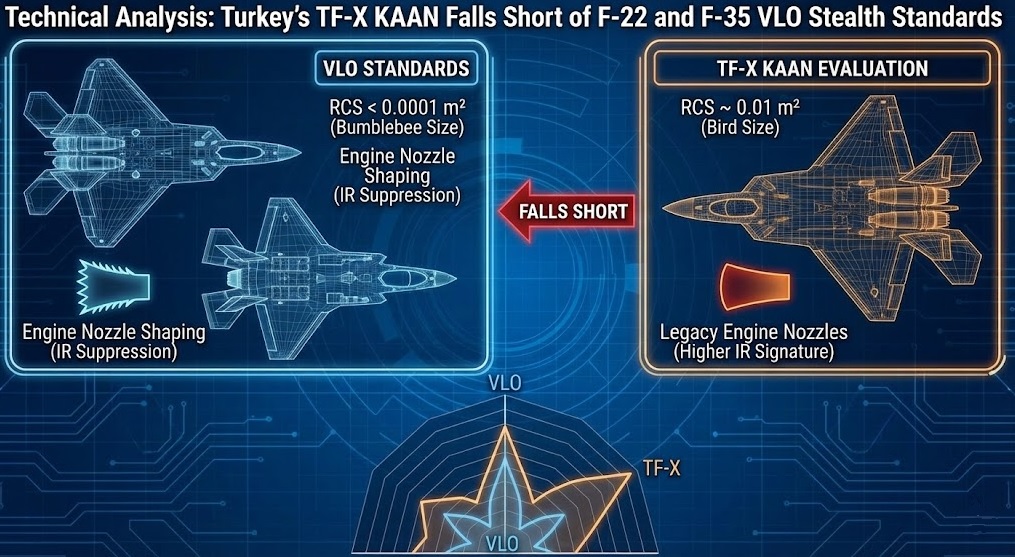
Aircraft classified as Very Low Observable (VLO) are engineered from inception to minimize detectability across all aspects. Publicly cited estimates place the all-aspect radar cross-section of the F-22 at approximately 0.0001 square meters (m²). The F-35’s frontal RCS is widely estimated between 0.001 m² and 0.0015 m².
By comparison, engineering projections for the KAAN’s early production blocks indicate a target frontal RCS of approximately 0.01 m², with later iterations aiming for approximately 0.003 m². These figures position the aircraft within the Low Observable category, representing a substantial reduction compared to legacy fighters but not matching established VLO thresholds.
Airframe Geometry and Signature Management
The KAAN incorporates fifth-generation shaping principles, including edge alignment geometry, diverterless supersonic inlet concepts, and a chined fuselage to manage radar wave deflection. The aircraft features internal weapons bays, preventing external stores from increasing radar return during combat operations.
Achieving VLO status requires extremely tight manufacturing tolerances. Panel alignment, access door fitment, fastener treatments, and weapons bay seam management are critical to limiting radar reflections. U.S. stealth programs benefit from decades of classified production refinement and advanced radar-absorbent material (RAM) application techniques.
Turkey’s Scientific and Technological Research Council (TÜBİTAK) is developing a domestic Radar Absorbing Multilayered Thin Film Surface Coating to support KAAN’s stealth objectives. Long-term durability, field maintainability, and large-scale application consistency will determine how closely the aircraft can approach VLO standards.
Propulsion Configuration and Infrared Signature
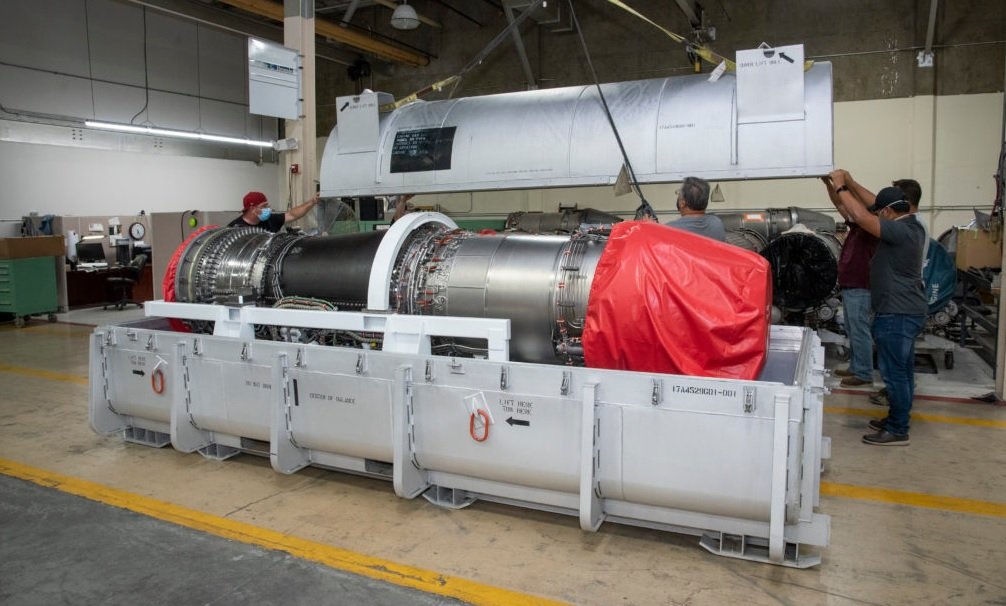
The current KAAN prototypes, designated Block 0, are powered by two General Electric F110-GE-129 turbofan engines, also used in fourth-generation platforms such as the F-15 and F-16. While proven and reliable, the F110 does not incorporate advanced exhaust shaping, serrated nozzle geometry, or dedicated infrared suppression systems comparable to the F135 engine of the F-35 or the F119 engine of the F-22.
As a result, early KAAN variants are expected to exhibit a higher rear-aspect radar signature and elevated infrared emissions relative to VLO aircraft. This increases detectability by modern Infrared Search and Track (IRST) systems, particularly from the rear hemisphere.
Turkey plans to replace the F110 engines with a domestically developed TF35000 engine, targeted for introduction in the 2030s. Key performance factors will include thrust output, thermal management, and exhaust signature suppression, all of which directly influence stealth characteristics.
Sensor Architecture and Electronic Emission Control
The KAAN will integrate the domestically developed ASELSAN MURAD-600A Active Electronically Scanned Array (AESA) radar. AESA systems provide enhanced detection range, improved resistance to electronic jamming, and a lower probability of intercept compared to mechanically scanned radars.
A defining benchmark of fifth-generation capability is sensor fusion — the integration of radar, electronic warfare, infrared sensors, and datalink inputs into a unified pilot interface while maintaining strict electromagnetic emission control. The F-35’s AN/APG-81 AESA radar operates within a mature, fully integrated architecture optimized for low electronic signature management.
TAI’s ongoing integration of the MURAD-600A, electronic warfare systems, and onboard processing architecture represents a complex engineering phase. Maintaining a reduced electronic signature while ensuring high data-processing throughput remains central to achieving advanced stealth performance.
Comparison with Advanced 4.5-Generation Fighters
To contextualize KAAN’s capabilities, analysts compare it with leading 4.5-generation fighters such as the Eurofighter Typhoon and the Dassault Rafale.
In a clean configuration — without external weapons or fuel tanks — modern 4.5-generation aircraft using radar blockers and RAM coatings achieve estimated frontal RCS values between 0.1 m² and 0.5 m². However, these aircraft rely on external payload carriage, and once armed for combat, their radar signatures increase substantially.
The KAAN’s internal weapons bays provide a clear operational advantage. By carrying air-to-air and air-to-ground munitions internally, the aircraft preserves its reduced radar profile during combat missions. Even with legacy propulsion and evolving RAM technology, a fully armed KAAN is projected to maintain a significantly lower radar signature than externally armed 4.5-generation fighters.
Industrial and Strategic Context
The TF-X KAAN program represents an expansion of Turkey’s domestic aerospace manufacturing capability, integrating indigenous radar systems, electronic warfare suites, composite airframe structures, and a planned domestic engine program to reduce reliance on foreign defense technologies.
Early production blocks are projected to remain within the Low Observable (LO) classification. While incremental improvements in materials science, propulsion development, manufacturing precision, and avionics integration are planned, the aircraft does not currently meet Very Low Observable (VLO) standards.
Based on disclosed engineering targets, the KAAN is expected to surpass modern 4.5-generation fighters in stealth configuration due to its internal weapons carriage and lower projected frontal radar cross-section (RCS). However, its use of F110 engines and evolving radar-absorbent material (RAM) application places it below the stealth threshold associated with the F-35 Lightning II and F-22 Raptor.
——— End of Article ———