TAIPEI, — June 09, 2026 : Taiwan is moving forward with plans to manufacture between 1,200 and 1,376 Hai Chien II (Sea Sword II) naval air defense missiles as part of a major effort to modernize the Republic of China Navy’s surface fleet and improve protection against evolving aerial threats.
The Hai Chien II, also known as the TC-2N, is expected to become the standard air defense missile across Taiwan’s principal surface combatants. The production program follows a successful live-fire test conducted last week in waters near the National Chung-Shan Institute of Science and Technology (NCSIST)’s Jiupeng facility in Pingtung County.
According to military sources cited by local media, the missile procurement plan forms part of a broader naval modernization effort focused on replacing aging air defense systems and increasing the fleet’s ability to counter aircraft, helicopters, drones, and anti-ship missiles.
Fleet-Wide Deployment Plan
Taiwanese naval planners estimate that at least 688 missiles are required to fully equip the magazines of vessels currently in service or under construction. However, military doctrine requires additional missile inventories for training, operational reserves, and wartime replenishment. As a result, total production is expected to reach between 1,200 and 1,376 missiles.
The baseline allocation of 688 missiles is planned across several classes of naval vessels:
-
Kang Ding-class frigates: 192 missiles for six ships, with up to 32 missiles per vessel.
-
Next-generation light frigates: 288 missiles for future anti-air warfare and anti-submarine warfare variants.
-
Tuo Chiang-class corvettes: 176 missiles for 12 vessels, with 16 missiles carried by each ship.
-
Yushan-class landing platform dock (LPD): 32 missiles for self-defense operations.
The estimate does not include Taiwan’s future next-generation principal surface combatant, which remains under development and could further increase missile requirements.
Military planners reportedly favor the upper production target to ensure sufficient stockpiles for sustained combat operations and to counter potential large-scale saturation attacks.
Replacing Legacy Air Defense Systems
The Sea Sword II program is intended to replace older naval air defense systems currently deployed across parts of Taiwan’s fleet, including the M48 Chaparral surface-to-air missile system carried by the Kang Ding-class frigates.
Defense officials have assessed that some legacy systems no longer provide the range and engagement capabilities necessary to counter modern aircraft and missile threats. The integration of the TC-2N is expected to significantly improve the fleet’s layered air defense network.
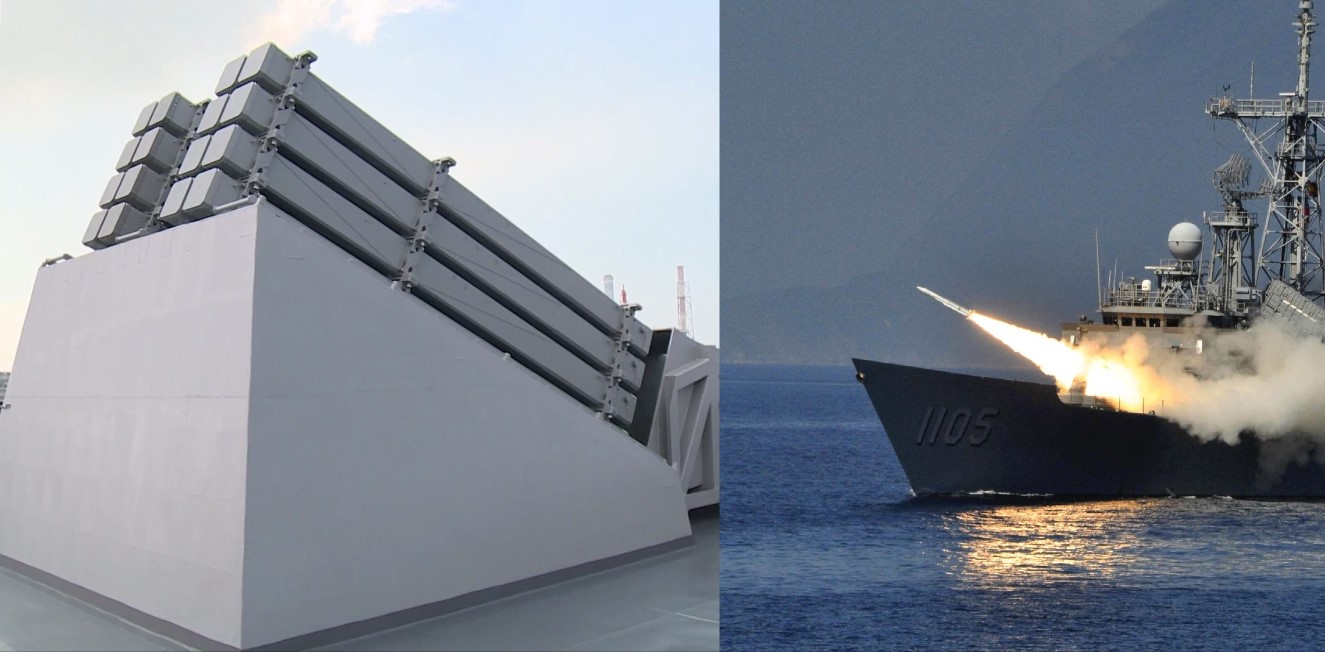
The Kang Ding-class frigates, derived from the French La Fayette-class design, are being upgraded with the domestically developed Hua Yang Vertical Launch System (VLS). Each Hua Yang launcher module contains eight cells, and each cell can accommodate four Sea Sword II missiles, allowing ships to carry larger missile loads while providing 360-degree defensive coverage.
The Yushan-class landing platform dock is equipped with four eight-cell launchers capable of carrying up to 32 TC-2N missiles. Meanwhile, second-batch Tuo Chiang-class corvettes are being delivered with the missile integrated into their standard air defense configuration.
Missile Development and Capabilities
The Hai Chien II is the naval variant of Taiwan’s Tien Chien II (Sky Sword II) beyond-visual-range air-to-air missile, developed by NCSIST as part of the island’s indigenous defense technology programs.
Development work began during the 1990s, while integration with a vertical launch system was completed around 2006. The first ship-based launch took place in 2014, followed by a series of operational evaluations and live-fire tests. The missile completed major operational testing by 2021, including launches from the Tuo Chiang-class corvette Ta Chiang.
The missile is designed to provide medium-range air defense with a reported engagement range of approximately 30 kilometers in its naval configuration.
Key features include:
-
Active radar homing guidance during the terminal phase.
-
Inertial navigation and data-link guidance during mid-course flight.
-
Electronic counter-countermeasure (ECCM) capabilities to resist jamming.
-
Thrust-vectoring booster technology that improves maneuverability and engagement performance.
-
All-weather operational capability against multiple types of aerial threats.
The system is designed to intercept fixed-wing aircraft, helicopters, unmanned aerial vehicles, and sea-skimming anti-ship missiles, filling the gap between close-in weapon systems such as the Phalanx CIWS and longer-range air defense missiles.
Supporting Taiwan’s Naval Modernization Strategy
The decision to standardize the Sea Sword II across multiple classes of warships is expected to simplify logistics, maintenance, training, and ammunition management throughout the fleet.
The missile will play an important role in Taiwan’s ongoing naval modernization efforts, which include the construction of new light frigates and the expansion of the Tuo Chiang-class corvette program. The corvettes are designed to operate using a dispersed “wolf pack” concept, combining high speed, reduced radar signature, and a mix of offensive and defensive weapons.
Production of the Sea Sword II will be supported by NCSIST’s expanded manufacturing capacity and reflects Taiwan’s broader emphasis on indigenous defense systems. Once fully deployed, the missile is expected to become a central component of the Republic of China Navy’s air defense architecture and future fleet operations.
——— End of Article ———