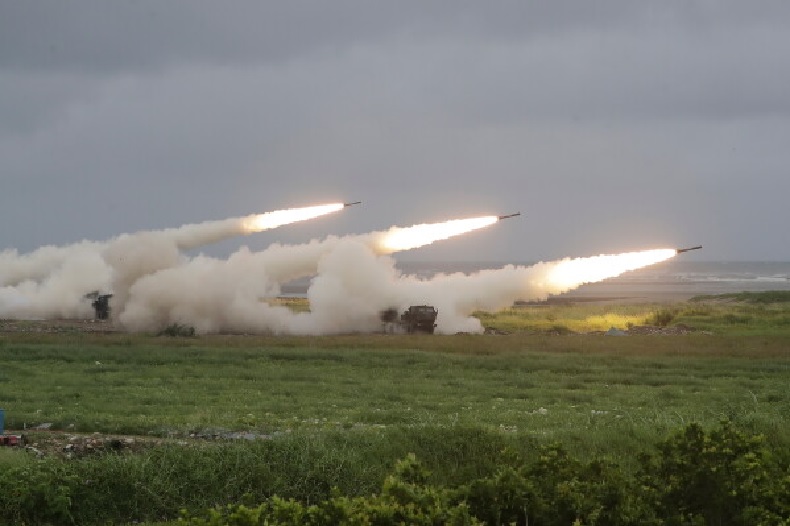
TAICHUNG, Taiwan — June 10, 2026 : Taiwan’s military conducted its first-ever live-fire exercise using U.S.-supplied High Mobility Artillery Rocket Systems (HIMARS) on the island’s western coast on Wednesday, marking a significant step in the integration of the advanced rocket system into Taiwan’s defense strategy. The exercise simulated a response to a potential cross-strait invasion and focused on rapid deployment, precision strikes, and battlefield survivability.
The drill took place near the mouth of the Dajia River in Taichung and marked the first time HIMARS rockets were fired into the Taiwan Strait from Taiwan’s western coastline directly facing mainland China. Previous live-fire tests involving the system had been limited to training areas on Taiwan’s eastern coast.
The exercise was carried out by the Army’s 10th Corps as part of a multi-day heavy artillery training program designed to test cross-regional fire support capabilities and the rapid deployment of long-range precision strike systems. The military’s 58th Artillery Command deployed six HIMARS launchers, with three positioned on each side of the Dajia River.
According to military officials, the launchers were scheduled to fire a total of 36 M28 reduced-range practice rockets in three separate firing waves. Each launcher was configured to launch two rockets per wave. During the exercise, 32 rockets were successfully fired, while four rockets failed to ignite due to technical malfunctions.
Colonel Weng Yi-ming, chief of staff of the 58th Artillery Command, confirmed that two misfires occurred on the north bank of the river and two on the south bank. The military stated that an investigation is underway to determine the cause of the failures.
Officials said the primary objective of the exercise was to demonstrate the HIMARS system’s mobility and its ability to survive in a contested battlefield environment. During the drill, launchers employed “shoot-and-scoot” tactics, a method that allows artillery units to quickly move into firing positions, launch rockets within minutes, and immediately relocate before enemy forces can detect and target them.
Military personnel involved in the training emphasized the importance of maintaining readiness under evolving security conditions. Army Sergeant Wang Ming-hui stated that HIMARS training would continue as part of efforts to strengthen Taiwan’s defensive capabilities and protect the island against potential threats.
The western coast of Taiwan has long been regarded by defense planners as the most likely area for any potential amphibious landing operation due to its beaches, coastal plains, and accessible terrain. As a result, the region remains a major focus of Taiwan’s coastal defense planning and military exercises.
The deployment of HIMARS on the western coast reflects Taiwan’s broader shift toward an asymmetric warfare strategy, often referred to as a “porcupine defense.” The concept emphasizes the use of highly mobile, precise, and difficult-to-target weapon systems capable of imposing significant costs on a larger adversary rather than matching its military strength directly.
Taiwan has acquired 29 HIMARS launchers from the United States as part of its ongoing military modernization program. Manufactured by Lockheed Martin, the system is capable of firing a variety of guided rockets and missiles. When equipped with long-range munitions such as the Army Tactical Missile System (ATACMS), HIMARS can engage targets at distances of up to 300 kilometers.
Military analysts note that HIMARS units positioned along Taiwan’s western coast could potentially cover key staging areas and military facilities across the Taiwan Strait in China’s Fujian Province, enhancing Taiwan’s long-range precision strike capabilities.
Wednesday’s exercise followed the opening day of the artillery drills on Tuesday, during which Taiwan’s military employed domestically developed Thunderbolt-2000 multiple rocket launchers alongside 155 mm howitzers and M109A2 self-propelled artillery systems to simulate coastal defense operations and coordinated artillery support missions.
The live-fire exercise forms part of Taiwan’s annual readiness training program aimed at improving operational coordination, rapid response capabilities, and the integration of newly acquired weapon systems. Military officials said the drill successfully validated the deployment procedures and operational effectiveness of HIMARS in a realistic combat scenario on Taiwan’s strategically important western coastline.
Taiwan continues to expand the role of advanced precision-guided weapons within its armed forces as it strengthens deterrence capabilities and enhances preparedness for potential cross-strait contingencies. The latest exercise represents another milestone in the island’s efforts to develop a more mobile, resilient, and distributed defense posture.
——— End of Article ———