LAUSANNE, Switzerland, — Engineers at the Swiss Federal Institute of Technology Lausanne (EPFL) have developed miniature robots and ultralight flying devices that generate thrust from sound waves without using onboard motors, batteries, electronics or conventional actuators.
The research, published on August 12, 2026, in Science Advances, uses a well-known acoustic effect called Helmholtz resonance. The same phenomenon produces a tone when air is blown across the opening of an empty bottle. At a suitable frequency, air inside a cavity oscillates strongly.
Researchers from EPFL’s MicroBioRobotic Systems (MICROBS) Laboratory, led by Selman Sakar, designed hollow acoustic cavities using 3D-printing techniques. When exposed to sound at their resonant frequency, the cavities produce a concentrated air jet. The difference between the outgoing and returning airflow generates directional thrust.
Sound-controlled miniature boats
At the centimetre scale, the team built small boats fitted with up to three acoustic resonators. Each cavity was tuned to a different audible frequency and positioned to produce thrust in a specific direction.
By changing the frequency from a nearby speaker, researchers could activate individual resonators to move the boats forward or turn left or right. The boats were also able to navigate around obstacles and follow programmed paths.
The researchers demonstrated the same principle using both airborne sound and structure-borne sound, where a transducer excites the cavity through physical contact.
Microfliers use ultrasound
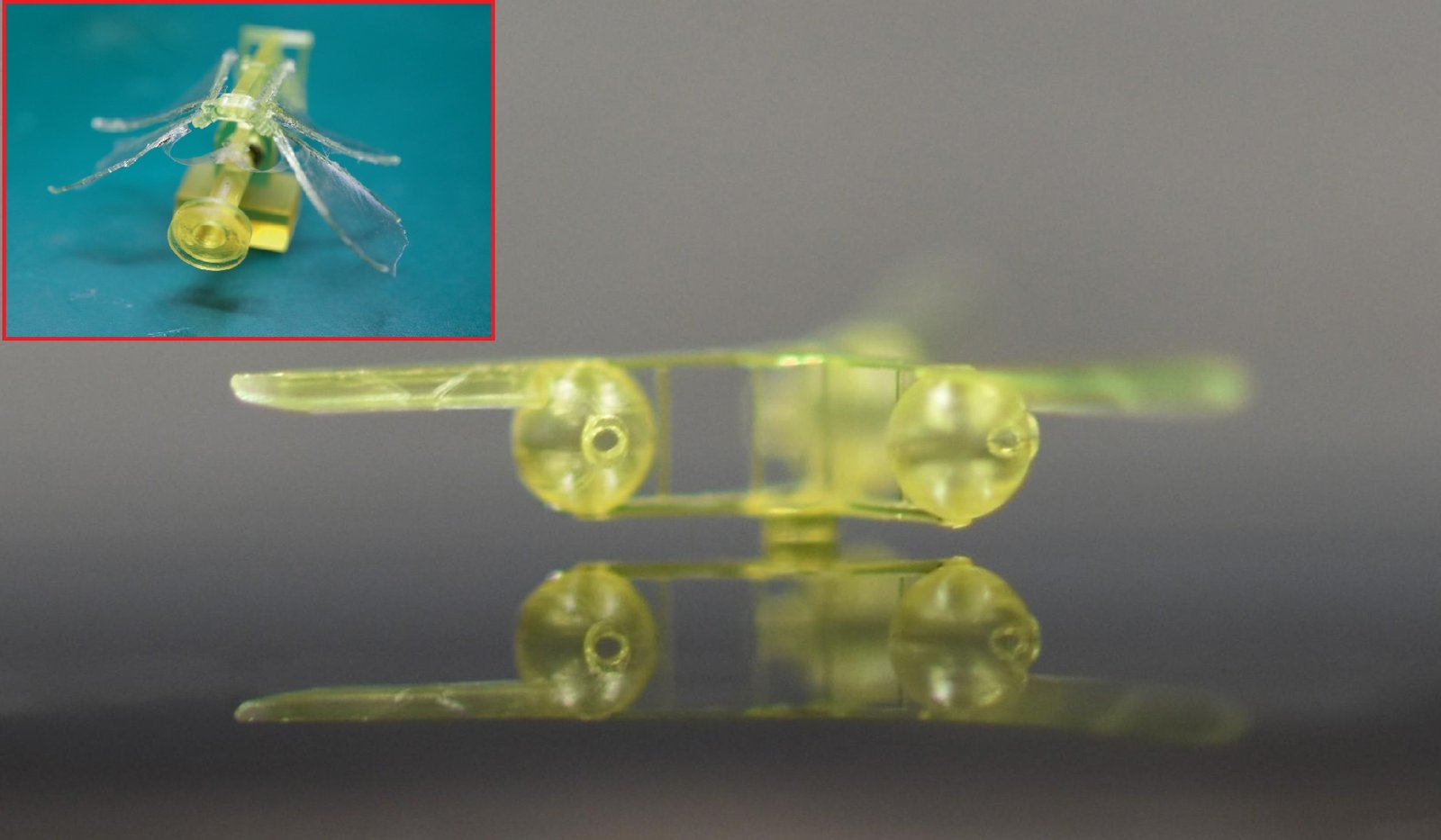
The team then applied the technology at a much smaller scale. Using two-photon polymerisation, a high-resolution 3D nanoprinting technique, researchers produced ultralight devices called microfliers.
Because the sound levels required for comparable operation with audible frequencies would be unsuitable for humans, the microfliers were designed to respond to ultrasound at around 40 kHz, which is above the human hearing range.
One microflier weighed 150 micrograms and used three microscopic cavities to generate upward thrust. It achieved a thrust-to-weight ratio of 4.9, meaning the generated thrust was nearly five times its weight.
A second design weighed 184 micrograms and combined three acoustic resonators with small blades. When activated by ultrasound, the blades reached speeds of up to 13,000 revolutions per minute, producing stable aerodynamic lift.
No conventional motor components
The approach replaces conventional miniature motor components with precisely shaped hollow cavities. The structures can be produced using materials including common 3D-printing plastics, rubber-like polymers and glass.
The researchers say the design can be further miniaturised because it does not depend on the magnets, coils, shafts and other components normally found in small motors.
The study also presents analytical models, numerical simulations and experimental results to establish design principles for acoustic resonators used as wireless actuators.
Potential future applications
EPFL researchers say multiple sound-responsive cavities could eventually be integrated into flexible structures, with different sections responding to different frequencies. Such designs could allow parts of a device to move, bend or vibrate selectively.
Potential applications suggested by the researchers include soft robotic structures, contact-free manipulation of small objects and biomedical devices. The team also identified possible applications in medical technology, including components for heart stents.
The current work establishes the basic operating and design principles. Further research is expected to focus on practical designs, improved control and navigation.
——— End of Article ———