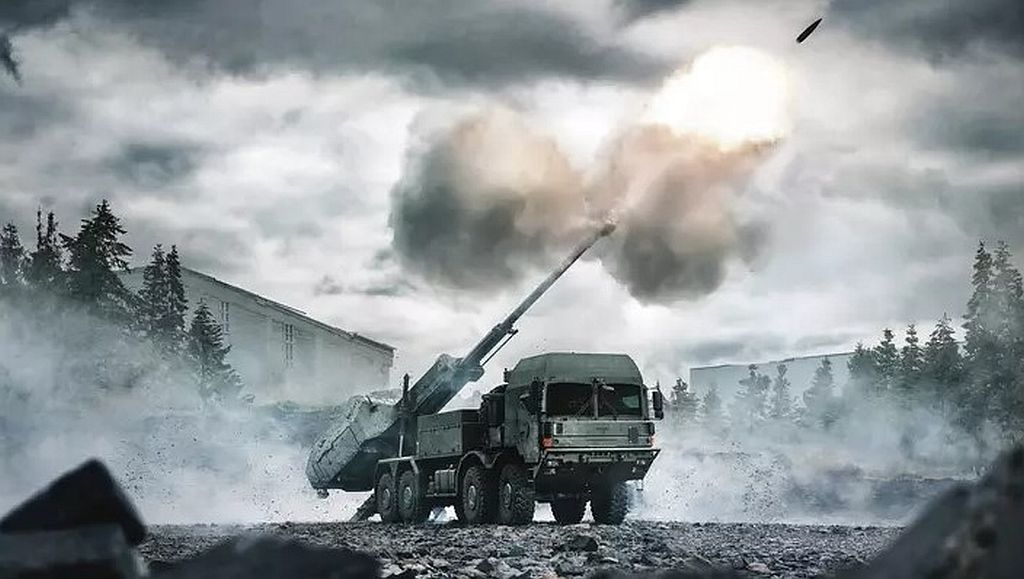
KARLSKOGA / STOCKHOLM : BAE Systems has rolled out the first newly manufactured Archer 155 mm self-propelled howitzer for the Swedish Army, formally marking the restart of national Archer production after several years without domestic deliveries. The vehicle, unveiled on January 30, 2026, is the first Swedish Army Archer built from a new production batch and is mounted on the MAN HX2 8x8 military truck, representing a significant evolution in the system’s design, mobility, and sustainment concept.
The rollout follows a contract signed in September 2023 between the Swedish Defence Materiel Administration (FMV) and BAE Systems Bofors for the acquisition of 48 newly built Archer artillery systems. The agreement, announced during the DSEI 2023 exhibition in London, was valued at several billion Swedish kronor and was intended to restore and expand Sweden’s artillery capacity following the transfer of previously fielded Archer systems to Ukraine. The current program is based entirely on new-build vehicles, ensuring full lifecycle support and long-term industrial continuity for Sweden’s artillery force.
Restart of Swedish Archer Production
The January 2026 vehicle is the first Archer specifically produced for the Swedish Army since earlier systems were reallocated abroad. According to defense analyst Gabriele Molinelli, the system represents the most up-to-date Archer configuration, incorporating both hardware and software refinements derived from operational experience. The restart of production also reflects Sweden’s broader effort to strengthen national defense capabilities following its accession to NATO.
Archer is a 155 mm/L52 wheeled self-propelled howitzer designed for high responsiveness and minimal crew exposure. The system is operated from a protected armored cab, with all gun-laying, loading, firing, and stowage functions fully automated. The crew does not need to exit the vehicle during firing operations.
System Performance and Automation
One of Archer’s defining characteristics is its rapid reaction time. From a complete halt, the system can typically fire its first round in under 30 seconds. After completing a fire mission, the howitzer can immediately relocate, reducing exposure to counter-battery fire. This shoot-and-scoot capability is increasingly valued in modern combat environments characterized by counter-battery radars, unmanned aerial systems, and long-range precision munitions.
The system supports a range of NATO-standard 155 mm ammunition types and is capable of multiple-round simultaneous impact (MRSI) firing, allowing several shells to strike a target nearly simultaneously. Automation reduces crew size requirements compared with many other artillery systems and supports sustained firing cycles with consistent accuracy.
Transition to the MAN HX2 8x8 Platform
Earlier Archer systems were built on the Volvo A30D 6x6 articulated hauler chassis, a civilian-derived platform adapted for military use. While the Volvo chassis provided strong off-road mobility in snow, forested terrain, and soft ground, it imposed limitations on payload growth, protection upgrades, and long-term compatibility with NATO-standard logistics fleets.
The new Archer configuration is mounted on the MAN HX2 8x8 military truck, a fully militarized platform designed for high durability and modular protection. The HX2 offers a reinforced frame, higher gross vehicle weight rating, and improved driveline robustness compared with the earlier chassis. Optional ballistic and mine protection kits enhance survivability, while increased onboard power generation supports advanced digital systems and future upgrades.
The HX2-based design also improves long-distance road mobility and simplifies logistics by aligning the Archer fleet with widely used NATO truck families. This is intended to reduce sustainment complexity during multinational operations and prolonged deployments.
Comparison With Other Modern Artillery Systems
Within the category of modern wheeled self-propelled howitzers, Archer occupies a distinct position. France’s CAESAR offers high strategic mobility and has seen extensive operational use, but relies on a semi-automated loading process that exposes crew members during firing. Germany’s RCH 155 provides comparable automation and protection but is heavier and more complex, with corresponding implications for cost and deployability. South Korea’s K9A1 is a tracked system optimized for sustained high-intensity operations rather than rapid road-based redeployment.
Archer combines near-total automation, high road speed, and relatively low crew requirements, making it well suited for dispersed operations and rapid repositioning across wide areas.
Industrial and Operational Implications
BAE Systems has indicated that the new Swedish Archer production batch incorporates lessons learned from operational use by partner nations, including systems deployed in Ukraine. While detailed specifications remain classified, reported improvements include updates to the fire-control software, increased autoloader reliability during sustained firing, and enhanced integration with digital command-and-control networks.
For the Swedish Army, the reintroduction of domestically produced Archer systems signals a shift from interim capability measures to long-term force development. Archer is expected to form the core of Sweden’s long-range artillery capability, particularly in the Baltic Sea region and the High North, where rapid mobility and survivability are central operational requirements.
Outlook
With serial production now underway, deliveries of the remaining Archer systems are expected to continue through the second half of the decade. Full operational capability is planned once all 48 howitzers are fielded and crews have completed training and integration within Sweden’s artillery units.
The January 2026 rollout confirms that Sweden’s artillery modernization has moved from the contracting and planning phase into active execution, centered on a modernized, NATO-aligned Archer system designed for current and future operational demands.
——— End of Article ———