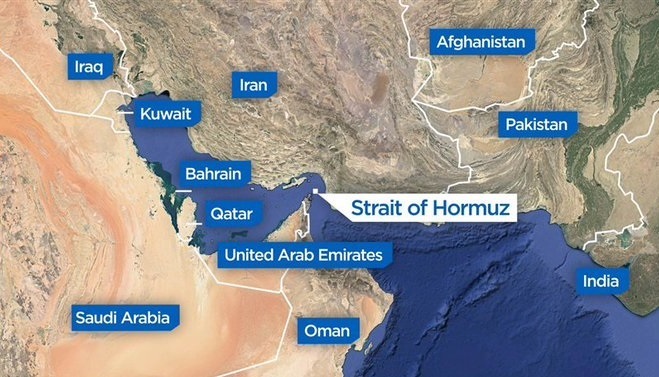
NEW DELHI : Rising tensions involving Iran have renewed concerns over the security of the Strait of Hormuz, a maritime corridor that handles a significant share of the world’s oil and natural gas trade. Economic assessments cited in recent reporting by Axios indicate that any disruption to shipping through the strait would have immediate and measurable effects on global energy markets, inflation, and economic growth.
The Strait of Hormuz connects the Persian Gulf to the Arabian Sea and serves as a transit route for a substantial portion of internationally traded crude oil and liquefied natural gas (LNG). Even a short-term interruption in maritime traffic through this corridor would constrain supply at a scale difficult to offset through alternative routes.
Oil Prices Could Move Above $90 in Baseline Scenario
According to projections referenced by Axios, a baseline disruption scenario in which Iran restricts or disrupts transit through the strait could push global crude oil prices above $90 per barrel in the near term. Such a move would translate directly into higher fuel costs in major consuming economies.
In the United States, analysts estimate that average retail gasoline prices could exceed $3 per gallon if crude stabilizes above the $90 mark. The price transmission mechanism would be rapid, as refiners and fuel distributors adjust to higher input costs.
Severe Scenario Points to $130 Per Barrel
In a more severe escalation involving direct attacks on Gulf oil infrastructure, crude oil prices could rise to approximately $130 per barrel, according to the same reporting. The impact would be amplified if production facilities, export terminals, or storage hubs in key Gulf producers were damaged.
Market analysts note that alternative export routes, including pipelines that bypass the Strait of Hormuz, do not possess sufficient capacity to fully replace daily maritime flows handled by the chokepoint. As a result, a prolonged closure combined with infrastructure damage could tighten global oil supply beyond the initial disruption.
Under such conditions, price volatility would likely increase, and emergency stockpile releases by major consuming nations could be required to stabilize markets.
Supply Shock and Energy Transmission Effects
The removal of millions of barrels per day from global supply would constitute a direct supply shock. Forecast ranges suggest crude prices could move between $100 and $130 per barrel depending on the duration and scale of disruption.
Higher crude prices would feed into the broader economy through multiple channels. Transportation and freight costs would rise first, followed by increased input costs for manufacturing and industrial operations. Food production and agricultural supply chains, which are energy-intensive, would also experience cost pressures.
Consumer goods prices would reflect higher logistics and production expenses, contributing to broader inflationary trends across developed and emerging markets.
Risk of Stagflation Increases
Economic analysts warn that sustained high energy prices combined with slowing economic activity would elevate the risk of stagflation. This condition is characterized by persistently high inflation occurring alongside weak or stagnant economic growth.
Central banks could face policy constraints under such a scenario. Efforts to contain inflation through tighter monetary policy could further dampen growth, while accommodative policies risk entrenching inflationary pressures driven by energy costs.
The scale of stagflation risk would depend on the duration of disruption, the responsiveness of global supply chains, and the use of strategic reserves.
Impact on Corporate Earnings and GDP
Higher energy and transportation costs would reduce corporate profit margins, particularly in energy-intensive sectors such as aviation, shipping, chemicals, and heavy manufacturing. Companies with limited pricing power would face margin compression, while those able to pass on costs could contribute to sustained inflation.
Consumer spending could weaken as households allocate a larger share of income to fuel, electricity, and essential goods. Economic estimates indicate that global Gross Domestic Product (GDP) could decline by approximately 0.3% to 0.8% under sustained disruption conditions. In a prolonged or severe case, the contraction could exceed that range.
A synchronized slowdown across major economies would increase the probability of recession risks rising simultaneously.
LNG and Natural Gas Supply Exposure
In addition to crude oil, the Strait of Hormuz is critical for global LNG trade. Between 20% and 22% of worldwide LNG exports transit through the strait. Major exporters reliant on this route include Qatar and the United Arab Emirates.
A closure would immediately constrain LNG shipments to key importing regions in Europe and Asia. The resulting supply imbalance could lead to higher natural gas prices, affecting electricity generation and heating costs.
Energy-importing countries with limited storage or diversified supply sources would be particularly exposed. A gas supply shock occurring alongside oil price increases would compound inflationary pressures and strain energy security strategies.
Limited Substitution Capacity
Although some Gulf producers maintain pipeline infrastructure that bypasses the strait, these systems are not capable of handling the full volume of oil and LNG typically shipped through Hormuz. Maritime transport remains the primary export mechanism for several major producers.
As a result, even partial disruption would affect market expectations, potentially driving speculative price movements and increased volatility in futures markets.
Broader Macroeconomic Implications
The cumulative effect of elevated oil and gas prices would extend beyond immediate energy markets. Increased freight rates could alter trade flows, and higher insurance premiums for shipping in conflict zones would add to transportation costs.
Financial markets could react through higher bond yields in energy-importing nations, currency depreciation in vulnerable economies, and shifts in capital toward commodity-exporting countries.
The overall macroeconomic outcome would depend on the duration of disruption, the scale of military escalation, and coordinated responses from energy-producing and consuming nations.
For now, analysts emphasize that the Strait of Hormuz remains operational. However, contingency planning by governments and energy firms reflects recognition that even temporary instability in this corridor would carry significant economic consequences across global markets.
——— End of Article ———