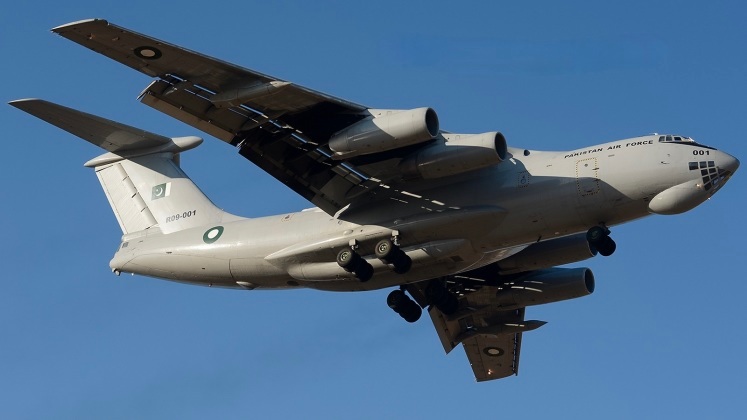
ISLAMABAD : Pakistan’s long-range air operations have come under renewed scrutiny following intelligence and defense assessments indicating that only one aircraft in the Pakistan Air Force (PAF) aerial refueling fleet is currently assessed as fully mission-capable. The situation significantly limits the service’s ability to sustain extended combat air patrols and long-distance strike missions.
According to defense sources familiar with fleet readiness, three of the PAF’s four Ilyushin Il-78 Midas aerial refueling aircraft are grounded or restricted to non-refueling roles due to technical issues and the unavailability of critical spare parts. The Il-78s, inducted between 2007 and 2009 after being procured from Ukraine, form the backbone of Pakistan’s aerial refueling capability.
Role of the Il-78 Fleet
The Il-78 tankers are used to extend the operational range of frontline fighters, including the JF-17 Thunder and legacy Mirage aircraft, allowing them to remain airborne longer and operate farther from home bases. In regional operational terms, aerial refueling is considered essential for sustained air defense patrols, maritime strike missions over the Arabian Sea, and contingency operations requiring rapid redeployment.
Each Il-78 is equipped with D-30KP turbofan engines and UPAZ-1 refueling pods, systems that require specialized maintenance and certified replacement components. Defense officials say the aircraft’s average age, now exceeding three decades since manufacture, has increased maintenance demands while reducing overall availability.
Maintenance and Spare Parts Constraints
The primary challenge facing the fleet is a shortage of serviceable spare parts for engines, refueling pods, and avionics. Pakistan has reportedly sought overhaul kits and replacement components through formal channels, but progress has been limited.
Russia, which holds intellectual property rights and original manufacturing authority over several Il-78 subsystems, has not approved recent requests for parts or technical assistance, according to regional defense analysts. This position is widely attributed to Moscow’s current industrial constraints and its expanding defense cooperation with India, which operates a larger Il-78 fleet.
Alternative Procurement Efforts
In parallel with official requests, Pakistan has explored indirect procurement options, including sourcing components from third-party operators of the Il-76 family of aircraft. However, officials note that many commercially available Il-76 parts are not compatible with the specialized aerial refueling configuration of the Il-78, limiting their operational utility.
As a result, aircraft that are technically flyable have reportedly been restricted to transport or ferry roles, as they do not meet mechanical and safety standards required for aerial refueling operations.
Recent Movements and Clarifications
In January 2026, aviation tracking data showed multiple Pakistani Il-78 aircraft operating on routes involving China. Defense experts stress that these flights should not be interpreted as evidence of restored refueling capability. While the aircraft can still conduct point-to-point flights, aerial refueling missions involve significantly higher mechanical loads and system reliability requirements.
China, while a major supplier of combat aircraft to Pakistan, does not operate the Il-78 Midas variant and therefore has limited capacity to provide specialized maintenance or certified spare parts for the platform.
Strategic Implications
The reduced availability of aerial refueling assets places structural limits on the PAF’s operational planning. Without sufficient tanker support, fighter aircraft must operate closer to base, rely more heavily on ground refueling, and conduct shorter patrols.
Analysts note that regional air forces are increasingly emphasizing long-range operations supported by robust tanker fleets. In contrast, Pakistan’s current situation underscores the risks of operating aging, foreign-origin platforms without assured long-term logistical support.
Absent a breakthrough in spare-parts access or the induction of a replacement tanker platform, Pakistan’s aerial refueling capability is expected to remain constrained, shaping air force posture and planning in the near to medium term.
——— End of Article ———