Puerto Real, Spain / London : Navantia has begun construction work in Spain on a major British naval logistics programme, marking a significant step forward in the Fleet Solid Support (FSS) ships that will underpin the Royal Navy’s future global operations.
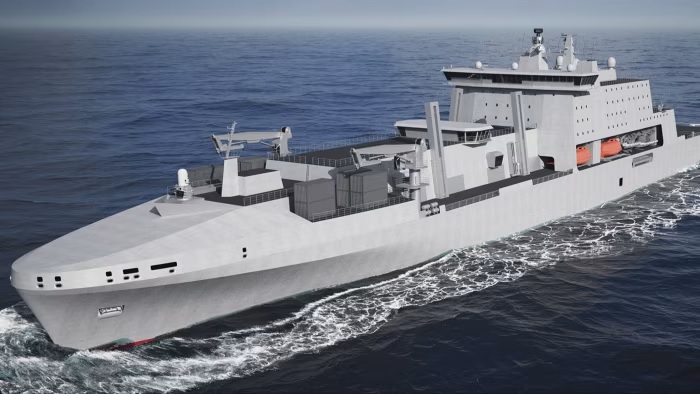
At Navantia’s shipyard in Puerto Real, Cádiz, workers have started building the first structural modules for three large logistics vessels destined for the UK’s Royal Fleet Auxiliary (RFA). The programme, led by Navantia UK under contract from the UK Ministry of Defence (MoD), is designed to deliver a new generation of solid support ships capable of sustaining British carrier strike operations far from home waters.
A Programme Moving from Design to Production
The commencement of module construction in southern Spain comes three years after the FSS contract was first signed and follows a steel-cutting ceremony held on 3 December at Navantia UK’s Appledore shipyard in Devon. That event was attended by the UK Minister for Defence Industry, Luke Pollard, alongside Navantia Chairman Ricardo Domínguez, and formally marked the transition of the programme from the design phase into full industrial production.
A parallel steel-cutting event in Cádiz underlined the growing role of Navantia’s Spanish facilities in the programme. Among those present were the UK Defence Attaché to Spain, Captain Antony Crabb, and Navantia’s Director of Operations and Business Development, Gonzalo Mateo-Guerrero, highlighting the depth of UK–Spain defence-industrial cooperation.
UK–Spain Defence Cooperation Highlighted
British defence officials have described the start of construction at Puerto Real as a major milestone. The British Embassy Defence Attaché in Spain said the work demonstrated Navantia’s commitment to delivering the ships on time and within budget, calling the FSS programme “a great example of cooperation between our two defence industries and our two countries.”
Under current programme plans, modules fabricated in Spain will be transported to the integration yard in Belfast, where final assembly, systems integration, testing and delivery will take place. Navantia UK’s Appledore yard and Harland & Wolff in Belfast are working alongside Navantia’s Spanish shipyards in a coordinated production model intended to combine British and Spanish industrial strengths.
Commitment to Quality and Delivery
Navantia executives have stressed the strategic importance of the programme for both the company and UK defence. Gonzalo Mateo-Guerrero said the start of work at Puerto Real demonstrated Navantia’s determination to deploy its best technical and industrial capabilities in support of a customer of vital importance, adding that the ships would be delivered to the highest standards of quality and rigour.
The FSS ships rank among the most complex non-combatant vessels in the UK naval inventory, requiring advanced cargo-handling systems, robust replenishment-at-sea capabilities, and the endurance to operate continuously with frontline naval forces.
Backbone of the Carrier Strike Group
Once delivered, the three FSS ships will be operated by Royal Fleet Auxiliary personnel and will form a central pillar of the Royal Navy’s Carrier Strike Group. Their primary mission will be to supply ammunition, spare parts, food and other essential stores to warships at sea, allowing carrier-led task groups to remain deployed for extended periods without returning to port.
Each vessel will be approximately 216 metres long—roughly two Premier League football pitches—and will have a displacement of around 39,000 tonnes. This makes them the second-largest ships in UK Defence service, surpassed only by the Queen Elizabeth-class aircraft carriers.
Strengthening UK Maritime Endurance
Defence planners regard the Fleet Solid Support programme as critical to sustaining Britain’s ability to operate globally in an era of increased maritime competition and longer naval deployments. By replacing ageing logistics vessels with larger, more capable ships, the Royal Navy aims to enhance resilience, sustainment and operational flexibility across its fleet.
With module construction now underway in Spain and integration planned in Belfast, the FSS programme has entered its most intensive industrial phase. If delivered as planned, the new ships will significantly strengthen the logistical backbone of the UK’s naval forces and reinforce long-term defence cooperation between the United Kingdom and Spain.
——— End of Article ———