RIYADH — Korea Aerospace Industries (KAI) has unveiled its Medium Unmanned Collaborative Combat Aircraft (MUCCA) at the World Defense Show 2026, marking the program’s first public debut. The presentation in Riyadh underscores South Korea’s intent to position the platform in the Gulf market, where air forces are expanding investment in autonomous systems and collaborative combat aircraft (CCA).
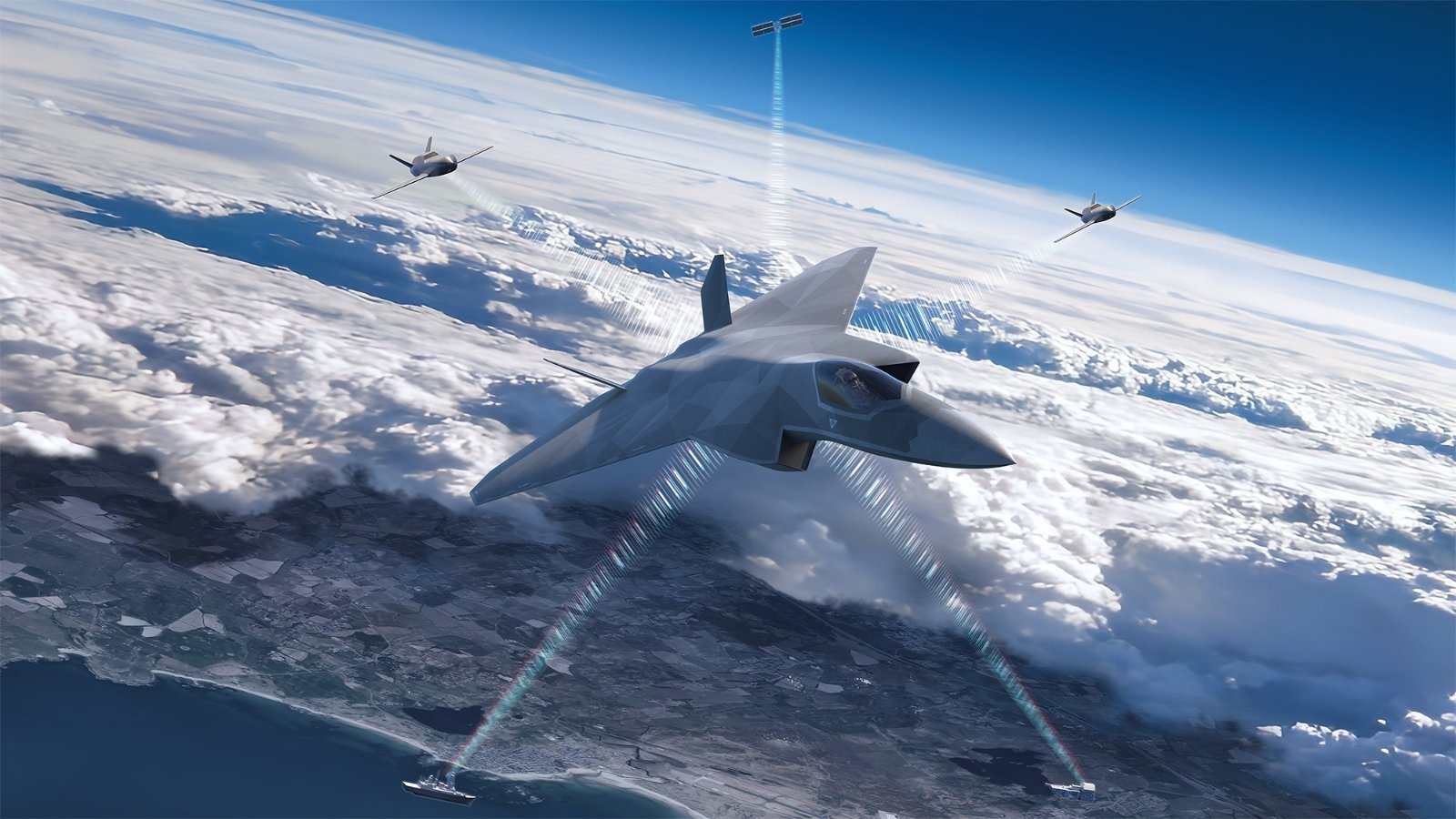
KAI introduced MUCCA as a modular “loyal wingman” designed to operate alongside crewed fighter aircraft under a Manned-Unmanned Teaming (MUM-T) concept. The system is intended to expand combat mass, enhance survivability of manned platforms, and conduct high-risk missions in contested environments.
Design and Technical Characteristics
MUCCA is a medium-class, reusable uncrewed combat aerial vehicle (UCAV) with a maximum take-off weight (MTOW) of approximately 5,420 kilograms. The platform falls within a size category comparable to a light combat aircraft or advanced jet trainer.
The aircraft is powered by a single turbofan engine generating 4,100 pounds of thrust. According to specifications presented at the exhibition, MUCCA is designed to achieve a maximum speed of Mach 0.85 and an operational range of 1,400 nautical miles (approximately 2,593 kilometers).
The airframe incorporates stealth-oriented shaping, including a blended fuselage profile, V-tail configuration, and an upper-fuselage air intake to reduce radar cross-section. Internal weapons carriage is prioritized to maintain low observability during strike missions.
Weapons Configuration and Payload Capacity
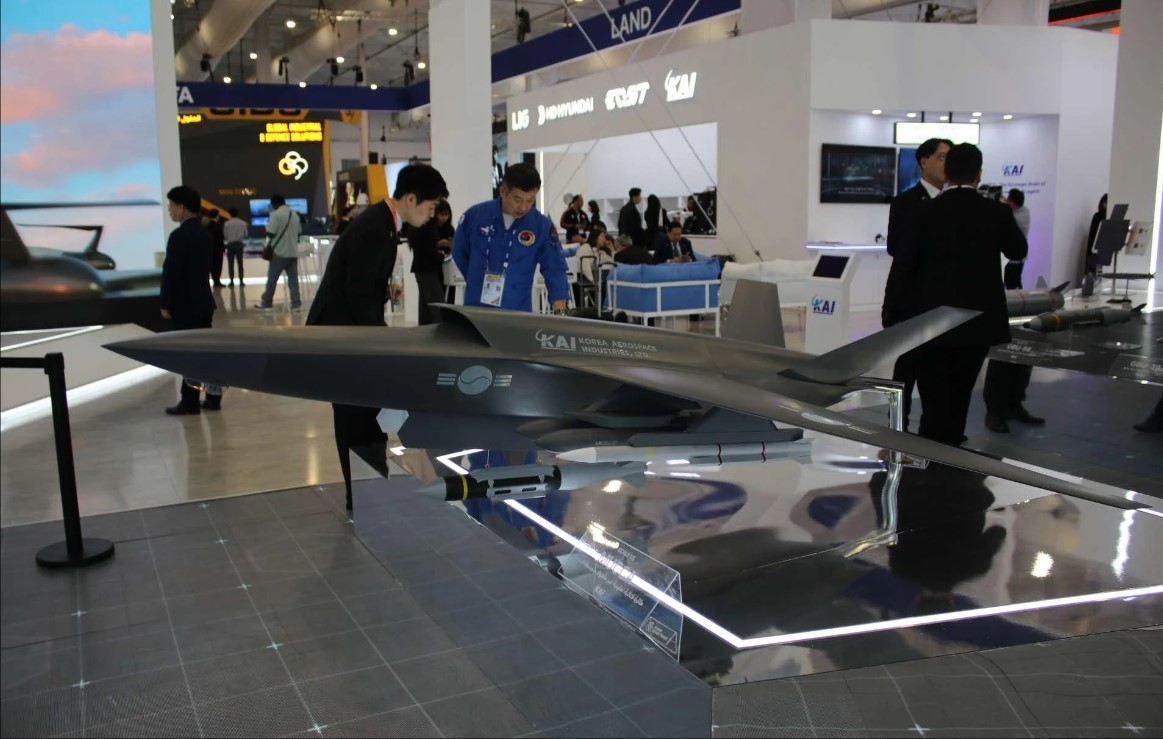
At the Riyadh exhibition, KAI displayed a 1:5 scale model highlighting MUCCA’s multi-mission configuration.
The aircraft features an internal weapons bay located beneath the fuselage, sized to accommodate a single 907-kilogram (2,000-pound) class precision-guided munition, such as a JDAM-type bomb. Internal carriage supports strike operations while preserving reduced radar signature.
In addition to the internal bay, MUCCA is equipped with four external hardpoints mounted under the wings. The display configuration included one air-to-air missile for self-defense and quad-carriage racks on each wing capable of carrying precision air-to-ground munitions.
The total payload capacity is listed at approximately 1,200 kilograms (2,650 pounds), enabling flexible combinations of internal and external stores depending on mission requirements.
Modular Sensors and Mission Adaptability
The MUCCA platform incorporates a modular nose section designed to accommodate different sensor suites. Configurations can include an Active Electronically Scanned Array (AESA) radar for active targeting and engagement, or an Infrared Search and Track (IRST) system for passive detection in radar-contested environments.
This modular architecture allows the aircraft to transition between strike, escort, reconnaissance, and electronic warfare roles without structural modification.
Manned-Unmanned Teaming Role
A primary operational role for MUCCA is to act as a force multiplier for advanced fighters, including the KF-21 Boramae, as well as the F-15 Eagle and F-35 Lightning II.
Under the MUM-T framework, a pilot in a crewed aircraft can direct one or more MUCCA drones to execute designated missions. These include:
-
Escort operations to shield high-value assets
-
Suppression of Enemy Air Defenses (SEAD) by entering heavily defended airspace ahead of manned aircraft
-
Electronic warfare and sensor extension to broaden situational awareness for the formation
KAI also stated that MUCCA is designed to function as a “mother ship” for the Small Unmanned Collaborative Aircraft (SUCA), enabling layered and distributed mission execution.
SUCA: Small Collaborative Drone
The SUCA platform weighs approximately 220 kilograms and is categorized as expendable. It has a maximum speed of Mach 0.65 and an operational range of 300 nautical miles. The system carries a payload of up to 25 kilograms (55 pounds).
SUCA is intended for intelligence, surveillance, and reconnaissance (ISR), decoy operations, and swarm strike missions. When deployed from MUCCA, it extends the operational reach of the larger platform and supports distributed air operations.
Comparative Specifications
| Specification | MUCCA (Medium) | SUCA (Small) |
|---|---|---|
| Status | Reusable / Attritable | Expendable |
| Maximum Speed | Mach 0.85 | Mach 0.65 |
| Range | 1,400 nautical miles | 300 nautical miles |
| Payload Capacity | 1,200 kg (2,650 lbs) | 25 kg (55 lbs) |
| Primary Role | Strike, Escort, Sensor Node | ISR, Decoy, Swarm Strike |
Strategic Positioning in the Gulf Market
The decision to debut MUCCA at the Riyadh defense exhibition reflects KAI’s focus on the Middle East as a priority export region. Gulf air forces are increasingly pursuing collaborative combat aircraft capable of operating alongside advanced fighter fleets while supporting industrial participation and defense localization objectives.
The MUCCA concept aligns with demand for attritable systems—platforms that combine advanced sensors and weapons integration with cost structures that allow operational risk tolerance. By integrating a 2,650-pound payload capacity, stealth-oriented design, autonomous control architecture, and a deployable SUCA ecosystem, KAI is positioning MUCCA as a scalable platform for next-generation air operations.
KAI has not announced a production timeline or confirmed customer commitments, but the World Defense Show 2026 debut marks the formal introduction of MUCCA to the international defense market.
——— End of Article ———