SEOUL, — May 26, 2026 : South Korea is accelerating the development of indigenous jet engines for future combat drones and next-generation fighter aircraft as part of a broader national effort to strengthen aerospace self-sufficiency, secure domestic propulsion supply chains, and reduce long-term dependence on foreign engine technology.
The initiative is focused on two key areas of military aviation: unmanned Cooperative Combat Aircraft (CCA) and next-generation manned fighter jets. Multiple state-backed programs are advancing simultaneously, with government agencies and domestic defense companies coordinating efforts to establish full-cycle indigenous propulsion capabilities.
KASA Launches Combat Drone Engine Program
On Tuesday, the Korea AeroSpace Administration (KASA) formally launched a state-funded next-generation dual-use aircraft engine program during a joint kickoff briefing in Sacheon, South Gyeongsang Province. The project is being led by Hanwha Aerospace in partnership with the Korea Aerospace Research Institute (KARI), universities, and domestic subcontractors, with approximately 900 billion won in government funding allocated between 2026 and 2029.
The immediate objective is to develop a 4,500-pound-force (lbf) high-bypass turbofan engine designed primarily for future unmanned aerial vehicles and collaborative combat aircraft while maintaining dual civil and military applications. South Korean authorities are targeting operational deployment by 2029.
A major technical focus of the program is the integration of a starter-generator directly into the engine’s rotating shaft. Unlike externally mounted systems, the embedded design is intended to reduce weight while producing up to 100 kilowatts of electrical power to support advanced onboard systems. Officials say the high power output will be essential for future CCAs operating artificial intelligence computing, advanced sensors, radar systems, and electronic warfare equipment.
Indigenous Fighter Engine for the KF-21 Block III
Alongside the unmanned engine effort, South Korea is advancing a longer-term program aimed at achieving propulsion independence for future manned combat aircraft.
Working with the Defense Acquisition Program Administration (DAPA), Hanwha Aerospace is leading the Advanced Aviation Engine Development Project to produce an indigenous turbofan engine in the 15,000–16,000 lbf thrust class for future variants of the KF-21 Boramae fighter and potential sixth-generation combat aircraft.
The fighter engine development initiative is scheduled to run from 2027 to 2040 and is backed by approximately $3.4 billion in government investment. The project is being conducted in partnership with Doosan Enerbility and supported by the Agency for Defense Development (ADD).
The domestically developed engine is intended for the KF-21 Block III configuration, replacing foreign propulsion systems currently used in earlier aircraft variants. Officials have indicated that the same core propulsion technologies may later support future sixth-generation fighter concepts.
Transitioning Beyond Licensed Production
The KF-21, South Korea’s indigenous 4.5-generation multirole fighter, entered serial production earlier this year and is expected to begin frontline service with the Republic of Korea Air Force in 2026. Current Block I aircraft and the upcoming Block II configuration continue to rely on F414 turbofan engines manufactured domestically under licensing agreements with GE Aerospace.
An indigenous engine for the Block III variant would mark a major milestone in South Korea’s effort to achieve end-to-end domestic combat aircraft production, including engine research, prototype development, testing, manufacturing, and platform integration.
The transition from licensed manufacturing to indigenous design represents a significant technological step for South Korea’s aerospace sector. Military turbofan engines remain among the most complex aerospace systems and are produced by only a small number of countries and companies worldwide.
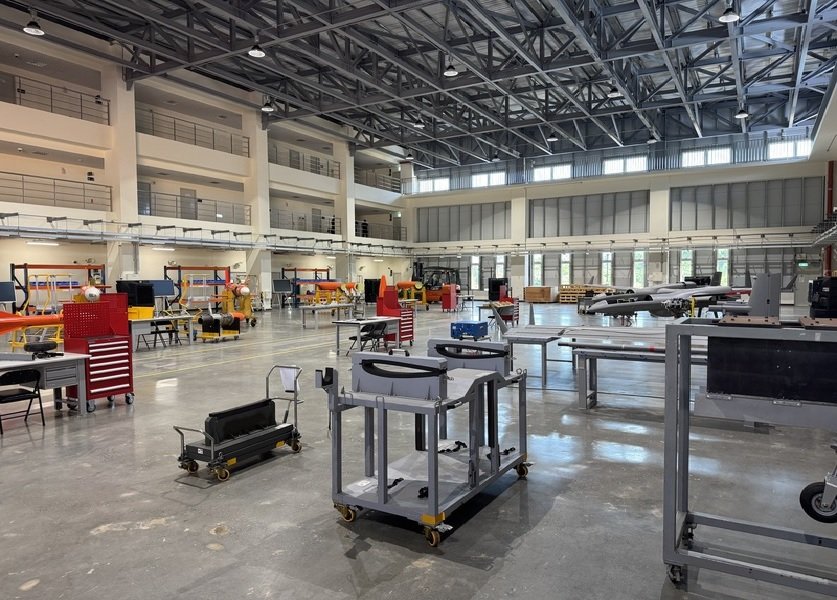
Hanwha Aerospace recently marked production of its 10,000th military engine after decades of manufacturing propulsion systems under license and supplying components to major aerospace firms, including GE, Pratt & Whitney, and Rolls-Royce. The company is also upgrading domestic facilities to support future research, testing, and large-scale engine manufacturing requirements.
Expanding Indigenous UAV Propulsion Programs
In addition to the 4,500 lbf-class combat drone engine, South Korea is expanding indigenous propulsion programs for other unmanned aerial systems.
Ongoing efforts include development of a 5,500 lbf-class engine intended for the LOWUS stealth wingman drone and a 1,400-horsepower turboprop engine for a domestically developed medium-altitude long-endurance (MALE) unmanned aircraft. The MALE UAV engine is targeted for operational service by 2028.
These projects build on earlier efforts to develop multiple indigenous military propulsion systems and form part of a wider aerospace industrial strategy overseen by KASA, DAPA, the Ministry of Trade, Industry and Energy, and ADD through an interagency task force established in late 2025.
Strategic and Industrial Objectives
Government and industry officials say indigenous propulsion capability is intended to strengthen national defense supply resilience, reduce vulnerability to external supply disruptions, and improve export competitiveness for domestically developed aircraft.
South Korea also views proprietary engine technology as a strategic requirement for long-term participation in the expanding global military aviation market. Industry projections indicate that more than 3,000 collaborative combat aircraft could be operational worldwide by the 2040s, creating growing demand for advanced unmanned combat aviation technologies and associated propulsion systems.
——— End of Article ———