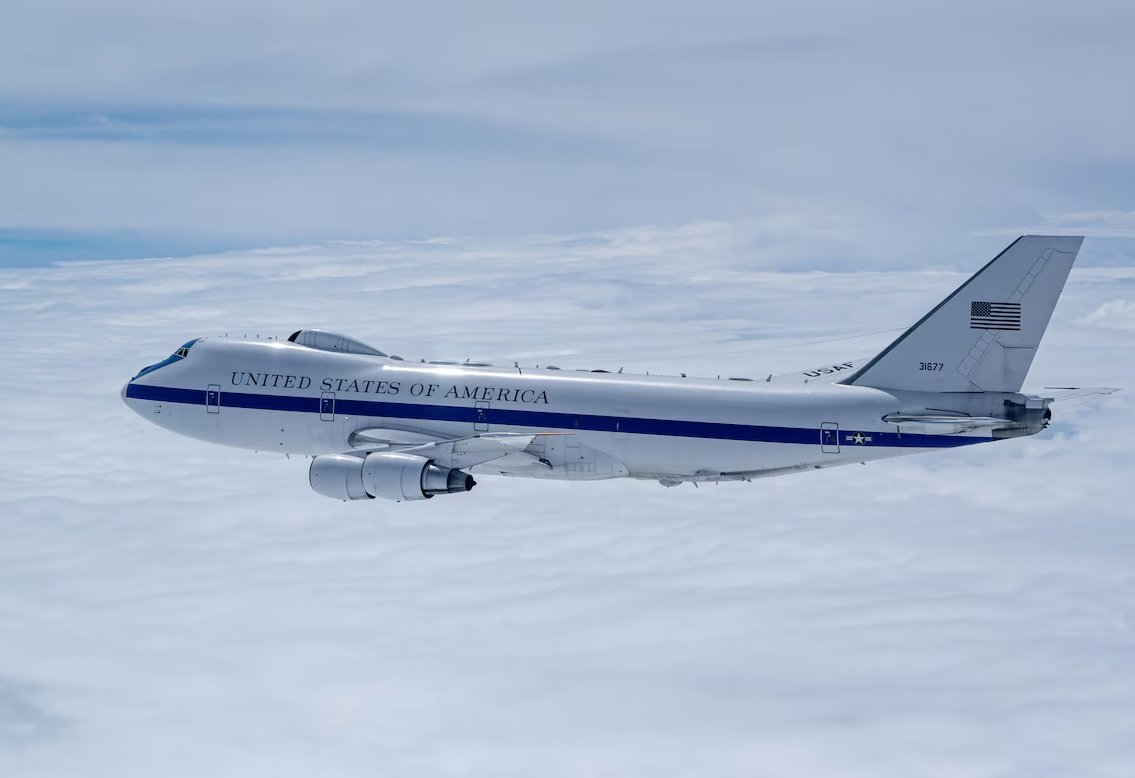
Washington, — A U.S. Air Force E-4B Nightwatch, also known as the "Doomsday Plane", was spotted flying over the western Pacific near Japan as President Donald Trump returned to the United States from China on November 19. Public flight-tracking data showed the aircraft travelling alongside Air Force One and two other presidential Boeing 747 aircraft.
Open-source aviation analyst Andrew Leyden reported the movement on X as the presidential aircraft crossed the region. Data shared from ADS-B Exchange identified the E-4B under the callsign TRUCK55, with registration number 73-1676. The aircraft was reportedly flying at approximately 31,000 feet, at a ground speed of 628 knots (around 720 mph).
The E-4B had been positioned at Kadena Air Base in Okinawa, Japan, during Trump's China visit. A U.S. Air Force C-32, based on the Boeing 757 and commonly used to transport White House staff and press personnel, also supported the delegation.
E-4B Nightwatch: America's Airborne Command Centre
The E-4B Nightwatch is a heavily modified Boeing 747-200 operated as the National Airborne Operations Center (NAOC). It provides a secure airborne command and communications facility for the president, secretary of defense and senior military officials if ground-based command centres become unavailable.
The aircraft features protected communications equipment, satellite links and shielding against electromagnetic pulse (EMP) effects. It can carry up to 111 personnel and remain airborne for approximately 12 hours without refuelling. Aerial refuelling allows it to extend its operating time significantly.
The U.S. Air Force operates four E-4B aircraft, assigned to the 595th Command and Control Group at Offutt Air Force Base, Nebraska. At least one aircraft is maintained on continuous 24-hour alert.
E-4B Deployment During China Summit
Trump travelled to Shenzhen for the 33rd Asia-Pacific Economic Cooperation (APEC) Economic Leaders' Summit, where he met Chinese President Xi Jinping and Russian President Vladimir Putin. The three leaders held a trilateral meeting and issued a joint declaration stating that a nuclear war cannot be won and must never be fought.
Russia's nuclear command equipment also attracted attention during the summit. Russian state television filmed a naval officer accompanying Putin's delegation carrying the Cheget, Russia's nuclear command briefcase. When asked whether he was carrying the Cheget, the officer confirmed that he was. The device provides secure communications and authentication for Russia's nuclear command system.
The U.S. nuclear football, used to support presidential nuclear command procedures, was not publicly seen during the visit.
Refuelling Support for the Return Flight
According to flight-tracking information cited in Leyden's report, aerial refuelling tankers were expected to operate from Yokota Air Base in Japan and Elmendorf Air Force Base in Alaska to support the E-4B during its trans-Pacific journey.
Air Force One was heading towards Joint Base Andrews, near Washington, D.C., while the E-4B was returning to its home base at Offutt Air Force Base, Nebraska.
The E-4B's presence alongside presidential aircraft is consistent with its national command and control mission. Its deployment does not, by itself, indicate an emergency. The aircraft provides an additional airborne command facility to maintain communication and continuity of government during overseas presidential travel.
——— End of Article ———