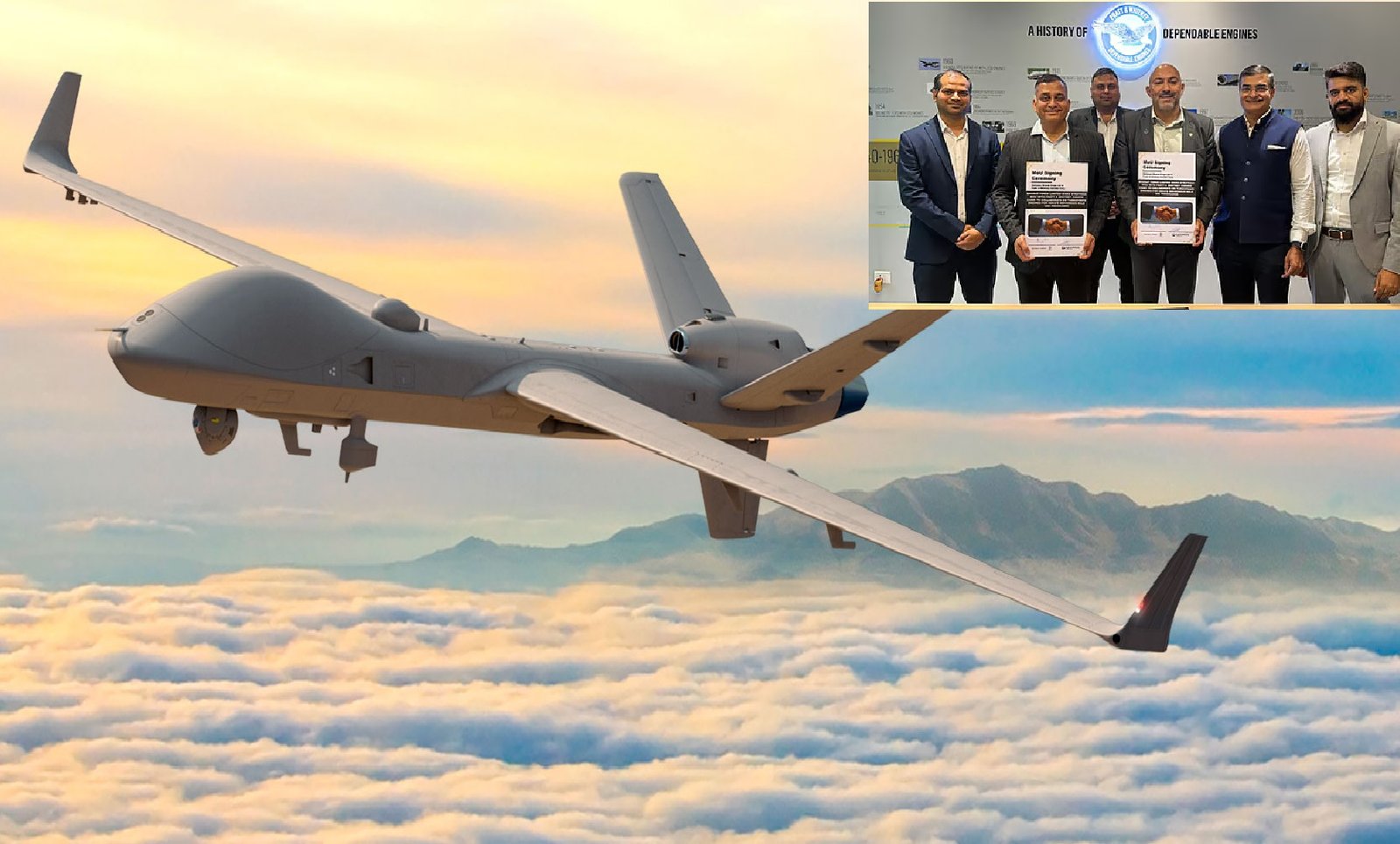
New Delhi : Solar Industries has publicly showcased a three-dimensional (3D) model of its new Medium Altitude Long Endurance (MALE) unmanned aerial vehicle, designated Vijayastra, marking the first detailed public view of the platform. The MALE-class UAV has been designed to perform Intelligence, Surveillance, Target Acquisition and Reconnaissance (ISTAR) missions, while also supporting precision strike roles through dedicated weapon integration.
The display of the Vijayastra model offers insight into the company’s entry into heavier, long-endurance unmanned systems, with emphasis on indigenous propulsion, extended persistence, and multi-mission adaptability. The platform is positioned as a high-endurance asset capable of sustained operations across land and maritime domains.
Platform Design and Performance Profile
Vijayastra is engineered for prolonged missions at medium altitude and is powered by a domestically developed 177 horsepower turbocharged engine. The airframe features a wingspan of 18.6 metres, optimized for aerodynamic efficiency and long-duration endurance.
According to the technical details presented, the UAV is capable of operating at altitudes of up to 30,000 feet and sustaining flight for approximately 29 hours. The maximum takeoff weight (MTOW) of the platform is rated at 1,800 kilograms, with a maximum speed of 225 kilometres per hour. These parameters place Vijayastra firmly within the MALE category, intended for persistent surveillance and extended-area coverage.
Operational reach varies by communications mode. In line-of-sight (LOS) configuration, the UAV supports operations up to a radius of 250 kilometres, while beyond-line-of-sight (BLOS) missions enabled through satellite communications (SATCOM) extend the operational range to approximately 1,000 kilometres.
Payload Capacity and Hardpoint Configuration
The Vijayastra UAV has been designed with a total weapon and mission payload capacity of 300 kilograms, distributed across four dedicated external hard points. This configuration allows the platform to carry a combination of sensors, mission-specific equipment, and precision-guided munitions, enabling a rapid transition from surveillance to engagement roles when required.
The hardpoint architecture supports modular payload integration, allowing the UAV to be configured according to mission demands without changes to the core airframe.
Sensor Suite and Surveillance Capabilities
For intelligence, surveillance, and reconnaissance tasks, Vijayastra is designed to integrate both medium-range electro-optical (MREO) and long-range electro-optical (LREO) systems, providing day-and-night imaging capabilities. These systems are complemented by synthetic aperture radar (SAR), enabling high-resolution ground mapping and target detection in adverse weather conditions. A maritime patrol radar (MPAR) option is also included, extending the platform’s suitability for over-sea surveillance and coastal monitoring missions.
The sensor architecture is intended to provide persistent situational awareness over wide areas, supporting both strategic reconnaissance and tactical battlefield observation.
Intelligence Collection and Electronic Warfare Support
Beyond conventional ISR roles, Vijayastra incorporates electronic intelligence (ELINT) and communications intelligence (COMINT) payloads. These systems enable the interception, detection, and analysis of electronic emissions and communication signals, contributing to broader intelligence-gathering and electronic support operations.
The integration of ELINT and COMINT modules allows the UAV to function as a node in network-centric operations, supporting real-time intelligence dissemination to command and control elements.
Airspace Integration and Mission Systems
To support safe operation in controlled and contested airspace, Vijayastra is equipped with Identification Friend or Foe (IFF) capability and a Traffic Collision Avoidance System (TCAS). Unified Communications Routing (UCR) is included to manage secure data links and coordinate sensor feeds, command inputs, and mission data transmission during extended sorties.
These systems are intended to ensure interoperability with existing airspace management frameworks while maintaining secure communications during BLOS operations.
Expansion of Unmanned Systems Portfolio
The unveiling of the Vijayastra MALE UAV represents an expansion of Solar Industries’ unmanned systems portfolio into higher-endurance and higher-payload platforms. With its combination of long-range surveillance, electronic intelligence capability, and precision strike integration, the platform reflects a move toward multi-role unmanned aircraft designed for sustained operational deployment.
The company has not disclosed timelines for flight testing or induction, but the public presentation of a detailed 3D model indicates that the design has reached an advanced configuration stage, with clearly defined performance parameters and mission roles aligned to MALE-class operational requirements.
——— End of Article ———