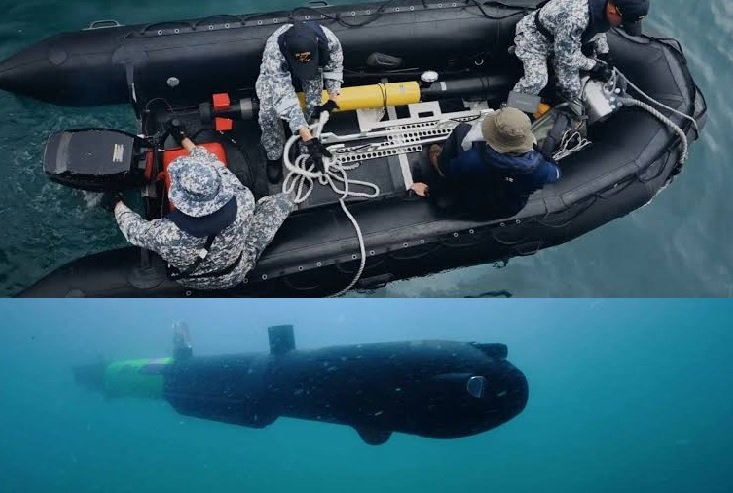
SINGAPORE — The Republic of Singapore Navy (RSN), in collaboration with the Defence Science and Technology Agency (DSTA) and French company RTsys Underwater Technologies, has officially deployed several COMET-MCM autonomous underwater vehicles (AUVs) to strengthen mine countermeasure operations in the Singapore Strait.
The COMET-MCM systems are designed to detect, locate and identify naval mines and other suspicious objects on the seabed during the early stages of mine countermeasure missions. The deployment adds an autonomous capability to the RSN's existing mine countermeasure approach while reducing risks to personnel operating in potentially hazardous waters.
Protecting One of the World's Busiest Shipping Routes
The Singapore Strait is one of the world's busiest and most strategically important maritime routes. According to the announcement, nearly 150,000 ships pass through the strait each year, making it one of the most heavily used sea lanes for international trade. Any disruption caused by underwater threats such as naval mines could affect maritime traffic, regional shipping and trade across the Asia-Pacific.
To strengthen maritime security, the RSN has introduced autonomous underwater technology that can carry out mine detection missions while reducing operator workload and limiting crew exposure to dangerous areas.
COMET-MCM Designed for Early Mine Detection
The COMET-MCM vehicles form part of the RSN's mine countermeasure operations and are used during the initial phase of missions to detect, locate and identify objects on the seafloor before further investigation and neutralization.
The systems were developed by RTsys Underwater Technologies in partnership with DSTA, which managed the integration of the vehicles to meet the Singapore Navy's operational requirements.
The autonomous vehicles are manufactured at RTsys's factory in Lanester, Brittany, France.
Technical Capabilities
The COMET-MCM is a two-man portable autonomous underwater vehicle measuring 1.9 meters in length, with a 150-millimeter hull diameter and weighing 35 kilograms.
According to RTsys, the vehicle has a maximum operating depth of 300 meters and can reach speeds of up to 10 knots. It can operate for up to 20 hours at a cruising speed of 3 knots or approximately 7 hours at 7 knots.
The system is equipped with a Klein high-resolution side-scan sonar and a low-light HD camera for underwater detection and identification missions.
Its navigation suite includes GPS, inertial navigation, Doppler velocity log and Long Baseline (LBL) acoustic positioning, enabling accurate positioning while mapping large underwater areas.
The COMET-MCM can operate either independently or as part of a coordinated fleet in swarm mode. Missions are preprogrammed before launch, allowing the vehicles to conduct autonomous operations while reducing operator workload, speeding reconnaissance and limiting the time crews spend in hazardous environments.
During missions, the vehicles can transmit real-time tracking information to surface operators, complementing data collected by traditional minehunter sonar systems.
Supporting Complete Mine Countermeasure Operations
Data gathered by the COMET-MCM supports the full sequence of mine countermeasure operations, including detection, classification, identification and neutralization.
When a potential mine or underwater contact is detected, it can be further examined using remotely operated systems or Explosive Ordnance Disposal (EOD) divers.
The RSN also uses RTsys's SONADIVE handheld underwater navigation and sonar system to support divers during these missions. The system features a 12-inch display designed for underwater visibility, provides up to six hours of battery life, and allows divers to navigate accurately while communicating through an acoustic modem. It enables tactical data and text message exchanges with other divers and surface units at ranges of up to 2.2 kilometers.
Decade-Long Cooperation
The deployment reflects more than a decade of cooperation between the Republic of Singapore Navy, DSTA and RTsys in the field of autonomous underwater robotics.
Pierre-Alexandre Caux, Sales Director at RTsys Underwater Technologies, said the operational deployment demonstrates international recognition of the company's underwater robotics and acoustic technologies.
"The COMET-MCM is the result of more than a decade of cooperation with navies worldwide. Its operational deployment by the Republic of Singapore Navy is further recognition of our expertise in underwater robotics and acoustics. It demonstrates our ability to meet the demanding requirements of the world's most advanced navies in tackling the challenges of mine warfare. Finally, the COMET-MCM highlights how technological innovation can enhance national operational sovereignty."
The Republic of Singapore Navy also emphasized the importance of the new capability for safeguarding a major international shipping route.
"The Singapore Strait is a vital artery for global trade. With the COMET-MCMs, we are enhancing our ability to detect and identify underwater threats with greater precision, efficiency, and safety for our crews."
The operational deployment of the COMET-MCM autonomous underwater vehicles strengthens the RSN's mine countermeasure capabilities by adding autonomous underwater detection and identification systems to support existing mine warfare operations while improving efficiency and reducing risks to personnel.
——— End of Article ———