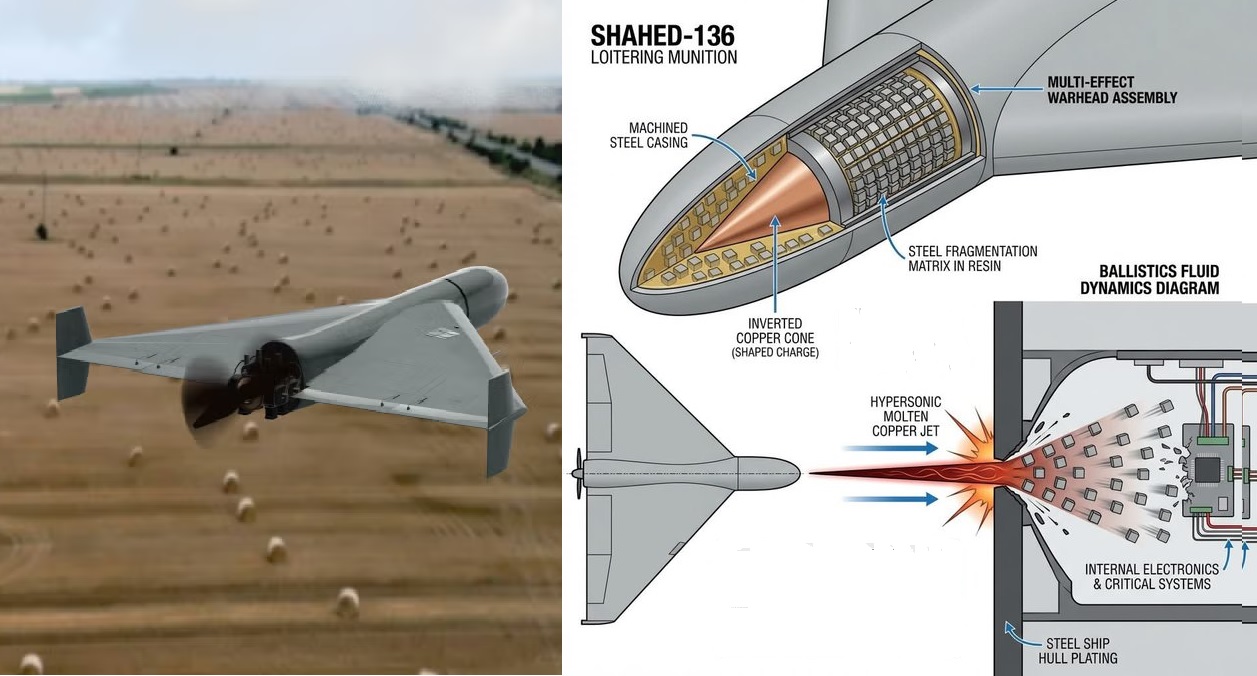
WASHINGTON — March 18, 2026 : Technical assessments of the Iranian-developed Shahed-136 loitering munition indicate that its operational effectiveness is derived less from overall explosive mass and more from a multi-effect warhead design that concentrates energy for targeted penetration and internal damage.
The system, developed by Iran’s HESA and fielded by Russian forces under the designation Geran-2, has been widely analyzed for its ability to engage high-value targets using relatively low-cost platforms. Defense analysts note that the munition demonstrates how engineered warhead physics can produce effects disproportionate to unit cost, particularly against armoured structures and critical infrastructure.
Warhead Architecture and Internal Composition
Technical diagrams show that the Shahed-136 incorporates a multi-effect warhead assembly housed within a machined steel casing. The internal configuration consists of two primary elements arranged sequentially to maximise impact efficiency.
At the forward section is an inverted copper cone designed to function as a shaped charge. Positioned directly behind it is a steel fragmentation matrix embedded in a resin binder. This dual-layer configuration allows the munition to combine armour penetration with internal system disruption in a single strike sequence.
The warhead assembly is engineered to direct explosive energy forward rather than dispersing it radially. This directional focus enables concentrated force application at the point of impact, improving effectiveness against hardened targets such as steel hulls, armoured vehicles, and reinforced infrastructure.
Impact Sequence and Ballistic Mechanism
The operational mechanics of the warhead follow a three-stage sequence governed by principles of ballistics and fluid dynamics.
Upon detonation, the explosive force collapses the inverted copper cone inward, forming a hypersonic molten metal jet. This jet concentrates both thermal and kinetic energy into a narrow stream capable of penetrating thick armour, including steel plating used in naval vessels.
Following the initial breach, the steel fragmentation matrix is propelled through the penetration channel. Once inside the target, the fragments disperse and interact with internal components, damaging electronics, wiring systems, and other critical subsystems. This sequential effect allows the munition to neutralize targets by targeting internal vulnerabilities rather than relying solely on external blast damage.
Platform Specifications and Configuration Variants
The Shahed-136 has a maximum takeoff weight of approximately 200 kilograms, with a length of 3.5 metres and a wingspan of 2.5 metres. It is powered by an MD-550 piston engine in a rear-mounted pusher configuration, enabling a maximum speed of about 185 kilometres per hour.
Operational range is estimated at up to 2,500 kilometres, supported by a guidance system that combines GNSS navigation with inertial backup systems. This allows the platform to operate over extended distances with limited reliance on continuous external control.
The baseline warhead mass is approximately 50 kilograms. However, documented variants—particularly those associated with Russian production—have been reported with warhead weights reaching up to 90 kilograms. These variants may incorporate shaped-charge, high-explosive fragmentation, or combined-effect payloads. Additional modifications include reinforced steel nose sections to improve penetration, as well as the integration of incendiary or thermobaric effects in certain configurations.
Cost Structure and Production Trends
Cost estimates for the Shahed-136 vary depending on production source and configuration. Iranian export pricing for assembly kits supplied to Russia in 2022 ranged between approximately $193,000 and $370,000 per unit.
Subsequent localization of production within Russia has reduced unit costs significantly. Estimates for domestically produced units in 2025 are approximately $70,000, with earlier analytical ranges suggesting potential costs between $20,000 and $50,000 depending on manufacturing scale, component sourcing, and batch size.
This cost structure contributes to the system’s operational utility, enabling deployment in large numbers while maintaining economic efficiency relative to the value of potential targets.
Operational Use and Strategic Implications
The Shahed-136 has been employed in multiple operational environments, including the Russia–Ukraine conflict and maritime-related engagements in the Red Sea region. In these contexts, it has demonstrated the ability to engage both stationary and semi-mobile targets, including infrastructure and armoured vessels.
Its effectiveness is often linked to coordinated use in salvos, which can complicate air defense responses and increase the probability of successful target engagement. The combination of range, cost efficiency, and warhead design allows the system to be used against a range of targets, including ships, armoured vehicles, and hardened facilities.
Evolving Role of Low-Cost Precision Systems
Ongoing production of the Shahed-136 includes incremental improvements to navigation systems, electronic counter-countermeasures, and warhead configurations. The integration of multi-effect warhead designs reflects a broader trend in loitering munitions toward precision-focused lethality.
Defense assessments indicate that such systems are reshaping operational cost dynamics by enabling relatively inexpensive platforms to threaten high-value assets. The use of shaped-charge physics combined with internal fragmentation mechanisms allows these munitions to achieve targeted effects without requiring large payloads or complex delivery systems.
As a result, low-cost loitering munitions are increasingly viewed as a significant component of modern strike capabilities, particularly in scenarios where cost efficiency and scalable deployment are key operational considerations.
——— End of Article ———